Part of the Series
Struggle and Solidarity: Writing Toward Palestinian Liberation
Did you know that Truthout is a nonprofit and independently funded by readers like you? If you value what we do, please support our work with a donation.
In early May, Israel announced Operation Gideon’s Chariots, a plan to occupy Gaza completely, corral the remaining residents into Rafah — a flattened wasteland — and then force them into a third country. In the days since, Israeli forces have intensified airstrikes and expanded ground operations across the besieged enclave, killing scores of Palestinians.
Meanwhile, there have been positive developments in the negotiations held in Qatar between Hamas commanders and Israeli representatives, which —somehow, even if leaders won’t nail down and reach an agreement — give Gazans like me a glimpse of hope.
Even if it’s false, all of us in Gaza are desperate for any news related to an end to this carnage and deliberate starvation.
When U.S. President Donald Trump, during his recent visit to the Gulf, announced that he wanted to stop the war in Gaza as quickly as possible, Gazans poured into the streets, whistling, jubilating and chanting the Takbirat al-Eid prayer, all while relentless massacres continued echoing in the backdrop.
Gazans were strangled from every direction — skies raining airstrikes, borders tightly sealed off since March 2, and a total humanitarian blockade on the Strip that kept out even flour, medication and potable water entering the Strip. That lasted until the Israeli defense minister permitted a trickle of aid to pass on May 19, under mounting pressure from Western leaders. Israeli Prime Minister Benjamin Netanyahu explained that the move was for diplomatic reasons — while in fact, the aid trucks are nowhere near enough to reverse the unfolding famine.
Still, the scenes on the ground are far graver than what’s livestreamed across media outlets. The day after some progress on ceasefire negotiations had been made, people opened their eyes after a night of cautious hope, confronted with news of forced evacuation orders to so-called safe zones. But safety does not exist in Gaza.
On May 14, leaflets rained down containing forced evacuation orders — warnings ahead of an unprecedented attack on al-Rimal neighborhood, al-Shifa Hospital and surrounding areas.
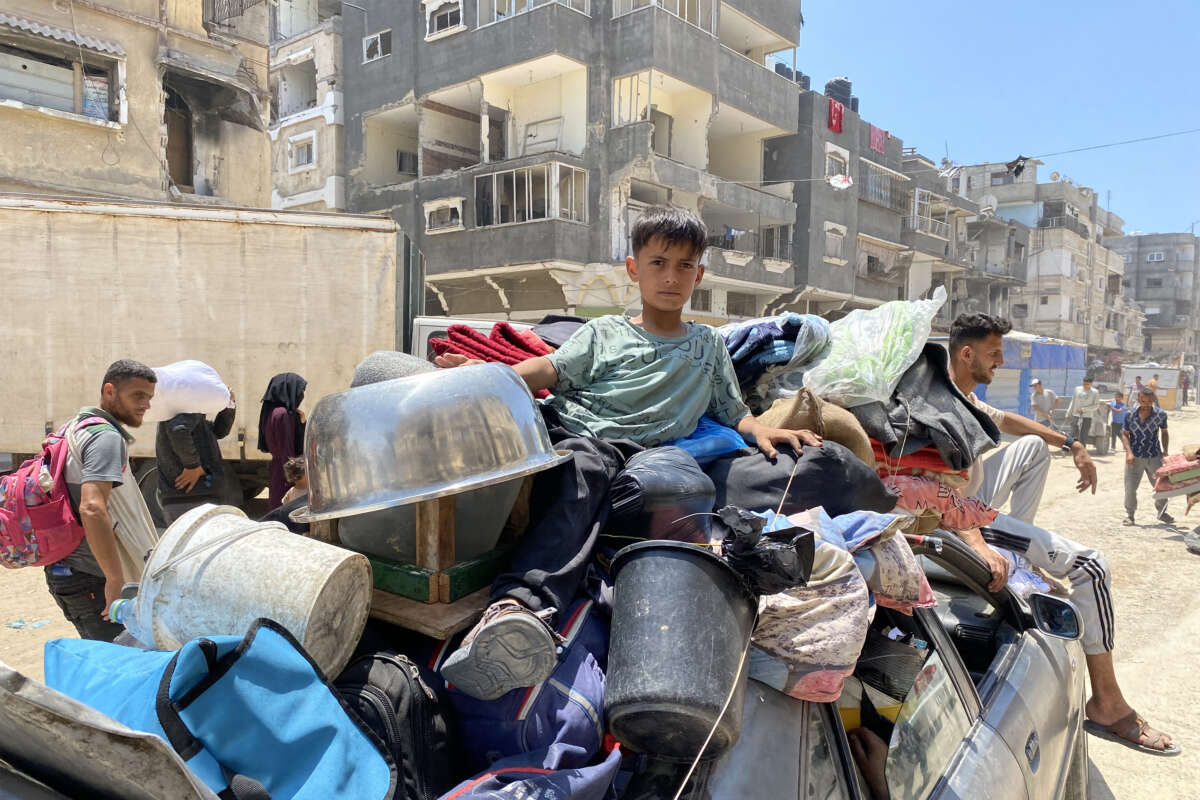
Al-Rimal neighborhood — considered the main bustling area of the Gaza Strip — had become a shelter for already displaced Gazans from the north, who have crowded into its schools, tents and hospitals. The only haunting question on the tip of people’s tongues was: Where to go now?
On May 19, Khan Younis — already a densely populated city in southern Gaza, which hosted waves of displaced civilians fleeing Rafah after Israeli forces expanded their ground operations there — came under military assault. This was followed by yet another map of evacuation orders.
“To all the residents of Khan Younis; you are residing in a conflict zone — it is going to be under attack. To keep yourselves safe, head to the al-Mawasi area.”
These leaflets were not just orders to be followed. They were searing declarations, tearing open a wound that was meant to be buried months ago. A circle of humiliation reopened. An ache, ever-appearing, overwhelming — resting on frail, exhausted bodies with nowhere left to run.
“I left under a barrage of rockets. I lost connection with my children — I don’t know if they’re alive or if they were killed.”
Al-Mawasi is not as safe as it sounds. It lies along the coast, overcrowded by countless families seeking refuge. It can no longer accommodate a single additional soul — not a tent, not a mat, not even a place to stand.
Where to go?
The question echoed louder than the ear-piercing explosions, louder than Israel’s strategic ethnic cleansing, louder than the Gideon’s Chariots plan itself, louder than the world’s deafening silence and the Arab leaders’ hollow indifference.
People with stunted, emaciated, malnourished bodies — dull minds and shattered hearts — stood stranded in the war-ravaged streets, with nowhere to go except toward death. Death was lurking around them, hunting them, finding its way not only through bombs, but through starvation and the anguish of endless displacement.
Fear has now surged again after Israeli forces threatened to turn Khan Younis refugee camp into barren swaths, much like Rafah.
I spoke to Om Yamin, 37, as she fled Khan Younis for Deir al-Balah — gasping for breath, on foot and alone. She had left her family behind, hoping to first secure a shelter.
Om Yamin is a breast cancer patient. Her condition has significantly deteriorated due to the lack of proper medical care, especially after the European Hospital — her only treatment option — was bombed on May 13. Her husband, who was injured, now struggles to fulfill his responsibilities as a father and husband.
“I left under a barrage of rockets. I lost connection with my children — I don’t know if they’re alive or if they were killed. The situation there is extremely dangerous,” she said.
“Today was supposed to be my chemotherapy session at the European Hospital. But it’s neither safe nor possible to go. Fire belts are continuously waged on the area.”
She continued, “I’ve passed out along the way. I haven’t eaten anything since the morning. But what matters more is finding a safe shelter for my children and husband — and bringing them here as soon as I can.”
“I can’t afford a vehicle or even a wagon cart. I’m terrified they won’t be able to walk the long miles — thirsty, hungry, under the blazing sun.”
Om Yamin appealed to both the Western and Arab world to exert pressure for an end to the bloodshed, and to allow medical supplies to enter Gaza.
I met Shokri Ahmed, 23, a fifth-year medical student volunteering at al-Nasr Hospital. “I come from a family of five,” he said. “I’ve lost my father and our home during the war. I’ve been displaced around 15 times.”
He described displacement as “a slow death walking on its feet.”
“I was determined not to leave my home, even if I was forced to. But the trauma of losing my family grew on me — so I had to flee to the al-Mawasi area. Yet even there, there was no space to pitch my tent. A relative hosted us until we managed to find a place.”
“I’ve never felt any stability — mentally, physically, or even academically — since the genocide broke out,” he continued. “The distraction I’m living with now, alongside the famine I’m fighting back against, makes life nearly impossible.”
“I held on to a shred of optimism that a ceasefire might be looming. But reality speaks louder — the contrast is stark. Everything is crumbling apart, including my academic life.”
Still, he added, “I have no choice but to keep going — volunteering, saving lives on the front lines — while my family is left behind, suffering, struggling to access even the most basic needs: bathrooms, potable water, and scavenging for food to eat.”
“I was determined not to leave my home, even if I was forced to. But the trauma of losing my family grew on me — so I had to flee.”
I met Nariman Ziyad, a fourth-year medical student volunteering at the European Hospital and working as a translator with the Heroic Hearts. She has been displaced 11 times. Her house had survived the past 19 months — until it was struck just one day after the evacuation order.
Breaking into tears, she said, “I survived miraculously. The shrapnels were flying, the bombs hit closely, the bullets pierced the walls. I don’t know how I made it through — I evacuated just before the tanks advanced and reached our area.”
“They didn’t just destroy our home,” she continued. “They burned our clothes, our memories, and the only refuge we had during days filled with hunger and horror.”
“Home is not about walls and a roof. It isn’t a collateral damage, and will never be,” she added. “It’s our past, our present — and the way to a future where no horrors dwell. Peace, just peace. Now I’m homeless, exhausted, lost and stripped of my compass.”
She recounted: “There is nowhere to shelter in, but a graveyard. We pitch our tent between the graves, I couldn’t flinch my eye out of fear that night. No words could fully capture the horrors and terrors my family and I experienced.”
Describing the current situation, she said: “Getting the basic needs requires a battle of survival, wrestling life to get objectives indispensable to stay alive.”
“I go to hospital with empty belly, my concentration is declining significantly. Yet, my family is rationing our food,” she went on.
She said she wishes for a ceasefire to come into effect soon, lest Gaza turn into a graveyard.
Gaza is facing a new wave of annihilation, more severe than ever. People are collapsing one by one, family by family, generation by generation. Layers of torment and anguish are compounded, and if the ceasefire isn’t reinstated to save those who remain alive, Gaza will vanish.
And still, there’s no answer to the question echoing across graveyards, tent camps, and the ruins of what once was home: “Where to go now?”
Media that fights fascism
Truthout is funded almost entirely by readers — that’s why we can speak truth to power and cut against the mainstream narrative. But independent journalists at Truthout face mounting political repression under Trump.
We rely on your support to survive McCarthyist censorship. Please make a tax-deductible one-time or monthly donation.