Support justice-driven, accurate and transparent news — make a quick donation to Truthout today!
The Central California Women’s Facility, the nation’s largest women’s prison, is in Chowchilla, where temperatures reached past 90 degrees by the second week of May. The prison lacks air conditioning or any facility-wide cooling system, turning cells into saunas.
“I dread going to my groups at night because we have to wait forever at the gates and we cannot bring water with us. We can’t take water bottles to the main yard and my groups are on the main yard, so I am SOL,” 45-year-old Tien Mo wrote on May 11, an afternoon when temperatures reached 96 degrees.
Dehydration is just one concern. People behind bars are particularly vulnerable to heat-related harm, including death. A 2019 study by the Prison Policy Initiative found that 13 states in the hottest parts of the U.S. lack universal air conditioning in their prisons, meaning that while some areas, such as the chapel, visiting room or administrative offices, might have air conditioning, others, such as housing units, do not. A 2023 study found that extreme heat was associated with higher overall mortality behind bars. Researchers found that, for every 10 degrees increase above the prison’s mean summer temperature, nearly five percent of deaths (from all causes) could be attributed to the heat.
Two years ago, on July 4, 2024, temperatures at Chowchilla reached 109 degrees. That day, 47-year-old Adrienne Boulware waited for her medications in the yard. Later that day, she became incoherent, dropped to the ground, and began shaking. She was transported to the hospital and died two days later.
She was one year from a parole hearing.
Now, her family members are among those pushing for Adrienne’s Act, which would implement relief measures during extreme weather events, including the punishing heat and wildfire smoke that pummels California every year between May and October. It would require the California Department of Corrections and Rehabilitation (CDCR) to implement a plan ensuring that living quarters, work areas, and recreational spaces have cooling systems and shade structures. It would also require that officials monitor indoor temperatures, investigate and document heat-related incidents, and develop emergency response protocols during extreme weather events, which include extreme heat.
Adrienne’s Act also establishes the Climate Justice in Prisons Emergency Response Act, which directs the state prison agency to issue summer-appropriate clothing, such as shorts, identify additional shade structures in yards and exercise areas, and allow increased access to showers and personal fans during excessive heat or wildfire smoke. It would also require prison medical staff to conduct regular assessments to identify those at risk for heat-related illnesses (such as those who are elderly, on medications that increase their risk, or have preexisting health conditions), to monitor symptoms for heat-related illnesses and provide prompt medical attention, and to document heat-related illnesses, symptoms, and treatment, establishing relief measures such as access to cool drinking water and cooled indoor areas, and modifying work and program requirements for those with risk factors.
Had such measures been in place, Boulware would not have died, her daughter Tyresha Reed told Truthout.
In an email, CDCR spokesperson Mary Xjiminez stated that, “after a thorough autopsy including ancillary testing, the Madera County Coroner ruled Ms. Boulware’s cause of death as undetermined.” She directed Truthout to the coroner’s report which found it unlikely that Boulware was “significantly hyperthermic leading to her demise. It was possible that her increase in body temperature was secondary to seizure activity.”

“This Could Have Been Preventable”
In March, more than 10 of Boulware’s family members traveled to Sacramento for a committee hearing on the bill. The family who were present included Boulware’s siblings, cousins, daughters, and nine of her grandchildren.
“My mother left behind four kids, 12 grandkids who she loved dearly, a lot of other family members as well,” Reed testified at a March 24 hearing before the California State Assembly committee on public safety. “My children and my siblings’ children cry every single day because their nana was supposed to come home and she didn’t, and this could have been preventable.”
“I believe that the dead can speak from the grave, and she’s speaking loud and clear,” testified bill sponsor Assemblymember Mike Gipson. “She’s saying that we must do something, and we must do something now. I respectfully ask for a strong aye vote in the memory of not only her, but those who’ve come before her as well.”
The seven committee members unanimously voted to approve the bill. It then moved to the appropriations committee. In mid-May, it passed that committee.
Adrienne’s Act notes that California’s Legislative Analyst’s Office (LAO) has found that closing prisons can allow the state to avoid costly infrastructure improvements at those facilities and concentrate resources at the remaining prisons. The LAO has recommended that the state prioritize closure of certain prisons as a first step in managing prison infrastructure.
While CDCR does not comment on pending legislation, its press materials note that cooling its 31 prisons would cost the state approximately $6 billion. It has rolled out an air cooling pilot program at the Central California Women’s Facility as well as Kern Valley State Prison and California State Prison.
The California Coalition for Women Prisoners notes another way to save money — decarcerating the aging. Roughly one in five people in California women’s prisons are over age 50. The state spends up to $300 million each year incarcerating approximately 740 elders in its two women’s prisons. None of that money is allocated to air conditioning or other means of cooling the housing units even though in 2024, the year that Boulware died, Chowchilla had 28 days when temperatures reached or surpassed 105 degrees.
“Women in prison over 65 used to be a rarity here,” said Christie, now in her 80s. (Christie asked that her legal name not be published to avoid retaliation.) “Now there’s a whole herd of us.” And the combination of climate change and aging has taken its toll on this growing herd.
“Absolutely, extreme heat is way less tolerable as I have aged,” 71-year-old Mindy, incarcerated at the California Institution for Women in southern California, told Truthout. “It makes it more difficult to walk to work and any other activity. It makes me feel sick to my stomach, exhausted, and my high blood pressure issues increase.”
Mindy was able to buy two fans, but notes that those who lack money or outside support are only issued one.
“This became a real call for action prior to last year because they were giving free fans to the dogs in the puppy program but humans were given nothing! It took a death for policy to change,” she said.
“Our buildings reach temperatures in the 90s and NEVER COOL OFF in the summer,” Christie told Truthout in an electronic message. “I feel we are being cooked to death.”
The California Institution for Women has a cooling area for senior citizens, but Christie notes that it is only open on weekdays from 8:30 am to 3 pm. CDCR stated that the hours are based on when count occurs and that the cooling area cannot be opened after count time because staff are not available to supervise. But temperatures are often hottest in the mid-afternoon.
At the 36-year-old Central California Women’s Facility, 54-year-old Ezekiel Teaque hasn’t noticed any construction or indoor temperature changes. “I really don’t believe we got a new cooling system because the roof is literally falling in and … water is just leaking all over the place,” he wrote in early June on a day when temperatures exceeded 90 degrees.
“I’m Not Going Out”
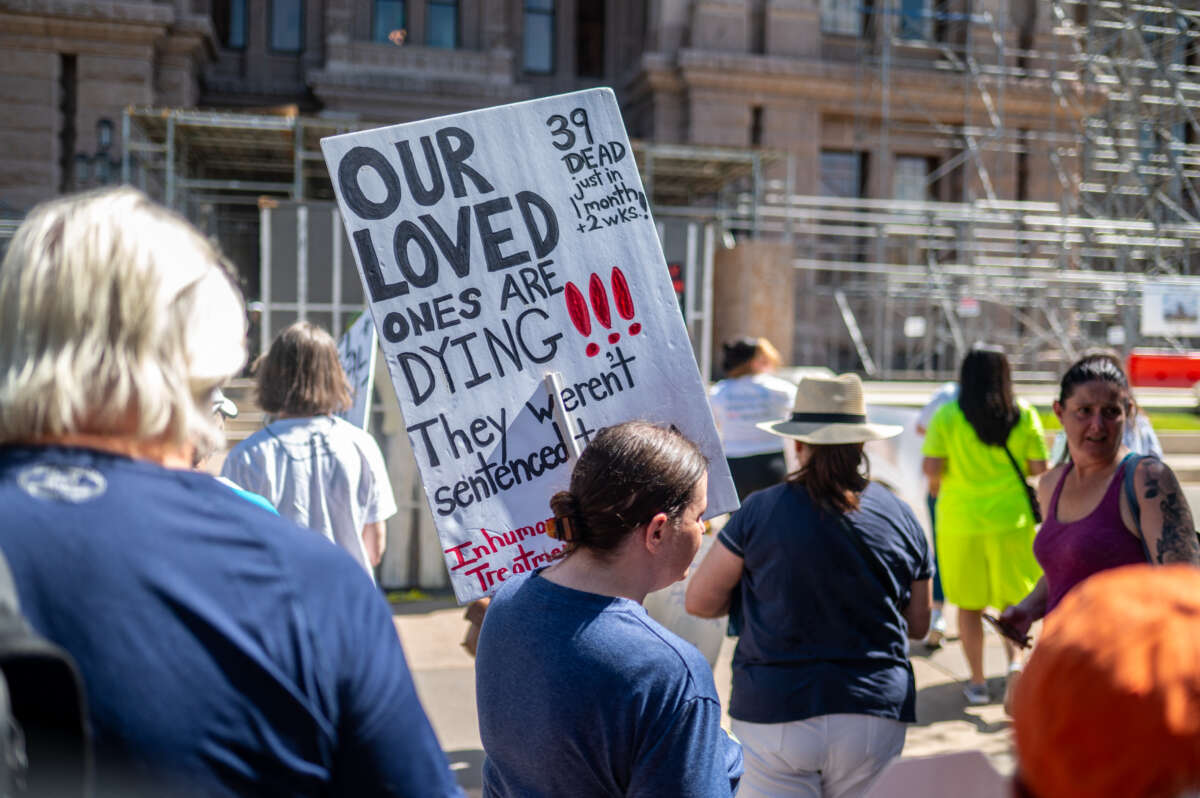
At least 41 people incarcerated in Texas prisons died during a 2023 heat wave when prison heat readings regularly read 100 degrees or higher. This included 37-year-old Elizabeth Hagerty, who was scheduled for parole one month after guards found her unresponsive in her un-air-conditioned cell. As previously reported in Truthout, temperatures had reached nearly 100 degrees the day before she was found.
The previous year, a study of Texas prisons found that even a one-degree increase above 85 °F in prisons without air conditioning was associated with a 0.7% increase in the risk of mortality. Researchers estimated that 13 percent of deaths in Texas prisons during warm months between 2001 and 2019 may be attributable to extreme heat.
In 2025, federal judge Robert Pitman ruled that housing people in prisons that lack air conditioning is “plainly unconstitutional.” But he declined to force the Texas Department of Criminal Justice (TDCJ) to immediately install either temporary or permanent air conditioning.
The issue came before Pitman again in 2026, when incarcerated people and advocacy groups filed a federal lawsuit in an attempt to force the state to provide air conditioning in all of its prisons. TDCJ argued that it would cost $1.5 billion to install air conditioning in all prisons. The two-week trial ended in early April. Pitman has yet to issue a ruling.
This leaves 59-year-old“Jack” sweltering in a cellblock that will soon become a sauna. Jack asked that his full name not be published so as not to affect his chances at parole. Jack was recently transferred from a prison which had full air conditioning to one that had none.
“Several of my medications have heat, humidity, and sunlight restrictions which make me more susceptible to the elements,” he told Truthout. “I can’t even open my window due to a wasp nest being somewhere near my window.” After being stung twice, he keeps his window closed.
“Fans do no good in the summer because all they do is circulate the hot air,” he said. “I am unable to go to outside recreation and this unit has no awnings, so I often am in the sun.”
When previously confined to hot units, Jack resorted to wearing a wet sheet like a toga and laying on a flooded cell floor to keep from overheating. He plans to revert to those practices this summer.
Aisha Bailey has been in Texas state prisons since 2004. “My tolerance to heat has gotten worse because the heat itself has gotten worse,” the 49-year-old told Truthout. “Even though recreation is offered less and less due to staffing issues, I still don’t want to go outside when the opportunity does come. Once we go to outside recreation, we are usually left out there for hours due to the officer forgetting or being too busy.”
During the summer, she avoids programs during the hottest part of the day.She also requests that her medications usually dispensed in the afternoons (between 2 pm and 5 pm) be changed to the mornings (3 am to 6 am), which she says providers are willing to accommodate.
Bailey was recently transferred to the Lane Murray unit. In 2024, officials installed an air cooling system in its segregation unit after the 2023 death of Hagerty and multiple op-eds by incarcerated journalist Kwaneta Harris on the blistering heat. General population cellblocks, however, remained uncooled.
Earlier this year, Harris was transferred from a non-solitary unit, which lacked air conditioning, to the fully air-conditioned Patrick O’Daniel unit, a six-minute drive from the Murray unit.
While the cellblock has air conditioning, she must walk through the yard to go to the cafeteria. On an 88-degree day, the three-minute walk leaves her dripping with sweat. The cafeteria only has fans which push around the hot air.
As temperatures rise, Harris plans her meals from the foods bought from commissary. “I’m not going out,” she said.
When asked about Haggerty’s death, air conditioning, and heat mitigation efforts, TDCJ spokesperson Amanda Hernandez directed Truthout to the agency’s page on air conditioning construction projects, which notes that 38 prisons are fully air conditioned and 52 are partly air conditioned. TDCJ has 100 facilities.
“One Person Can Change Someone’s World”
Tyresha Reed is somber when she talks about her and Boulware’s plans. Reed had moved to a bigger house so that Boulware could live with her and had even furnished her mother’s room.
“She wanted to get all her grandkids together at one time,” she said. “You can only have six people at a visit, so there was no way for her to see all her grandkids at one time. That was something she really wanted to do.”
Boulware also looked forward to tasting her adult daughters’ cooking. “When I cooked for the kids, she would have me send her pictures,” Reed recalled. She was especially looking forward to trying what Reed called a chicken roast. “It’s chicken, potatoes, bell peppers, mushrooms, onions all cooked together in the crock pot,” she explained.
Now, instead of gathering grandchildren or ingredients, Reed is learning how to advocate for a life-saving law. She has joined All of Us or None, a group fighting for the rights of currently and formerly incarcerated people and their families.
“I always tell my kids, one person can’t change the world, but one person can change someone’s world,” she said.
In early June, however, Reed and other advocates learned that Gipson’s office decided to “gut and amend” the bill.
“This means all existing bill language, everything that made up Adrienne’s Act, will be removed, and only the bill number will remain,” explained Ravyn McCullough, a member of California Coalition for Women Prisoners. “This gives the author’s office the authority to transfer language from a previous bill that died.”
Gipson’s office declined to comment.
As for Reed, she’s determined to keep fighting to ensure that no one else goes through the same tragedy. “I’m going to keep fighting until a change is made,” she said.
Press freedom is under attack
As Trump cracks down on political speech, independent media is increasingly necessary.
Truthout produces reporting you won’t see in the mainstream: journalism from the frontlines of global conflict, interviews with grassroots movement leaders, high-quality legal analysis and more.
Our work is possible thanks to reader support. Help Truthout catalyze change and social justice — make a tax-deductible monthly or one-time donation today.