Did you know that Truthout is a nonprofit and independently funded by readers like you? If you value what we do, please support our work with a donation.
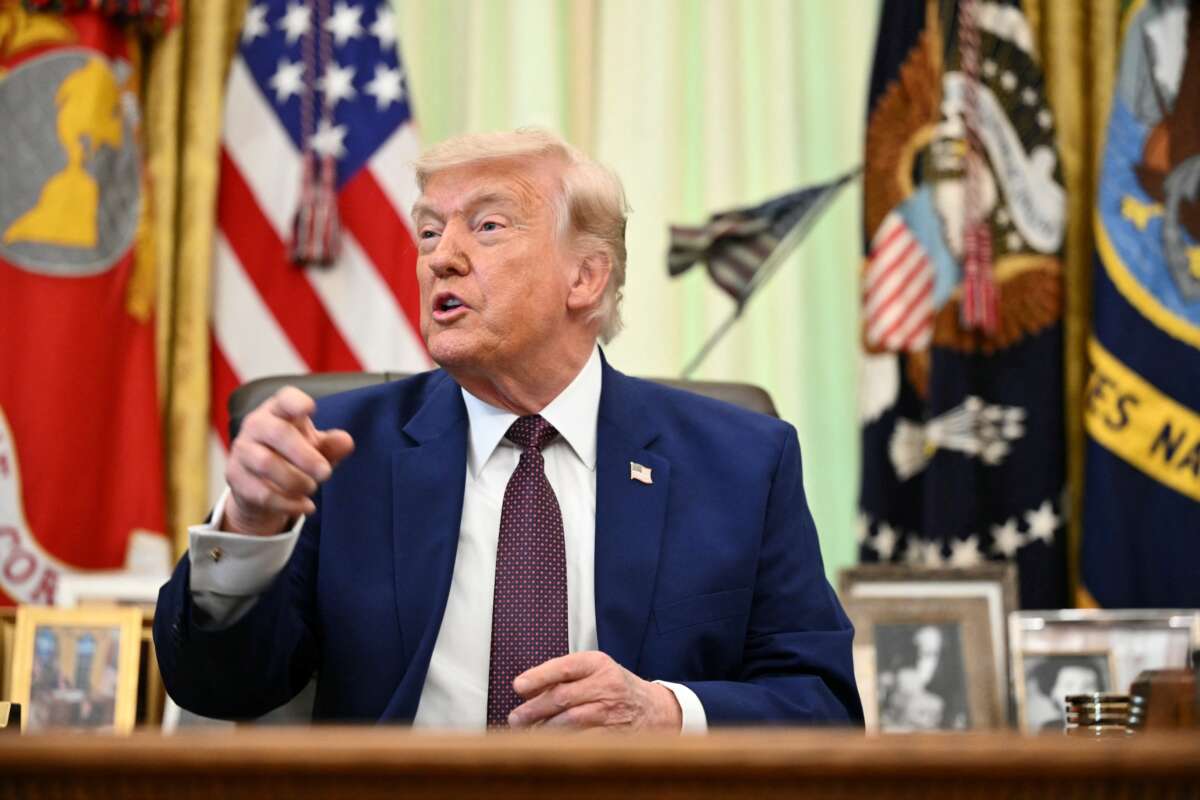
In remarks in the Oval Office on Wednesday, President Donald Trump stated that in the Middle East, “a ceasefire is when you’re shooting in a more moderate manner.”
“A ceasefire there is much different than in other parts of the world,” Trump said, in response to a question by a reporter about his definition of a ceasefire.
“In that part of the world, a ceasefire is when you’re shooting in a more moderate manner,” he went on, excusing his own failure to bring an end to his unprovoked war on Iran.
Trump has muddied the waters about the meaning of the term “ceasefire” in the U.S.-Israeli war on Iran, claiming for weeks that the April 8 ceasefire is intact despite blockading Iran and conducting so-called “self defense” strikes on the country. Iran also bombed Kuwait on Wednesday – though Trump was seemingly nonchalant about the attack in his Oval Office comments, saying that it was in retaliation for U.S. strikes over the previous day.
Trump’s comments also serve as justification for Israel’s repeated violations of its so-called ceasefires in Gaza and Lebanon, which have come to be seen as one-sided.
In the year after Israel’s 2024 ceasefire with Hezbollah, UNIFIL, the UN peacekeeping force in Lebanon, said that Israel violated the ceasefire more than 10,000 times. And Israel repeatedly takes advantage of ceasefires to put pressure on Lebanon and the U.S. through mass strikes – like on April 8, when Israel killed 357 people in Lebanon to make a point that Lebanon could not be part of the agreement with Iran.
Al Jazeera noted on June 1 that Israel violated the October 2025 ceasefire agreement in Gaza over 3,000 times, on a near-daily basis. These attacks have killed at least 932 Palestinians.
In both Lebanon and in Gaza, residents repeatedly ask, “Where is the ceasefire?”
Later, Trump repeated the sentiment, saying, “That’s a very volatile part of the world, probably the most volatile part of the world. The people are volatile, the leadership [as well].” This is an excuse that Israel has also used to justify its brutality across the region.
But the region is largely volatile as a result of imperialist intervention — led by the U.S., and with the help of Israel, which has played the role of the U.S.’s watchdog in the Middle East since 1967.
During his remarks in the Oval Office on Wednesday, Trump stated that the issue of Lebanon should be separate from a deal with Iran – which is what Israel has demanded, and Iran has repeatedly pushed back on.
Trump also said that he spoke with Hezbollah leaders. “We actually spoke with Hezbollah for the first time ever,” he said. “We didn’t know they spoke,” he added, continuing with his racist commentary on the region. Trump reportedly called both Hezbollah leaders and Israeli Prime Minister Benjamin Netanyahu on Tuesday to push for a de-escalation after Israel expanded its occupation of southern Lebanon and threatened to resume bombing Beirut.
Although Lebanon and Israel both agreed to renew their “ceasefire” on Thursday, this was done without the participation of Hezbollah, and is contingent on Hezbollah removing its fighters from the south – which is under Israeli occupation and has faced continuous bombardment since March. The U.S. and Israel have pressured factions of the Lebanese government to turn on Hezbollah over the past year.
But after this announcement on Thursday, Israel’s Defense Minister Israel Katz said that Israel will remain in southern Lebanon. Israel continued its airstrikes on both southern Lebanon and the Bekaa valley region.
Israel has attacked three hospitals in southern Lebanon over the past few days.
Rima Majed, professor of sociology at the American University of Beirut, condemned Israel’s repeated escalations in Lebanon in comments to Truthout earlier this week.
“We now live in a world where ceasefire means that Israel can continue bombing, and that we can keep reaching ceasefire agreements within ceasefire agreements without all of this meaning any real protection for people,” she said.
Important Message: Please Read
For 25 years, Truthout has survived by publishing impactful investigative journalism and analysis; distributing full editions 365 days a year; and building a community of readers who support us with small, hard-earned donations.
Eighty percent of our $3 million yearly budget comes from small donors alone. Of those, 8,000 readers support us with monthly donations. Back in 2018, when Facebook decided to suppress the circulation of posts made by organizations, thereby cutting readers off from seeing many articles shared by the news organizations they had intentionally decided to follow, Truthout’s total traffic declined by 40 percent, as nearly all of our traffic from that platform disappeared.
Now, Google has recently rolled out its AI search bar, providing AI summaries instead of directing readers to our site. Google Search is our single largest source of traffic; it’s the route by which nearly one third of our readers find us. Much like in 2018, a shocking 40 percent of our Google traffic has disappeared overnight.
It will not be easy for Truthout to shoulder this blow. Nor will it be easy for our peers and collaborators — news sites that depend on traffic and aren’t bankrolled by large corporations.
If you can support Truthout with a donation today, you can help us resist the AI onslaught. Please give today.