Truthout is an indispensable resource for activists, movement leaders and workers everywhere. Please make this work possible with a quick donation.
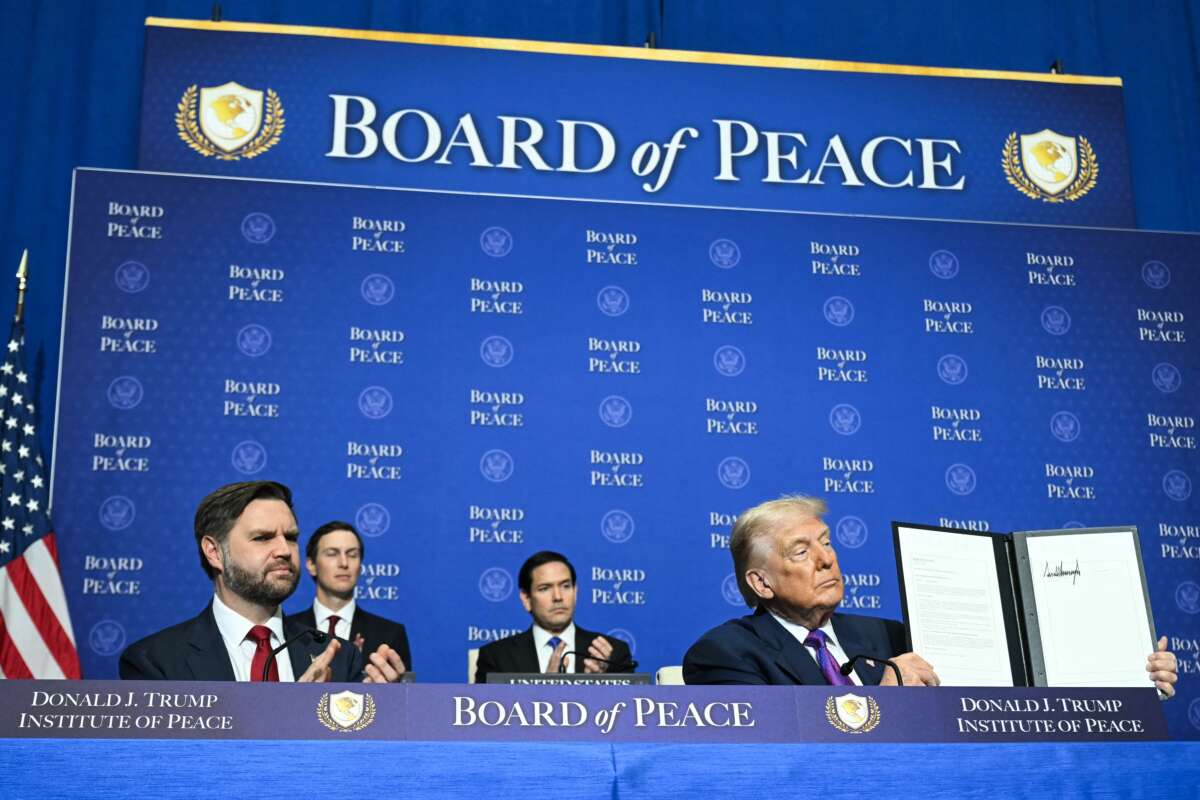
Wielding a golden gavel and a playlist featuring the Beach Boys, Donald Trump ushered in a new era of international humiliation at the inaugural meeting of the U.S.-led Board of Peace. The new body, while established by Trump, has been tasked by a UN Security Council resolution to administer Gaza’s reconstruction efforts. But Trump has also suggested his ambitions for the board go far beyond Gaza, saying it would “almost be looking over the United Nations and making sure it runs properly.”
Trump has demanded that world leaders pony up $1 billion for a permanent seat on the ostensible peacekeeping body, even as he defunds the actual peacekeeping mission of the United Nations, which he has suggested his new institution will supplant. Altogether, the February 19 inaugural meeting was a perfect distillation of Trump’s preferred method of extortion masked as diplomacy.
As soon as the Board of Peace was created, Palestinians and solidarity activists decried it as a farce and as a naked display of imperial ambition; the entire reason for its existence is to fully sidestep Palestinian autonomy in the rebuilding of Gaza. But any lingering doubts about the president’s lack of interest in peace were fully wiped away by his multiple references to bombing Iran during the Board of Peace’s first meeting, which took place in the newly branded Donald J. Trump Institute of Peace.
“Bad things will happen,” Trump said, if Iran does not submit to U.S. negotiations on a nebulous deal.
Meanwhile Trump has initiated a huge military buildup near Iran including multiple aircraft carriers and warships. The buildup is so massive it has drawn parallels to the buildup preceding the U.S. invasion of Iraq in 2003.
The buildup comes on the heels of the U.S.’s June 2025 aggression against Iran, when the U.S. bombed multiple Iranian nuclear sites during negotiations over the same nuclear program that the U.S. claims to be negotiating over today. That attack came during Israel’s 12-day war with Iran, which was conducted with U.S. arms and logistical support and funded with the help of U.S. taxpayers. During that war, more than 1,000 Iranians were killed. Trump has now said that Iran has “10 to 15 days” to make a deal. Following the charade of last year’s negotiations, analysts expect a U.S. attack on Iran to now come at any moment. New reporting has suggested that U.S. strikes could even target individual Iranian leaders, with the aim of bringing about regime change in the country.
New reporting has suggested that U.S. strikes could target individual Iranian leaders, with the aim of bringing about regime change in the country.
A war between the U.S. and Iran would be undeniably disastrous. U.S. allies across the region have spent weeks urging restraint. Even the U.K., in an uncharacteristically defiant move, has reportedly told Trump it would not allow the U.S. military to use Diego Garcia, the Indian Ocean island that the two countries ethnically cleansed in order to build a military base, to bomb Iran, for fear of violating international law.
The majority of people in the U.S. are also against such an attack. Multiple U.S. polls from recent weeks have shown broad resistance to the use of military force in Iran, and a strong desire for Trump to seek congressional approval before launching an attack against another country.
So how did we arrive in this position, where, despite widespread domestic and international opposition, Trump’s murderous impulses are treated as inevitable? Over and over, pundits have framed this as a war that the U.S. is falling into, or one that it is sleepwalking toward. But there is not some gravitational force pulling the U.S. and Iran toward major military catastrophe. This is a war of choice by the U.S., and we must remember that it could be stopped in an instant.
This is a war of choice by the U.S., and we must remember that it could be stopped in an instant.
We’ve been on a slow march toward this outcome, both over the decades that the powers that be in the U.S. and Israel have worked to manufacture consent for military action against Iran, and more deeply since they broke the dam on such an attack last June. There has been no accountability for that illegal attack, just as there has been no accountability for the U.S. kidnapping of Venezuelan President Nicolas Maduro — neither move was met with articles of impeachment for Trump nor for the cabinet members who orchestrated the attack. And there has been no accountability for the U.S.’s backing of Israel’s genocide in Gaza, even when some of those backers acknowledge themselves that U.S. support for the Israeli military went against domestic law.
And even before these last years, there has been no real accountability for the invasion of Iraq, to which a war with Iran has long been compared. Many of the architects of that war have proceeded to build storied careers in government and media without seeing so much as a single consequence for their devastating actions. In a grim twist of irony, even former Bush speechwriter David Frum — the same man who labeled Iran a member of the “axis of evil” — is now wringing his hands about the lack of consent from Congress or the U.S. public for a regime change war in the Middle East, writing: “We are poised days away from a major regime-change war in the Middle East, and not only has Congress not been consulted, but probably not 1 American in 10 has any idea that such a war is imminent.”
Trump is getting away with this because, for decades, we have let warmongers unleash their worst with little to no repercussions. But when it comes to Congress, part of the lack of opposition is because, at some level, there actually is a lack of opposition: Coercing other countries, especially Iran, has long been a bipartisan pastime.
During the Obama administration, Senate Minority Leader Chuck Schumer (D-New York) bucked his own party to come out against the landmark nuclear deal with Iran, which is widely considered to have been one of the most successful tools keeping escalations like this from happening. After Trump’s prior attack against Iran in June, Schumer hit him from the right, accusing the president of folding too early and letting Iran “get away with everything.” Meanwhile, House Minority Leader Hakeem Jeffries (D-New York) has been largely silent about Trump’s saber-rattling, save for a singular reference to Congress’s authority to declare war.
House Minority Leader Hakeem Jeffries has been largely silent about Trump’s saber-rattling, save for a singular reference to Congress’s authority to declare war.
While some lawmakers have been more vocal in their opposition to Trump’s buildup, the only halfway meaningful response from Congress to the Trump administration has come from Reps. Ro Khanna (D-California) and Thomas Massie (R-Kentucky), who are moving to force a war powers vote next week, to bring Congress on the record about whether Trump should be forced to terminate his military plans against Iran. But while these kinds of votes are necessary — anything that could potentially stop such a disaster is necessary — real opposition to Trump’s warmaking would require more than these process-oriented critiques.
A war with Iran is wrong because it’s morally wrong — not only because it’s illegal under the Constitution, or under international law. Laws can be useful tools for stopping military action — indeed, it appears the U.K.’s concerns about running afoul of international law could in fact materially affect Trump’s plans for military action. But we must be honest about the limitations of such laws as we hear the drumbeats for war, illegal or not, grow louder. We need real, principled opposition that will put fear of accountability into the hearts of the architects and defenders of this aggression, whether that comes from the streets or the ballot box or legal avenues or the halls of Congress.
Inherent in some of the critiques of Trump’s buildup is the idea that a war with Iran could be conducted a “right” way — with congressional permission, with actual strategic objectives, or as a more limited air war compared to a 2003-style invasion with boots on the ground. But there is no right way to conduct this war; no matter what happens, no matter who approves it, it will be deadly and dangerous and lead to further terror across the entirety of the region.
There is no right way to conduct this war; no matter what happens, no matter who approves it, it will be deadly and dangerous and lead to further terror across the entirety of the region.
This escalation also comes at an especially brutal time for Iranian civilians, who faced a marked increase in state repression in response to anti-government protests earlier this year. As U.S. airpower moved into place, Iranians were observing traditional 40-day mourning ceremonies for the thousands of people killed in the violent crackdown on protesters. The grief has been heavy to bear. And as Hanieh Jodat wrote in Truthout last month, the back-and-forth threats from the United States have added a burden of psychological warfare to those of us with ties to Iran — we were already struggling to reach loved ones in our homeland due to the state-imposed communications shutdown there.
While some in the diaspora have cheered on an invasion out of rage toward the Iranian state, those of us who study history know there is no such thing as bombing a country into liberation, especially not at the hands of the same people who have spent years backing genocide in Palestine. As it did last year, the Iranian state will use the instability and fear of a war to further crack down on labor, student, and feminist movements pushing for liberatory change within the country. A war would only inflict further trauma on a population onto which a desperate amount of violence and repression has been forced in under a year.
Back in July, after Israel’s assault on Iran, a video emerged that put to rest the already laughable idea that Israel’s “precision attacks” were targeting Iranian military sites, as if that would have made a war of choice more defensible. The video shows a densely populated street in Tehran’s Tajrish district. Two missiles strike in quick succession, one hitting a building and another hitting the city street, forcefully pushing cars into the air. The video is dramatic and heartbreaking, especially because it features a popular area that anyone familiar with Tehran likely knows well. Iranian authorities said that 17 people were killed in the strike, including two children and one pregnant person.
That is what war looks like. That is what the U.S. could impose on Iran yet again if we do not act to stop it. And the consequences this time around could be far more wide-ranging and disastrous for everyone involved.
A terrifying moment. We appeal for your support.
In the last weeks, we have witnessed an authoritarian assault on communities in Minnesota and across the nation.
The need for truthful, grassroots reporting is urgent at this cataclysmic historical moment. Yet, Trump-aligned billionaires and other allies have taken over many legacy media outlets — the culmination of a decades-long campaign to place control of the narrative into the hands of the political right.
We refuse to let Trump’s blatant propaganda machine go unchecked. Untethered to corporate ownership or advertisers, Truthout remains fearless in our reporting and our determination to use journalism as a tool for justice.
But we need your help just to fund our basic expenses. Over 80 percent of Truthout’s funding comes from small individual donations from our community of readers, and over a third of our total budget is supported by recurring monthly donors.
Truthout has launched a fundraiser, and we have a goal to add 231 new monthly donors in the next 48 hours. Whether you can make a small monthly donation or a larger one-time gift, Truthout only works with your support.