Truthout is an indispensable resource for activists, movement leaders and workers everywhere. Please make this work possible with a quick donation.
Anahita Panahi has spent the last year trying to put out fires set by Trump 2.0.
Panahi, who leads the refugee and asylee advocacy work at the California-based Coalition for Humane Immigrant Rights Los Angeles, has gotten used to public policies that are gratuitously cruel toward immigrants. She has spent months now navigating extreme interpretations of provisions in the federal code to make life all-but-unendurable for asylum seekers and would-be-refugees, as well as other categories of immigrants. She has watched as Trump reduced the annual refugee admissions cap in the U.S. to 7,500, down a stunning 94 percent from what it was during Joe Biden’s presidency, and proceeded to reserve most of the remaining spots for white Afrikaners from South Africa, leaving in limbo overseas more than 130,000 refugees who had already been cleared by the U.S.’s extremely thorough vetting process but are now unable to journey on to the United States.
On February 18, however, Panahi found herself stunned by a memo sent by the Department of Homeland Security to field agents, stating that refugees who have been in the country for more than a year and still don’t have their green cards will now be subject to arrest and indefinite detention while their cases are reviewed, approved, and processed. “This is probably one of the most unprecedented memos — introduced to impose trauma on refugees,” Panahi concluded.
“This is probably one of the most unprecedented memos — introduced to impose trauma on refugees.”
Under the terms of Section 209, which were added to the Immigration and Nationality Act under the terms of the Refugee Act of 1980, vetted refugees who arrive in the U.S. have to wait a year before they can receive permanent residency and thus their green cards — although they can start the application process during these months. After a year, they can get their green cards, though how long that takes is largely out of their hands, depending on the speed at which the government processes applications and schedules mandatory interviews. And while they have no green card they can be returned to the supervision of the Department of Homeland Security for “inspection and examination.”
The statute’s language around this is, however, ambiguous. It does state that after a year, refugees without green cards can be “returned” to the “custody” of immigration authorities. Over the decades, federal courts, including the Supreme Court, have taken the language to mean that after a year they would be “returned” to some form of oversight by immigration authorities, not that they would be newly incarcerated. As multiple immigration attorneys told Truthout, the government has previously chosen to incarcerate refugees only in rare instances, and mainly when they have been convicted of serious crimes. For the vast majority, the ambiguity of the Immigration and Nationality Act’s language was nothing to worry about — and, to put their worries to rest, in 2010, Immigration and Customs Enforcement (ICE) came out with a memo declaring that being a refugee without a green card was not a deportable offense.
Indeed, in the rare instances the government has sought to use the Immigration and Nationality Act’s language as the basis for detaining refugees, the courts have intervened to stop the practice. Holly Cooper, a long-time immigrant rights attorney who currently co-directs the immigration law clinic at the University of California-Davis School of Law, recalls successfully challenging the George W. Bush administration when it attempted to detain refugees, using the language of this statute, after the September 11 attacks.
During those years, Cooper says, it could take up to three years to process green card applications, even in those rare instances when a person was ordered detained until the processing was complete. Now, she says, the Trump administration has slowed the application process down even further, and, with a policy in place of wholesale detention, the potential for abuse is that much greater. “I’ve never in my 28 years of practicing immigration law seen anything this slow,” Cooper explains. ‘Everything is gummed up. Everything is getting rejected. It’s obstructionist. Most cases aren’t moving forward. They’re creating the alchemy for their own justification for detention.”
In short, having slowed the green card application process down, the Trump administration is now using the ambiguity of the Immigration and Nationality Act’s language to authorize the potential indefinite detention of 100,000 refugees who have been in the country a little over a year, don’t yet have their green cards, and are thus caught in a legal limbo: They arrived before Trump slammed the door on new refugee admissions, but because the government has deliberately slow-walked their green card applications, they find themselves having been here more than a year and with no indication of when they will get their green cards.
For their first 365 days in the United States, these refugees have protected status. But on day 366, according to this new memo, they suddenly become targets against whom ICE’s immigrant-hunters can be unleashed; they can be detained, they can be “re-vetted,” and, potentially, their refugee status can be revoked. It is the ultimate catch-22, designed to intimidate and re-terrorize people who thought they had been given sanctuary in the U.S. after having fled some of the most violent places on earth — including places in which U.S. interventions and economic policies have made life interminably harder.
“I do fear there is going to be mass trauma within these communities, and mass fearmongering as well. If you follow the law, you’re damned. If you don’t follow the law, you’re also damned.”
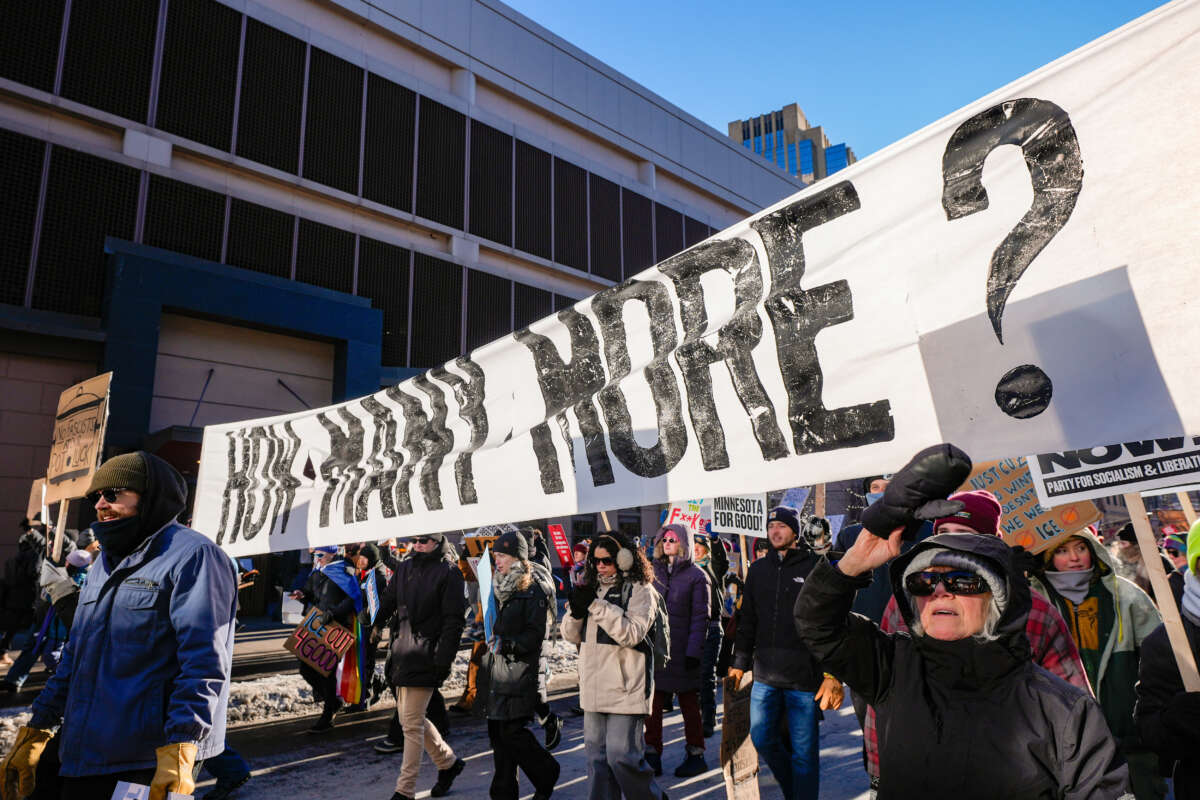
During the brutal ICE occupation of Minneapolis, dozens of Somali refugees were arrested and detained on exactly this pretext. And Afghan Special Immigrant Visa holders in Los Angeles faced the same criminalization during ICE’s California surge in the summer of 2025, despite the fact that they were issued visas for having helped U.S. and allied forces during the occupation of Afghanistan, and regardless of the reality that they are at serious risk of imprisonment, torture, or death should they remain in Taliban-controlled Afghanistan.
After the International Refugee Assistance Project went to court and secured a temporary restraining order against this practice, more than 100 refugees living in Minneapolis were released from custody. The International Refugee Assistance Project says 72 of these 100 refugees were released as a direct result of its lawsuit and that the rest had filed their own habeas petitions.
Now, however, that Minneapolis pilot program is being taken countrywide. As of the memo last week, 100,000 refugees are subject to arrest and indefinite detention.
Attorney Ghita Schwarz, litigation director at the International Refugee Assistance Project, says the memo is “lawless,” adding that “it’s not tethered to any part of the statute or to previous practice.” She worries that it will lead to the mass arrest of “people who followed all the instructions and were vetted prior to coming into the U.S.”
Immigrant rights organizations around the country are gearing up for a huge legal fight on this new policy. “I can’t imagine this won’t be challenged,” Schwarz says. “It conflicts with the language of the statute and with practice for more than four decades.” Already, she says, attorneys are hearing stories of refugees outside of Minnesota who are being caught up in new sweeps.
Anahita Panahi, whose own parents fled Iran as refugees decades ago, concurs. “It is completely inhumane, it is illegal,” she says. “I do fear there is going to be mass trauma within these communities, and mass fearmongering as well. If you follow the law, you’re damned. If you don’t follow the law, you’re also damned.”
An important fundraising appeal: 10 Days to raise $50,000
Truthout is one of only a few platforms for justice-oriented, grassroots journalism. Today, as political censorship from the right intensifies, we have no choice but to ask for your help.
We are fundraising right now to cover our basic operating expenses. If you can support Truthout with a one-time or monthly donation, you will make a significant impact on our work. Anything you can do makes a difference — we appreciate your support.