Truthout is an indispensable resource for activists, movement leaders and workers everywhere. Please make this work possible with a quick donation.
Billionaire tech moguls talk as if the artificial intelligence revolution is inevitable, and it’s up to the rest of us to adapt. Earlier this year in a blog post, OpenAI CEO Sam Altman boasted that society is now “past the event horizon; the takeoff has started” toward building computer “superintelligence.” However, the industry is not just facing blowback from skeptics of the technology itself.
A growing grassroots movement is fighting back against another concrete and immediate AI threat — the rapid expansion in local communities of massive “hyperscale” data centers, along with the fossil fuel plants to power them. In localities across the countries, neighbors worked across partisan lines to engage in David versus Goliath battles with Big Tech. As those fights over data center buildout are set to explode in 2026, some groups are calling for a larger moratorium to build on local fights.
“This movement isn’t about ideology so much as communities recognizing that a small group of wealthy and powerful tech companies are exploiting essential resources and infrastructure, while pushing risks and costs onto the public,” said Jim Walsh, policy director at the environmental health group Food & Water Watch, in an email.
On December 8, Food & Water Watch joined more than 230 state and local environmental and community groups to send a letter to Congress demanding a national moratorium on the construction of new data centers. The groups called the rapid expansion of data centers one of the greatest environmental and social threats in generations.
“This expansion is rapidly increasing demand for energy, driving more fossil fuel pollution, straining water resources and raising electricity prices across the country,” the groups wrote. “All this compounds the significant and concerning impacts AI is having on society, including lost jobs, social instability, and economic concentration.
Sen. Bernie Sanders (I-Vermont) joined the call for a national moratorium earlier this month, which he repeated in an interview with CNN on December 28. A moratorium would “slow the process down,” Sanders said, giving policymakers time to catch up with the companies racing to build out AI infrastructure regardless of the impacts on working people.
“It’s not good enough for the oligarchs to tell us ‘you adapt,’” Sanders said during the interview. “Are they going to guarantee healthcare to all people? What are they going to do when there are no jobs? Make housing free?”
The rush to build new data centers emerged in 2025 as a major fault line dividing working people of all political stripes against Silicon Valley. Tech moguls such as OpenAI CEO Sam Altman saw stock prices skyrocket while cozying up to President Donald Trump and framing adoption of their technology as an inevitability. People threatened by the industry’s physical infrastructure buildout are not buying it.
People are experiencing the impacts firsthand, from drained water supplies to higher electricity bills.
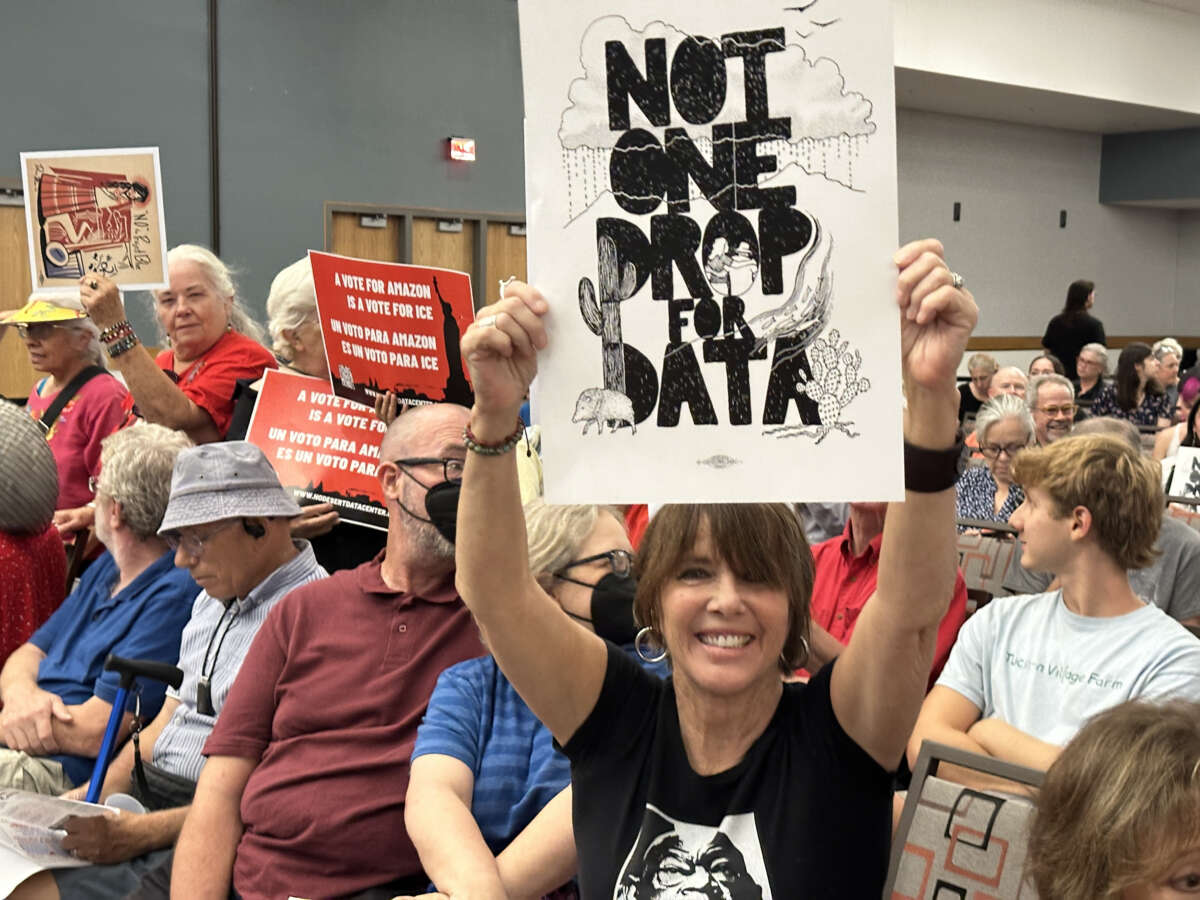
Across the country, local coalitions are rising up to resist the construction of new AI data centers that threaten to degrade water supplies and raise energy bills while providing little economic benefit to the affected communities. From South Carolina to Pennsylvania, from Mississippi to Michigan, Arizona, and Texas, residents filled public meetings in 2025 to voice opposition to the Big Tech companies chasing lucrative tax breaks to build data centers in their neighborhoods. .
“We are seeing a huge grassroots backlash to data centers that crosses party lines because people are experiencing the impacts firsthand, from drained water supplies to higher electricity bills,” Walsh said.
A recent analysis from Walsh’s organization expects energy demand from data centers to triple between 2023 and 2028, when AI is projected to consume as much electricity as 28 million U.S. households.
Electricity prices in regions where existing data centers are concentrated are up 250 percent over the past five years, and U.S. energy costs on average are projected to increase at least 8 percent by 2030 thanks to AI and cryptocurrency mining.
Billions of gallons of clean water are needed to cool the systems inside data centers — enough water to serve more than 18 million households by 2028 — which is a major concern for desert communities in the Southwest where future access to water is already a major issue.
For example, the No Desert Data Center Coalition working to stop the proposed Project Blue data center in southern Arizona’s Pima County declares, “Not One Drop for any development that has no intention to actively regenerate & revitalize the land, and reconcile the harmful legacy of extractive industries in the Sonoran Desert.” In rural Saline, Michigan, residents recently gathered to protest what they called “secret deals” made between state officials and DTE Energy, which would provide power to a massive data center proposed to be built in the area.
“Further enraging communities is the fact that many of these projects are being negotiated behind closed doors with non-disclosure agreements between local officials, utilities, and tech companies that prevent the public from even knowing how much water or energy a project will use, or what public subsidies are involved,” Walsh said.
Despite the public scrutiny of the AI industry, the Trump administration has worked to shield the industry from regulation and accelerate data center buildout despite opposition from members of his own party.
In addition to Sanders’s call for a moratorium, other politicians are taking steps to demand more accountability. Democrats in Congress are currently investigating whether companies including Google, Meta, Microsoft, and Amazon are quietly passing the costs of running data centers onto consumers in the form of higher utility bills. In 2025, lawmakers across all 50 states considered at least 238 data center-related bills and enacted over 40 of them in 21 states, according to the MultiState policy tracker.
Most of the statewide legislation addresses energy usage, but some local efforts go further. Cities and towns in at least 14 states have passed moratoriums on data center development, according to Tech Policy Press. With only local politicians taking action so far, the movement for moratoriums on new data centers is pitting individual communities against some of the most powerful people in the world.
“Who is pushing this revolution in technology? It is the richest people in the world — Elon Musk, Zuckerberg, Bezos, Peter Thiel — multi, multi-billionaires are pouring hundreds of billions of dollars into implementing and developing this technology,” Sanders said.
“Do you think they are staying up nights worrying about working people and how this technology will impact those people? They are not. They are doing it to get richer and even more powerful.”
A terrifying moment. We appeal for your support.
In the last weeks, we have witnessed an authoritarian assault on communities in Minnesota and across the nation.
The need for truthful, grassroots reporting is urgent at this cataclysmic historical moment. Yet, Trump-aligned billionaires and other allies have taken over many legacy media outlets — the culmination of a decades-long campaign to place control of the narrative into the hands of the political right.
We refuse to let Trump’s blatant propaganda machine go unchecked. Untethered to corporate ownership or advertisers, Truthout remains fearless in our reporting and our determination to use journalism as a tool for justice.
But we need your help just to fund our basic expenses. Over 80 percent of Truthout’s funding comes from small individual donations from our community of readers, and over a third of our total budget is supported by recurring monthly donors.
Truthout has launched a fundraiser to add 379 new monthly donors in the next 6 days. Whether you can make a small monthly donation or a larger one-time gift, Truthout only works with your support.