Truthout is an indispensable resource for activists, movement leaders and workers everywhere. Please make this work possible with a quick donation.
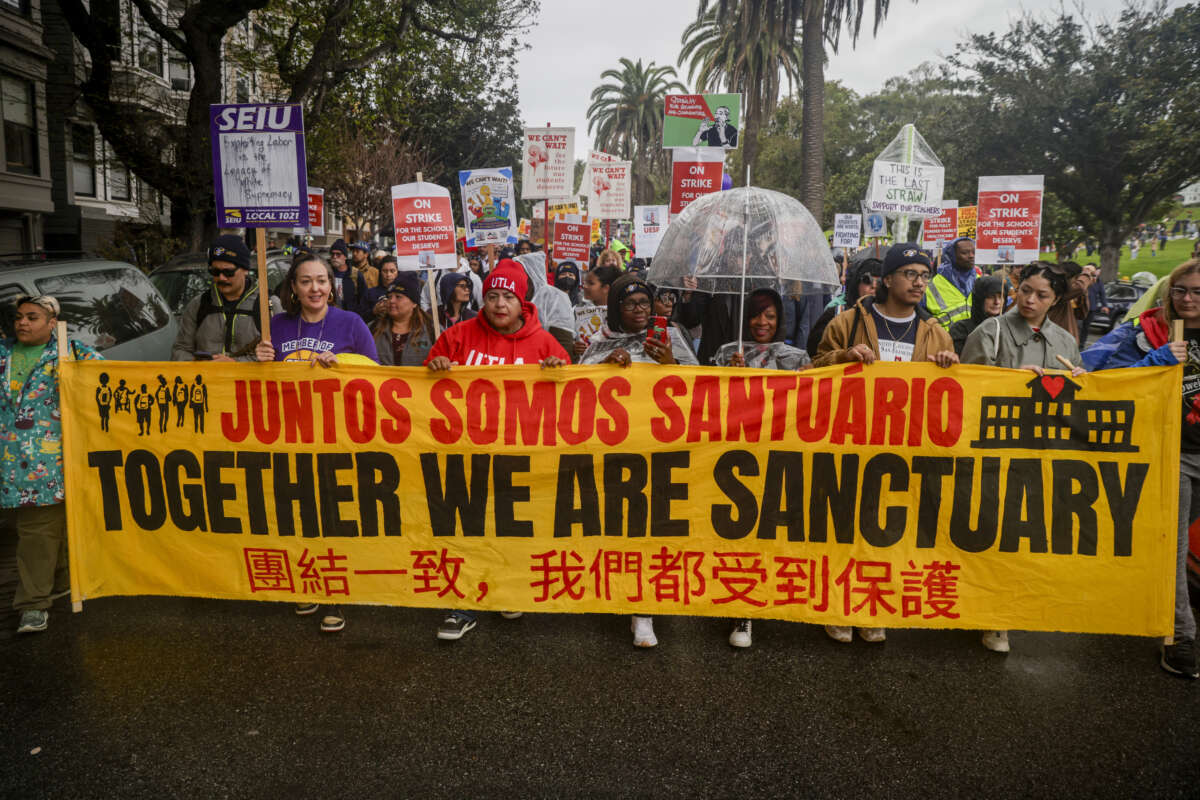
San Francisco public school teachers and their union celebrated Friday after negotiating a tentative agreement for a new contract with higher pay and fully funded family healthcare, ending a four-day walkout that was the city’s first educator strike in nearly half a century.
United Educators of San Francisco (UESF) said its bargaining team reached a two-year tentative deal with the San Francisco Unified School District (SFUSD) at around 5:30 am local time Friday. The 120 public schools that were closed due to the walkout by around 6,000 teachers are set to reopen for classes next Wednesday.
“This historic strike built an unbreakable solidarity across our city, among families, students, educators, and community,” UESF said in a statement. “This strike has made it clear what is possible when we join together and fight for the stability in our schools that many have said was out of our reach.”
The tentative agreement, which follows 11 months of bargaining, includes the union’s main demand for fully funded health coverage for dependents; raises of between 5-8.5%; caseload reductions for special educators; sanctuary protections for students and staff; limits on the use of artificial intelligence; preservation and expansion of the Stay Over program for unhoused students and their families; and better working conditions for librarians, substitute teachers, counselors, and other staff.
“By forcing SFUSD to invest in fully funded family healthcare, special education workloads, improved wages, sanctuary and housing protections for San Francisco families, we’ve made important progress towards the schools our students deserve,” said UESF president Cassondra Curiel “This contract is a strong foundation for us to continue to build the safe and stable learning environments our students deserve.”
SFUSD Superintendent Maria Su said in a statement: “I recognize that this past week has been challenging. Thank you to the SFUSD staff, community-based partners, and faith and city leaders who partnered with us to continue centering our students in our work every day.”
“I am so proud of the resilience and strength of our community,” Su added. “This is a new beginning, and I want to celebrate our diverse community of educators, administrators, parents, and students as we come together and heal.”
However, Su also warned that “we do not have enough funds to pay for this year and the next two years,” citing SFUSD’s over $100 million budget deficit.
The striking teachers enjoyed widespread support and solidarity across the city, including at a massive rally outside City Hall on Monday.
San Francisco teachers cheered the tentative agreement — especially its coverage of 100% of premiums on family health plans, which run about $1,500 per month, beginning next January.
“That amount of money is life-changing to us,” Balboa High School English teacher Ryan Alias said during a Thursday press conference.
“If we had that in our pocket, we would be able to save for retirement,” added Alias, who has two children in SFUSD schools. “We would be able to save for college funds. We’d be able to save for student loans. We’d be able to pay for art classes for our kids. This is the thing that is going to keep educators in the city.”
Important Message: Please Read
For 25 years, Truthout has survived by publishing impactful investigative journalism and analysis; distributing full editions 365 days a year; and building a community of readers who support us with small, hard-earned donations.
Eighty percent of our $3 million yearly budget comes from small donors alone. Of those, 8,000 readers support us with monthly donations. Back in 2018, when Facebook decided to suppress the circulation of posts made by organizations, thereby cutting readers off from seeing many articles shared by the news organizations they had intentionally decided to follow, Truthout’s total traffic declined by 40 percent, as nearly all of our traffic from that platform disappeared.
Now, Google has recently rolled out its AI search bar, providing AI summaries instead of directing readers to our site. Google Search is our single largest source of traffic; it’s the route by which nearly one third of our readers find us. Much like in 2018, a shocking 40 percent of our Google traffic has disappeared overnight.
It will not be easy for Truthout to shoulder this blow. Nor will it be easy for our peers and collaborators — news sites that depend on traffic and aren’t bankrolled by large corporations.
If you can support Truthout with a donation today, you can help us resist the AI onslaught. Please give today.