Support justice-driven, accurate and transparent news — make a quick donation to Truthout today!
FedEx and UPS — two private carriers positioned to capitalize on a weakened U.S. Postal Service — poured nearly $20 million into federal lobbying in 2025, an OpenSecrets analysis found.
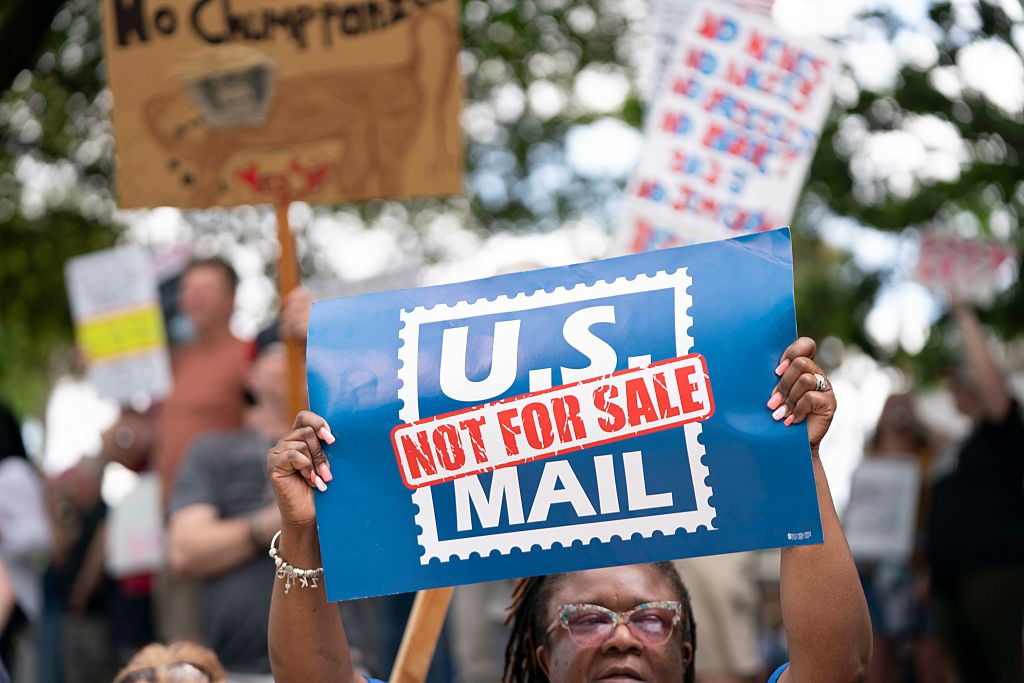
A series of events left USPS bracing for an uncertain future. First, its leader warned the agency could run out of cash by 2027, leaving it unable to pay employees or vendors. Amazon then announced it would sharply reduce the number of packages it ships through the Postal Service. Amazon moved more than 1 billion packages through USPS last year, roughly 15% of the agency’s total volume. A two-thirds reduction could strip USPS of billions in revenue amid those concerns of insolvency.
USPS cited that “severe financial crisis” in announcing plans to raise stamp prices by four cents, to 82 cents, in July, saying it is “using all available tools” in attempting to keep meeting its universal delivery obligations.
“The Postal Service is no longer a financial or economic issue,” James O’Rourke, a professor emeritus at the University of Notre Dame who studies USPS, told OpenSecrets. “It’s a political issue.”
Another USPS expert has a different view: Steve Hutkins, a retired literature professor at New York University who publishes “Save The Post Office,” said the “insolvency” narrative may be an overstatement.
“It’s not going to run out of money, and it’s not going to go down,” Hutkins told OpenSecrets, noting that USPS has historically defaulted on internal government payments to stay afloat. “It’s way too big to fail. … But there are ways to move some of its business into the private sector … to try and piecemeal privatize it.”
To help cover the gap, Postmaster General David Steiner — a former FedEx board member — has begun auctioning access to the Postal Service’s “last mile” delivery network to private bidders. Such a move underscores what Hutkins described as a “super complex” connective web in which FedEx and UPS are simultaneously USPS’s rivals, contractors and, in some cases, its largest customers.
“They give UPS and FedEx billions in business,” Hutkins said, referring to air transportation contracts. That dual role as both competitor and supplier gives private carriers a unique vantage point to push back against USPS expanding into new revenue streams, like postal banking or even basic in-office services like photocopying.
“One of the main reasons the Postal Service is limited in the products it can offer is thanks to the lobbying of UPS and FedEx,” Hutkins said.
USPS reported net losses of $9.5 billion in 2024 and $9 billion in 2025, followed by a $1.3 billion net loss in the first quarter of 2026.
“Government is not in business to make money,” O’Rourke said. “We don’t ask the Marine Corps to make money. We don’t ask the [U.S.] Forest Service … [or] the National Weather Service or the [National] Park Service service to make money. There is no reason along that line to ask the Postal Service to turn a profit.”
Those figures don’t include the impact of rising transportation costs, which USPS is attempting to offset with a temporary 8% surcharge on some popular products, including Priority Mail. While the surcharge could make FedEx and UPS more competitive on price, O’Rourke warned it may also have a “deleterious effect on demand” among the nation’s most vulnerable. While the private carriers aren’t seeking to take over USPS’s universal delivery mandate, he noted, they are strategically positioned to carve out its most profitable segments — particularly high-margin urban routes — while leaving rural and low-income Americans to “make do, or do without.”
A Crowded Lobbying Arena
Postal policy has become an active lobbying space. In 2025, 80 organizations — from postal unions to major retailers to municipalities — reported lobbying on postal issues, filing 333 disclosure reports listing the issue area. Among private-sector participants, FedEx and UPS ranked among the most active. They listed postal issues in 10 and 11 reports, respectively, placing them in the top tier of all groups engaged on USPS policy, an indication of how closely the private carriers are tracking legislative proposals that could reshape the market.
FedEx spent nearly $12.7 million on lobbying in 2025 — roughly a 16% increase over the previous year, and its highest total since 2014. Its roster of 70 lobbyists was down slightly from 2024 but remained well above its pre-2022 average. Among its 50 “revolving door” lobbyists (people who worked in government before transitioning to K Street, as the lobbying industry is known) are the former chiefs of staff to Sen. Mitch McConnell (R-Ky.) and Rep. Nancy Pelosi (D-Calif.) — both now at powerhouse firm Brownstein Hyatt Farber Schreck — and former House Transportation and Infrastructure Committee member Jeff Denham (R-Calif.). While McConnell and Pelosi are now rank-and-file lawmakers, they both held the top positions in their chambers in recent years.
FedEx’s lobbying priorities spanned a broad range of issues from taxation and trade to labor. Its quarterly disclosures also show the company monitoring several USPS-related issues, including:
- The USPS Shipping Equity Act, which would allow the Postal Service to ship beer, wine and other spirits directly to consumers.
- The STOP Act 2.0, aimed at curbing synthetic opioid shipments by tightening data requirements on international mail.
- The USPS SERVES U.S. Act, which would limit postage rate increases to once per year and expand Postal Regulatory Commission oversight.
- House and Senate resolutions urging Congress to ensure USPS remains an independent establishment not subject to privatization.
Filings do not indicate whether a company supported or opposed a particular bill, or how much of its total lobbying spending was directed toward an issue — only that a company engaged on the matter. However, the frequency in which a bill or issue is mentioned can signal a company’s priorities. FedEx mentioned the USPS SERVES U.S. Act in three reports and the Shipping Equity Act twice, but the legislation it most frequently referenced was the One Big Beautiful Act, largely in the context of taxation and trade.
UPS reported $6.3 million in lobbying expenditures in 2025. Its disclosures cite work on a wide range of issues that include “postal reform” and “general issues related to the postal service.” Its primary complaint, Hutkins said, centers on “cross-subsidization” — the claim that USPS uses revenue from its monopoly letter-mail business to underprice competitive package products. By lobbying to increase the “appropriate share” of overhead costs assigned to packages, rivals hope to force USPS prices upward, making their own rates more competitive, he said. If FedEx shares that concern, Hutkins added, it has kept it “much more in the background.”
“It’s not like [the Postal Service is] going to go out of business and FedEx and UPS are going to pick up all that package business,” Hutkins said. “The only way they pick up more of that package business is by finding ways to constrain what the Postal Service can do in terms of its pricing and so on. That’s what all that cost allocation debate is about.”
Half of UPS’s 36 lobbyists were revolvers. The company employed two of the 10 largest firms — Akin Gump and Cornerstone Government Affairs — and its roster included another former McConnell chief of staff, Billy Piper. It also included Eric Zulkosky, who lobbied for UPS shortly before he was hired in late 2025 as chief of staff to House Majority Leader Steve Scalise (R-La.) – who controls the chamber’s legislative calendar. Several others specialize in tax law, including Zach Rudisill, the former tax counsel to former Sen. Rob Portman (R-Ohio), a key architect of the Postal Service Reform Act of 2022, which removed a requirement that USPS prefund retirees’ health benefits.
Corporate PACs Have Been Big Campaign Spenders
FedEx and UPS were also active away from K Street.
The FedEx Corp PAC contributed $706,000 during the 2024 election cycle. While slightly favoring Republicans, it spread donations across 216 candidates — including the sponsors of USPS-related measures. The PAC, which raised $1.9 million during the 2023-24 cycle, donated:
- $10,000 to Rep. Sam Graves (R-Mo.), sponsor of the USPS SERVES Act.
- $1,000 to Sen. Gary Peters (D-Mich.), sponsor of the Senate resolution recommending USPS independence.
FedEx also donated roughly $1 million in early 2025 to President Donald Trump’s inaugural committee.
UPS’s corporate leaders did not donate to that committee, but the United Parcel Service PAC contributed even more broadly, giving $1.7 million to 309 federal candidates during the cycle with 59% going to Republicans. Its donations included:
- $10,000 to Graves.
- $5,000 to Rep. Dan Newhouse (R-Wash.), sponsor of the USPS Shipping Equity Act.
OpenSecrets reached out to FedEx and UPS but did not immediately receive responses.
The Other Side of the Ecosystem
While FedEx and UPS stand to gain if USPS falters, other major players depend on a stable, affordable postal service.
Pitney Bowes spent $910,000 for the second consecutive year on a lobbying agenda that included postal and banking issues. Eleven of its 13 lobbyists were revolvers, including the former general counsel to one-time Speaker Newt Gingrich (R-Ga.), the former chiefs of staff to Sens. Bernie Sanders (I-Vt.) and Susan Collins (R-Maine), and Scalise’s former director of floor operations.
Pitney Bowes also is a member of the Package Coalition, an alliance of major retailers and organizations including eBay, CVS Health and the National Retail Foundation. The coalition describes USPS delivery as “the only affordable option for package delivery” and opposes “legislative or regulatory changes that would force the Postal Service to raise its prices above market rates,” arguing such increases would harm businesses and consumers.
The coalition spent $760,000 in 2025, its highest annual total since forming in 2018. Its primary focus was the Protect Postal Performance Act, which seeks to limit USPS’s authority to close or consolidate post offices or distribution centers — a move many retailers fear would slow delivery times.
Amazon is also a member of the Package Coalition. But while its logistics decisions are among the drivers of USPS’s current crisis, postal issues ranked low on its $18.9 million federal lobbying agenda, which was instead dominated by tech, tax and labor issues. In a statement addressing its USPS negotiations, Amazon noted that it supported the Postal Service Reform Act four years earlier and said it spent more than a year trying to reach a long-term deal with Steiner’s leadership team.
“We want to find a path forward,” the company stated, “but that window is rapidly closing.”
An urgent fundraising appeal: We fell short of our goal
Thank you for reading Truthout today. We have a brief message before you go —
Unfortunately, donations are down for Truthout at a time when media is under immense pressure. Trump is arresting journalists, Big Tech is censoring independent news, and economic conditions for media have been worsening for years.
Simultaneously, movement media is vital in the fight against Trump’s authoritarian reign. Our mandate to tell the truth, share strategies for resistance, and speak against fascism is ever more urgent in this deluge of political censorship. Yet, we are struggling to meet our publishing costs when our work is so urgently needed.
If you can support Truthout with a one-time or monthly donation, you will make a significant impact on our work. Please give today.