
Honest, paywall-free news is rare. Please support our boldly independent journalism with a donation of any size.
When a Maryland domestic violence shelter launched a new hotline last year, staffer Lashell Mack found it “a bit jarring” at first. She and her co-workers had been initially skeptical of the idea. “We all had concerns,” Mack said.
That’s because this hotline isn’t for survivors of domestic violence — it’s for their partners, who use violence in their relationships.
When House of Ruth Maryland’s Chief Operating Officer Lisa Nitsch proposed a different approach to domestic violence services, colleagues in the prevention field didn’t hold back. “We were told in the beginning that we were hand-holding [abusers], and that people were going to die because of what we were doing,” she said.

Based in Baltimore, the Gateway to Change hotline is the United States’ first 24/7 hotline of its kind. It is closely modeled after the Massachusetts-based helpline A Call For Change, which operates on a more limited schedule from 10 am to 10 pm ET. House of Ruth Maryland’s hotline is also unique because it launched at the same time as a voluntary drop-in group for abusive partners that runs parallel to its existing court-mandated program. It operates out of a community center splashed with turquoise walls, an oasis on Baltimore’s busy North Charles Street.
This hotline isn’t for survivors of domestic violence — it’s for their partners, who use violence in their relationships.
For decades, the primary solution to intimate partner violence in the U.S. has been a criminal justice one. This places an impossible choice on victims’ shoulders. If a victim decides to report the abuse and leave, they may lose everything they own or become homeless, as domestic violence shelters are often over-full and underfunded. Police reports may go nowhere, or they may result in extended legal harassment, the partner’s incarceration, or children being taken away. Leaving the relationship can also threaten the victim’s safety if the perpetrator retaliates; in 2022, 26 percent of intimate partner homicide victims in Maryland had recently left their partners or were in the process of leaving. But staying in the relationship presents just as many risks, often with very little support.
“I don’t think people realize that it’s not just leaving,” said Lashell Mack, for whom the process of leaving an abusive marriage took 18 years. “It’s so much more afterwards.” She left with nothing, and at first even simple tasks like grocery shopping reminded her of the trauma. She often hears echoes of her story in the callers she now helps on House of Ruth’s victim hotline.

Dr. Charvonne Holliday Nworu is the co-director of the Center for Health Equity and Outcomes Research at the University of Maryland School of Nursing. “There’s a lot of resistance,” she said. “There are a lot of people who say, ‘They should be arrested; they’re horrible people.’”
But contrary to the critics, Dr. Holliday Nworu said that “when we developed the hotline, it very much was from the perspective of the survivors.”
She has worked closely with House of Ruth as a researcher and board member to create and study the Gateway to Change hotline with evidence-based approaches. “Sometimes when a partner is arrested, he or she might be the breadwinner of the family, and that has severe implications for how the family is able to survive,” she said. “Sometimes survivors want to keep their family together. They really just want the abuse to stop. They don’t want the relationship to end.”
Understanding the Complex Causes of Harming Others
U.S. criminal law has only recognized domestic violence in recent decades. Marital rape was legally permissible in many states through the 1990s. California was the first state to legalize no-fault divorce in 1969, as fault divorce often prolonged victims’ time in an abusive marriage.
But victims rarely found justice in the legal system. A 1982 report by the U.S. Commission on Civil Rights found that victims were often dismissed by police, prosecutors, and judges. The issue hits close to home for House of Ruth Maryland; a Department of Justice report revealed widespread mishandling of sexual assault cases in the Baltimore Police Department in 2016.
The criminal justice system has experimented with a variety of tactics to address intimate partner violence, such as mandatory arrests, extreme risk protection orders, and court-mandated abuser intervention programs.
But abusive partners who are incarcerated may be at greater risk of re-offending. Children exposed to incarceration — whether their own or that of a parent — may also be more likely as adults to harm their partners.
That’s no surprise to JAC Patrissi, founder of the A Call For Change helpline. “You can’t shame someone into stopping shaming people. You can’t control people into stopping controlling others,” she said. “You can’t punish them into stopping punishing others. You can’t abuse them into stopping abusing others.”
It would be easy to say that intimate partner violence is solely an outcome of the offending partner’s decisions. But like other destructive behaviors, Dr. Holliday Nworu says there is often a complex set of factors, circumstances, and stressors that make it more likely a partner will use harm in their relationship.
Dr. Holliday Nworu and her colleagues conducted a study of 28 men in Baltimore enrolled in an abuser intervention program. The participants identified having no hope for the future as the root cause of intimate partner violence, exacerbated by stressors like poverty, community disorganization, and the modeling of abusive behavior by parents and media.
“I’ve had grown men in my office just crying, saying, ‘I grew up in an abusive home, I swore I would never do this to my partner,’” said Nitsch. “And here they are sitting in Gateway, court-mandated for hurting their partner. It’s not because they want to hurt their partners necessarily. They just have a total skill deficit.”
Oliver is one of those men, a father of two who works in sales. He asked to go by his first name only. In the fall of 2024, a woman he was dating called the police after what he describes as a violent “explosion.”
“Growing up, I had seen my mother in abusive relationships,” he said. “I was always told, ‘Men gotta be this way.’” Today he is a participant in House of Ruth Maryland’s abuser intervention program, or AIP, called the Gateway Project.
Rewriting the Curriculum
Abuser intervention programs have become a more common feature of sentencing and probation in domestic violence cases, but their curriculums and regulation vary widely. In the 1980s, the Duluth Model became a foundational approach for many abuser intervention programs. At the time, the model’s focus on power dynamics and control — through perpetrator tactics like economic abuse, isolation, or using children to control a partner — was a novel departure from other programs.
But in the early 2000s, Nitsch found that the model’s singular focus on gender oppression wasn’t connecting with the Gateway Project’s participants, who were predominantly Black men who had themselves experienced racism and disenfranchisement.

Over the course of 15 years, she helped rewrite their curriculum, drawing from organizations focused on intimate partner violence in communities of color. A 2021 study showed that people who completed the new curriculum had significantly lower rates of rearrest for criminal offenses. In 2020, the Gateway Project eliminated the fees that court-mandated participants are often charged to attend abuser intervention programs. According to Nitsch, their completion rates went up 15 percent after this. The Gateway Project also contacts the participants’ partners to offer holistic support.
When Oliver first began attending his court-mandated group at the Gateway Project, his primary emotion was shame. But he credits the group facilitator with ensuring that none of the participants were made to feel worthless. “Once you get in there, you start talking and you start opening up and the counselors start showing different ways of dealing with things,” he said. “It becomes more so learning how to process those feelings and emotions in a proper way.”
But the Gateway Project was still missing a way to reach people before they were violent or engaged in the criminal justice system. The need for a widely accessible 24/7 point-of-contact for people at risk of harming their partners and families became clear, says Nitsch.
Both Gateway to Change and A Call For Change grappled with the question of anonymity in their early days, especially when advocates and critics alike were concerned with the possibility that someone might call in while actively causing harm. According to JAC, many hotline advocates have had the gut-wrenching experience of being on a call with a victim during a life-threatening situation, unable to meaningfully help in the moment.
Would a hotline for abusive partners replicate those moments from the other end, allowing the hotline to become complicit in the violence?
“Finding our phone number, getting their phone, dialing us, they’re deescalating themselves.”
That fear has not borne out on either hotline — nor have they received a call in which the caller was attacking someone else. Patrissi attributed that to the self-selection inherent to a hotline. “Finding our phone number, getting their phone, dialing us, they’re deescalating themselves,” she said.
The covenant of anonymity has allowed these hotlines to offer a unique opportunity for honesty. “So we learned that when the specter of policing — death by policing — is not in the mix [as a] form of accountability, people tell a whole truth,” said Patrissi. “And they’ll say, I’ve never told anyone the entire truth of this before. My attorney told me not to, because even therapy notes can be subpoenaed.”
Resources Make Change Possible
The operations for the Gateway to Change hotline are surprisingly simple. It runs out of the same call center and system as House of Ruth’s victim hotline. Gateway to Change has a unique number, and staffers are able to see which line is being contacted before picking up a call.
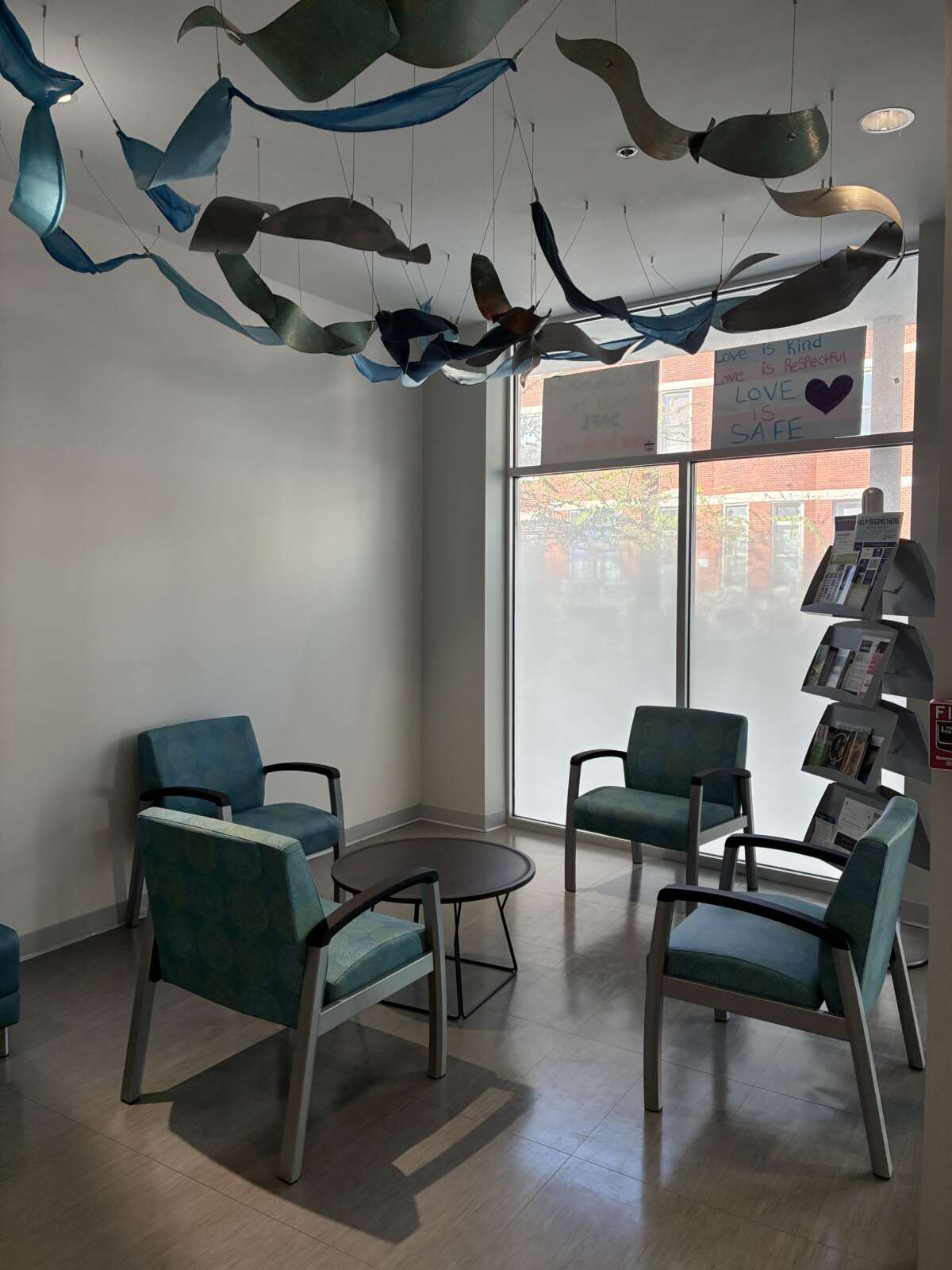
Compared to the victim hotline, Nitsch says that the approach is “mind-bogglingly the same”: avoid judgment, and focus on strategies for safety and the caller’s capacity to change. By building on the Gateway Project’s specific curriculum, Gateway to Change serves as a highly targeted and low-barrier resource for Baltimoreans.
Between April and December 2025, Gateway to Change has fielded 44 calls — without any advertising. Lashell Mack says caller frequency is difficult to estimate, but she typically fields a few calls from Gateway to Change per week, compared to up to 17 calls from the victim hotline in a single shift. Wait times for both lines are typically under a minute. This past fall, the hotline was awarded a grant from the Maryland Governor’s Office of Crime Prevention and Policy to fund a marketing campaign to raise awareness about the new resource.
Mack describes a collage of caller profiles who have contacted Gateway to Change — men who don’t want to hit their partner but feel like they’re being pushed to their emotional limit, couples that are trying to move forward after a physical altercation, and women who have just smacked a family member and don’t want to do it again. Hotline staffers may ask about the moment leading up to the abuse to identify thought patterns, beliefs, and emotions that contributed to their behavior. They may help the caller think through the perspective of the victim, or brainstorm strategies for how to interrupt a spiral or walk away in the future. And they refer callers to the voluntary drop-in group that meets on Thursdays at the Gateway Project’s community center.
This is an inexpensive resource at a time when funding cuts are devastating service providers.
This is an inexpensive resource at a time when funding cuts are devastating service providers. House of Ruth Maryland already had an anonymous hotline infrastructure and staffing. They paid a one-time cost to add a new hotline number, and invested in new training for staff. It’s a solution that could potentially be applied by other cities and states who also have existing hotlines, if they are willing to try something different and potentially controversial. House of Ruth Maryland even created a toolkit for other agencies to adopt or adapt their own hotlines.
Oliver has committed to not being in another relationship until he completes the AIP, which he feels has also allowed him to develop a better relationship with his daughters. “You don’t have to assert your dominance over anyone because you don’t know how to express yourself,” he says, encouraging other people using harm in their relationships to reach out for help. “That’s why I think Gateway is so important. I think the [hotline] will be even more important.”
When Oliver thinks back to the explosive moments leading up to his arrest, he says a resource like Gateway to Change would have been helpful. “I don’t really have a lot of people to talk to,” he says. “So to have a hotline to speak to someone that’s informative about domestic violence, or being able to talk someone off the ledge, I think it would prevent a lot of cases like mine.”
People at risk of doing harm can contact the free and anonymous Gateway to Change hotline in Baltimore at 667-240-8977. A Call for Change’s free and anonymous helpline operates 10am to 10pm ET, and can be reached at 877-898-3411 or at Help@ACallForChangeHelpline.org.
Editor’s note: This piece has been updated since publication.
A terrifying moment. We appeal for your support.
In the last weeks, we have witnessed an authoritarian assault on communities in Minnesota and across the nation.
The need for truthful, grassroots reporting is urgent at this cataclysmic historical moment. Yet, Trump-aligned billionaires and other allies have taken over many legacy media outlets — the culmination of a decades-long campaign to place control of the narrative into the hands of the political right.
We refuse to let Trump’s blatant propaganda machine go unchecked. Untethered to corporate ownership or advertisers, Truthout remains fearless in our reporting and our determination to use journalism as a tool for justice.
But we need your help just to fund our basic expenses. Over 80 percent of Truthout’s funding comes from small individual donations from our community of readers, and over a third of our total budget is supported by recurring monthly donors.
Truthout has launched a fundraiser to add 310 new monthly donors in the next 4 days. Whether you can make a small monthly donation or a larger one-time gift, Truthout only works with your support.