Truthout is a vital news source and a living history of political struggle. If you think our work is valuable, support us with a donation of any size.
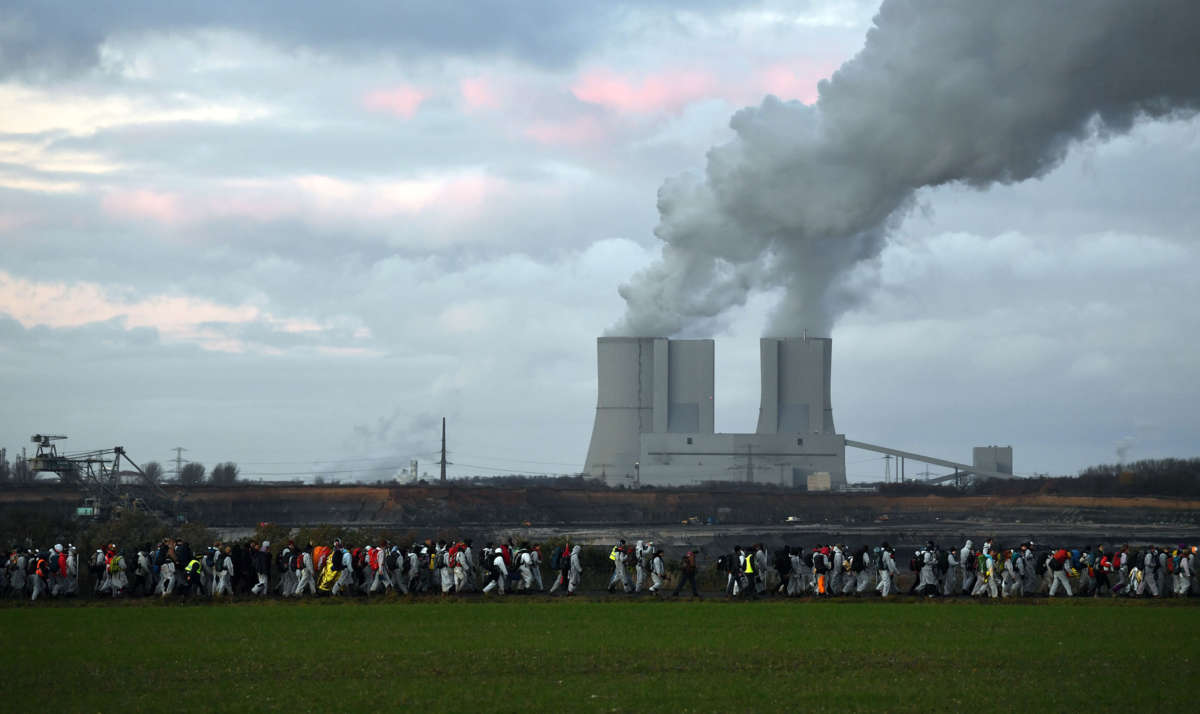
On the heels of Friday’s global youth-led climate strike, thousands of activists staged demonstrations at three coal mines in Germany Saturday to protest the government’s plan to phase out coal by 2038, which activists say isn’t soon enough.
The German news agency dpa reported that “protesters ran into the Jänschwalde and Welzow-Süd open-cast mining sites in the eastern state of Brandenburg, as well as the United Schleenhain lignite mining area in neighboring Saxony.”
Ende Gelände (End of the Road), which helped organize the protests, said there were about 4,000 demonstrators total, while some reporting put the number closer to 2,000.
“We’re at a critical moment—the window of opportunity to stop the climate crisis is closing rapidly,” Ende Gelände spokesman Johnny Parks told German broadcaster DW.
4000 activists left this morning to stop the climate crisis at its dirty crime scenes.
4000 activists have reached the blockades. United we stand, together we fight for climate justice! #EndeGelaende #AlleGegenKohle pic.twitter.com/54Bqu3fDq2
— Ende Gelände (@Ende__Gelaende) November 30, 2019
The power plant at Jänschwalde has been deemed one of the top polluting facilities in Europe in terms of planet-warming emissions. Parks said that “we want to show with our protest today that this mine needs to be shut down permanently.”
According to DW:
By early evening, about 500 protesters had left Jänschwalde, either on foot or transported in mining company vehicles.
However, another 500 activists remained on-site at Welzow-Süd, with police preventing them from occupying large equipment. Activists said they did not plan to spend the night there, however, with temperatures in the single digits.
In Saxony, police were escorting the approximately 1,200 protesters in stages, first taking their details before allowing them to leave.
The demonstrations drew a strong police presence at each of the mines and there were reports of some clashes between authorities and protesters. LEAG, the energy company that operates the mine in Welzow-Süd, said it “will use legal means against anyone who disregards the boundaries of our premises.”
Meanwhile, Fridays for Future Germany—a regional branch of the youth climate movement launched last year by Swedish teenager Greta Thunberg—expressed solidarity with the protesters at the coal mines, a move that was welcomed by Ende Gelände.
Danke für eure Solidarität! Unser gemeinsames Aktionswochenende ist ein voller Erfolg! 640.000 Menschen im Streik gestern, heute weitere Demos im Revier und tausende Menschen von #EndeGelaende in der Grube und auf der Schiene! #AlleGegenKohle https://t.co/ZLq5eokygz
— Ende Gelände (@Ende__Gelaende) November 30, 2019
Saturday’s actions came after tens of thousands of people poured into the streets across Germany on Friday for a global climate strike that aimed to pressure all governments attending the U.N.’s COP 25 summit in Madrid on Monday to pursue bolder policies to battle the climate emergency.
German youth climate leader Luisa Neubauer—along with Thunberg and Angela Valenzuela of Chile—wrote Friday for Project Syndicate that “the science is crying out for urgent action, and still our leaders dare to ignore it. So we continue to fight.”
Neubauer told The Local Germany that there has been massive “political failure” in terms of tackling the climate crisis.
Tens of thousands of people in Germany rally against climate change https://t.co/nu0Hq8nyw4
— The Local Germany (@TheLocalGermany) November 29, 2019
The Local Germany reported that climate strike events were held in more than 500 cities across the country Friday “as Germany’s upper house of parliament, the Bundesrat, voted to block part of the German government’s new climate package.”
“Members voted for the majority of measures to pass,” the report continued, “but urged a renegotiation of some parts related to taxes and subsidies.”
The vote and protests followed the publication Tuesday of the German government’s Climate Monitoring Report—which, as Environment Minister Svenja Schulze summarized, found that “the consequences of climate change are becoming increasingly apparent” in the country.
The United Nations Environment Program also released a major climate report on Tuesday. Warning that global temperatures are on track to rise as much as 3.2°C by the end of the century, the U.N.’s new Emissions Gap report called for “rapid and transformational” action to curb emissions and avert climate catastrophe.
Important Message: Please Read
For 25 years, Truthout has survived by publishing impactful investigative journalism and analysis; distributing full editions 365 days a year; and building a community of readers who support us with small, hard-earned donations.
Eighty percent of our $3 million yearly budget comes from small donors alone. Of those, 8,000 readers support us with monthly donations. Back in 2018, when Facebook decided to suppress the circulation of posts made by organizations, thereby cutting readers off from seeing many articles shared by the news organizations they had intentionally decided to follow, Truthout’s total traffic declined by 40 percent, as nearly all of our traffic from that platform disappeared.
Now, Google has recently rolled out its AI search bar, providing AI summaries instead of directing readers to our site. Google Search is our single largest source of traffic; it’s the route by which nearly one third of our readers find us. Much like in 2018, a shocking 40 percent of our Google traffic has disappeared overnight.
It will not be easy for Truthout to shoulder this blow. Nor will it be easy for our peers and collaborators — news sites that depend on traffic and aren’t bankrolled by large corporations.
If you can support Truthout with a donation today, you can help us resist the AI onslaught. Please give today.