Honest, paywall-free news is rare. Please support our boldly independent journalism with a donation of any size.
 (Image: The Source Project)Also see: A Forest of Fortune: Borneo, Indonesia
Also see: A Shifting Culture in Rural India
Also see: The Lives of Others: Mother’s Earth in Odisha, India
Also see: Adolfo and the Essence of Food Diversification
Also see: A Natural System and an Agricultural Philosophy
Also see: Not a Very Green Revolution
It was a friend of mine, Loren who runs ‘a growing culture’ in the US who told me about Chandran Master. I was sent a link from the Hindu about this old Keralan ex English teacher who had decided to collect indigenous Indian cows so that future generations could see what India once had.
He reminded me of Natabar Sarangi, the rice seed farmer from Odisha, both retired teachers who understood how much their lives and environments were changing, and wanted to do something about it. According to the article, breeding these indigenous cows is illegal unless you have a licence from the government. There seems to be a very conscious move, as with all other forms of agricultural biodiversity, to destroy much of what has always existed and replace it with inferior foreign imports.
It seemed like a good story, Chandran Master a good subject and the monsoon seemed to be a good time to shoot. Although it rained from morning tillnoon then all through the night, the light was just perfect. From morning to dusk the light was rich and diffused and stable to work in… between the downpours. Chandran Master was everything I had imagined, bumbling, emotional, intelligent and passionate.
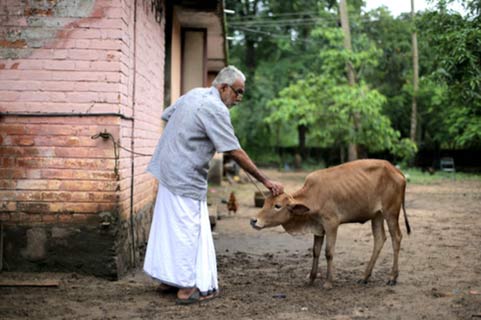
Dressed in his white Mundu, he would wonder aimlessly around his cow sheds and gardens mumbling about government policy and the importance of bio diversity while ripping off Papaya leaves to feed his fish or shout an order to his old school friend Thomas, who seems to do all the work around the farm.
 (Image: The Source Project)Chandran has been collecting cows for about 24 years. He began collecting because he was shocked at the rapid decline of local species within his area. The Vechur cow from Kerala is the smallest cow in the world and very much his favourite. At just 82cm (32″) high, this cow needs almost no attention or food; it just wonders around the fields and gardens happily munching its way through almost anything, then returns at night. Early the next morning it will give you a couple of litres of ‘medicinal milk’ for tea and breakfast.
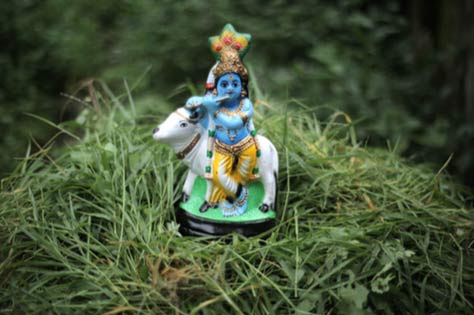
It is Chandran’s belief that what we are about to lose in India will have a profound effect on the future health and wealth of India. The very symbol of Indian cultural and spiritual life is disappearing in the space of just one generation while a system of monetary-motivated policies are actively discriminating against small farmers in India.
The problem, Chandran argues, is that if small farmers were supported by government, then their cows could produce more than enough milk, not only for Indian consumption but also for export. The yields are lower than they should be because the cows do not have access to enough food or water. The mighty Gir cow of Gujarat is the perfect example. This indigenous cow has produced record amounts of milk (up to 62 litres of milk a day) but this is not in India; this is in Brazil where this high yielding cow is now imported and treasured by local farmers. Across the whole of south America, the Gir cow is favoured over hybrid varieties because of their lactation period and ability to withstand most environments.
As with almost all agricultural policy throughout the world, it seems that life-changing decisions are being made based purely on profit. Once again, detached academics, policy makers and economists seem determined to destroy what has taken many thousands of years to develop. We have moved from a food system totally in tune with our life-giving environments to one based on systems that destroy and harm human health, our environment and our future of food sustainability.
This is the eighth film in the 9×9 film festival. These films have been made for one reason: to help people understand the reality of what’s really happening to the world’s food and farming systems, and why.
I really think that short documentaries need to be more character lead and ‘The Keralan Cowboy’ is a perfect example of this. This is far more than just a nice film about a nice man who is in love with nice cows. This is a film about the importance of biodiversity and questioning the economically driven government policy that will have a profound effect on our society and environment. Linked to this film is an article that was published in Tehlka magazine a few years ago, telling the story of misinformation and a decision making process developed by a people totally detached from the real issues being faced by society and agriculture. A shocking report on the incompetence by government policy makers and an industry driven by control and profit.
The Keralan cowboy from the source project on Vimeo.
The Source Project was set up to work in a more holistic way within the development media as business interests transform the development sector into a business driven model. By changing the way we live and operate, we are able to use our limited funds to help subsidize films that we feel need to be made. We have created a short film format that can be easily watched and shared on various social media platforms. We feel that this way we are able to not only help counter an imbalance and misinformation within development media, but also stimulate consciousness on issues that otherwise would pass unnoticed. At the heart of The Source Project is agriculture, a system not only of food production, but also one that maintains our ecosystem, our cultures, our health and the very survival of humanity.
25 Years of Truthout: An important fundraising appeal
This September, Truthout is celebrating 25 years of publication. For over two decades, we have been a trusted source for fiercely independent journalism thanks to readers like you.
As we look to the next 25 years, we have launched a special fundraising campaign. At this moment, we have a goal to raise $27,000 in the next 24 hours.
We are asking for your support at this juncture because we face greater threats than ever before in our organizational history. Trump and his MAGA allies are determined to control the information ecosystem, and movement-based organizations are subject to dangerous censorship and scrutiny.
If you can support Truthout with a one-time or monthly donation, you will make a significant impact on our work and our legacy. Anything you can do makes a difference!