Did you know that Truthout is a nonprofit and independently funded by readers like you? If you value what we do, please support our work with a donation.
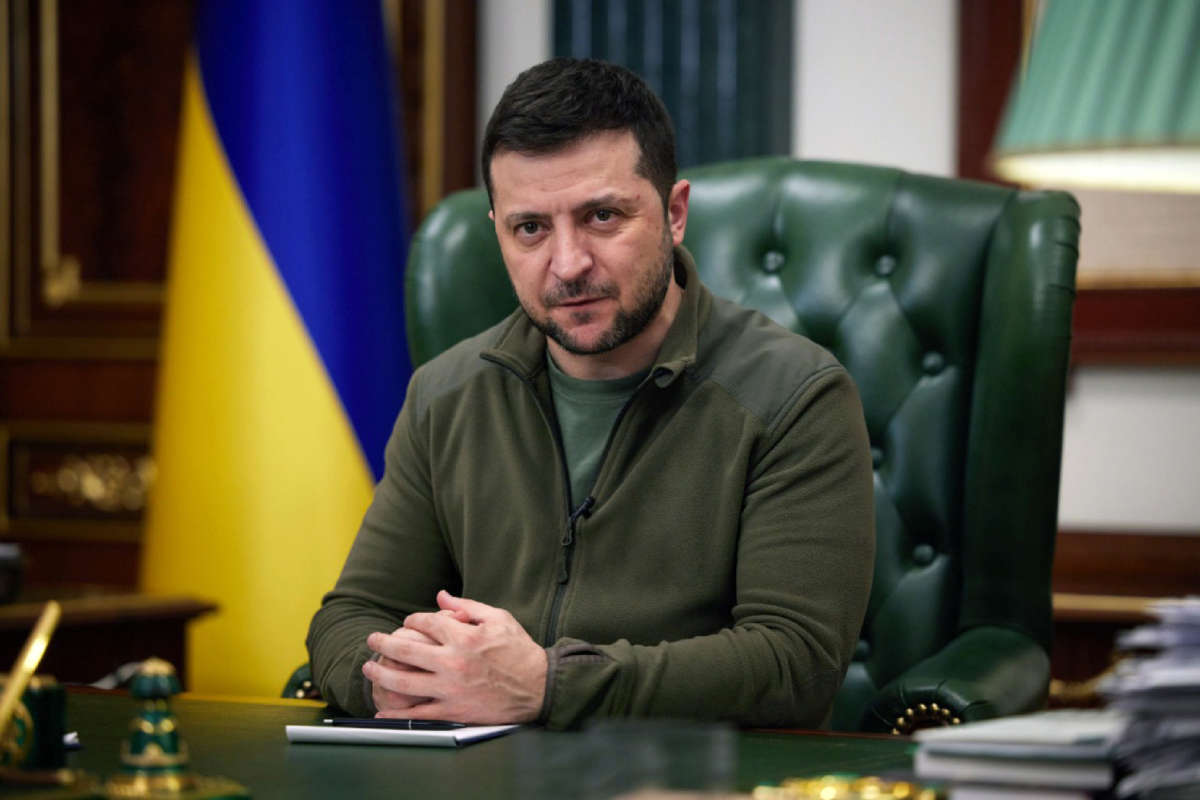
Ukrainian President Volodymyr Zelenskyy said ahead of the latest round of in-person talks between Kyiv and Moscow on Monday that his country is prepared to declare neutrality from NATO, a move that would fulfill one of Russia’s long-standing demands.
“Security guarantees and neutrality, non-nuclear status of our state. We are ready to go for it,” Zelenskyy said in a video call with several Russian reporters ahead of a fresh round of negotiations between Russian and Ukrainian diplomats in Turkey. The four Russian journalists involved in the call were reportedly ordered not to publish the Ukrainian president’s remarks.
Zelenskyy stressed, however, that a final peace agreement can’t be reached without a ceasefire and withdrawal of Russian troops, whose assault on major Ukrainian cities has entered its second month, worsening a massive humanitarian catastrophe that has reverberated worldwide.
“We are looking for peace, really, without delay,” Zelenskyy said in his nightly address to the Ukrainian public, reiterating that any negotiated deal will be put to the country’s people for a referendum. “There is an opportunity and a need for a face-to-face meeting in Turkey.”
“Our priorities in the negotiations are known,” he continued. “Ukraine’s sovereignty and territorial integrity are beyond doubt. Effective security guarantees for our state are mandatory. Our goal is obvious — peace and the restoration of normal life in our native state as soon as possible.”
In recent weeks, Ukrainian and Russian delegations have reportedly made progress toward a 15-point peace plan that would include Kyiv renouncing its ambitions of NATO membership in exchange for security assurances, but it’s unclear how far apart the two sides are heading into the new round of talks.
Over the weekend, despite some indications that Moscow may be narrowing its military ambitions in Ukraine, Russian forces “stepped up [their] missile attacks on fuel and food depots, hitting Lviv, close to the Polish border, as well as Lutsk, Zhytomyr, and Rivne in the west and Kharkiv in the east,” according to the Financial Times.
“Around 30 separate strikes were reported on the Kyiv region over the past day,” FT noted.
On Sunday, hours before diplomatic talks were slated to begin in Istanbul, Turkish President Tayyip Erdogan urged Russian President Vladimir Putin in a phone call to pursue “a ceasefire between Russia and Ukraine, the implementation of peace, and the improvement of humanitarian conditions in the region.”
Important Message: Please Read
For 25 years, Truthout has survived by publishing impactful investigative journalism and analysis; distributing full editions 365 days a year; and building a community of readers who support us with small, hard-earned donations.
Eighty percent of our $3 million yearly budget comes from small donors alone. Of those, 8,000 readers support us with monthly donations. Back in 2018, when Facebook decided to suppress the circulation of posts made by organizations, thereby cutting readers off from seeing many articles shared by the news organizations they had intentionally decided to follow, Truthout’s total traffic declined by 40 percent, as nearly all of our traffic from that platform disappeared.
Now, Google has recently rolled out its AI search bar, providing AI summaries instead of directing readers to our site. Google Search is our single largest source of traffic; it’s the route by which nearly one third of our readers find us. Much like in 2018, a shocking 40 percent of our Google traffic has disappeared overnight.
It will not be easy for Truthout to shoulder this blow. Nor will it be easy for our peers and collaborators — news sites that depend on traffic and aren’t bankrolled by large corporations.
If you can support Truthout with a donation today, you can help us resist the AI onslaught. Please give today.