Did you know that Truthout is a nonprofit and independently funded by readers like you? If you value what we do, please support our work with a donation.
Tuesday night marked another significant battle in the clash between establishment Democrats and insurgent progressives that has come to define the 2026 primary season. After hard-fought battles in Michigan, Missouri, and elsewhere, progressive candidates defied expectations and reams of outside spending to emerge victorious in most of the closely watched races.
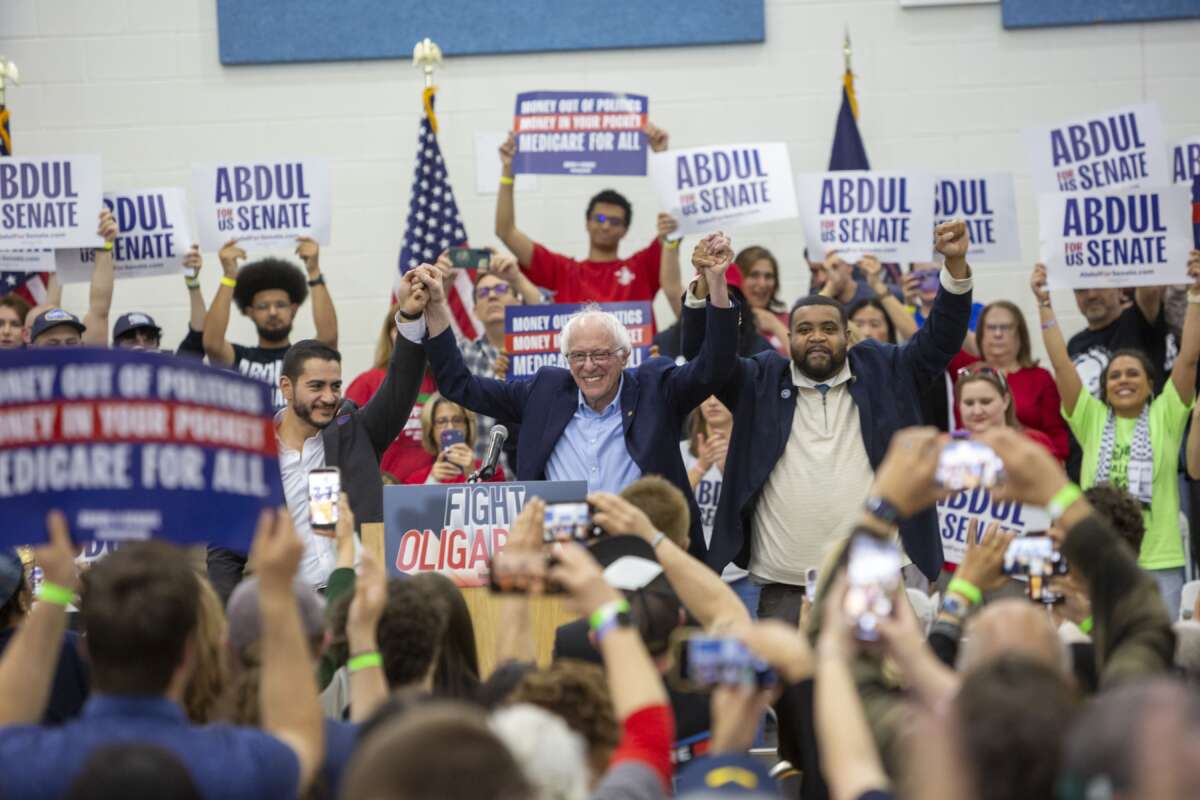
In Michigan, insurgent candidate Abdul El-Sayed defeated Democratic establishment favorite, Rep. Haley Stevens. El-Sayed led by about 14,000 votes on Wednesday morning, edging Stevens in the marquee race.
El-Sayed’s victory is the culmination of a remarkable primary campaign that began with him as an outsider candidate who was lagging in the polls in the beginning of the year. Stevens, meanwhile, was the clear establishment pick from the beginning of the race. She held endorsements from Senate Minority Leader Chuck Schumer, outgoing Michigan Sen. Gary Peters, and Michigan Gov. Gretchen Whitmer to lend an air of inevitability to her campaign. Ultimately, though, neither the full-throated backing of the political establishment nor tens of millions of dollars could get Stevens’s candidacy across the finish line.
El-Sayed is now set up for a bruising general election against Republican Mike Rogers, who was narrowly defeated in Michigan’s 2024 senatorial race by Elissa Slotkin. A victory in the general election would make El-Sayed the first Muslim to serve in the U.S. Senate.
In the months leading up to the primary, Stevens benefited from record-breaking spending by the American Israel Public Affairs Committee (AIPAC) and its affiliates. AIPAC’s super PAC, United Democracy Project, dumped more than $30 million into this Senate primary alone. This marked AIPAC’s single biggest spend on an individual race since it became active in primaries near the beginning of this decade. Together, outside groups spent more than $60 million to back Stevens, a 9-to-1 spending advantage over El-Sayed. In dark money-funded ads that ran across the state, Stevens was celebrated for her purported close connection to former President Barack Obama and her pro-manufacturing policies, with no mention of Stevens’s stalwart support of Israel. Other ads alleged, without evidence, that El-Sayed was disrespectful toward women, and painted him as an opponent of the Obamas, and suggested that El-Sayed had helped Donald Trump win in 2024. Stevens’s surrogates on the campaign trail repeated these talking points, bombarding Michigan voters with a false image of El-Sayed as a misogynist and secret right-winger.
The spending, though, became an issue of its own during the race. El-Sayed and his campaign surrogates repeatedly brought up corporate spending, as well as regularly pointing out AIPAC by name, making an effective boogeyman of an organization that, until recent cycles, was rarely directly mentioned by candidates running for office. Stevens’s loss is a major rebuke to AIPAC’s involvement in primary races, and a testament to the erosion of the influence of outside money in general among Democratic primary voters.
Stevens’s loss is a major rebuke to AIPAC’s involvement in primary races, and a testament to the erosion of the influence of outside money in general among Democratic primary voters.
This pattern repeated in House races across the state, too. In Michigan’s 13th congressional district, insurgent Donavan McKinney secured the Democratic nomination against incumbent Shri Thanedar in a safe blue district. Thanedar, a multimillionaire who has bankrolled his own campaigns, was once an adversary of AIPAC and won his seat in the House in 2022 amidst an avalanche of opposition spending from the organization. Once he got to Congress, though, Thanedar substantially moderated his position on U.S. support for Israel and enjoyed millions of dollars in support from AIPAC and its backers in 2024, and again this year.
McKinney, on the other hand, made no secret of his enmity toward Israel’s conduct in Gaza, calling it a “genocide” on his campaign website. That tack, plus his emphasis on affordability and getting big money out of politics, was apparently more than enough for voters to opt for the newcomer over Thanedar. With Rep. Rashida Tlaib’s easy victory in her primary on Tuesday, the entire city of Detroit will now be represented by democratic socialists in Congress, the first major U.S. city where that is the case.
Even in mid-Michigan — outside of the dense, urban areas that have generally been prime targets for progressive insurgents — left-leaning candidate William Lawrence handily topped the field in the race for the Democratic nomination in Michigan’s 7th district. Lawrence, a co-founder of the environmental group the Sunrise Movement, was bludgeoned by a flurry of last-minute outside spending against his candidacy. While he faced candidates with backgrounds that hewed more closely to traditional resumes for public office, his two opponents likely split the moderate vote in the field, allowing Lawrence to win the election with around 44 percent of the vote. His opponents — Bridget Brink, a diplomat and former ambassador to Ukraine under Joe Biden, and Matt Maasdam, a retired Navy SEAL endorsed by Sen. Elissa Slotkin — both collected just under 30 percent of the vote, allowing Lawrence to eke out a win with a simple plurality of the total.
The entire city of Detroit will now be represented by democratic socialists in Congress, the first major U.S. city where that is the case.
Lawrence will now go on to represent the Democratic Party in a swing district general election that the party has eyed as one of its biggest pickup opportunities as it seeks to reclaim the House of Representatives. In a typical cycle, Lawrence would receive some of the highest-profile support from the Democratic Party in an attempt to flip a red seat widely considered a toss-up. Whether his progressive bent will complicate the party’s support for his run is still an open question.
The progressive swing did not sweep across every primary state on Tuesday, though. Missouri’s 1st district saw one of the most dramatic showdowns of the entire primary season, with former Rep. Cori Bush challenging current Rep. Wesley Bell to take back the seat that he won from her in 2024. That year, Bush was a prime target of AIPAC spending, with the group devoting more than $7 million to helping Bell defeat her. Since then, Bell has been a reliable ally to Israel in Congress, and was among the minority group of Democrats who recently voted against slashing aid to Israel.
Once again, AIPAC devoted substantial resources to defending Bell’s seat, spending at least $2 million in campaign ads supporting Bell. In the end, he walked to an easy victory over Bush, with the race called shortly after polls closed. Bush — who was one of the most stalwart progressives in Congress during her tenure — will now spend at least another term in exile, as AIPAC holds on to one of its hardest-won seats.
The mixed results on Tuesday night ensure that the internecine battle between the Democratic Party’s establishment and progressive flanks will continue through the rest of the primary season. August 11 will mark the next opportunity to gauge enthusiasm for each flank among the primary electorate: Democratic socialist Francesca Hong will face off against a field of more establishment-friendly picks in the primary for Wisconsin governor. Hong has established a clear lead in the polls over the last few weeks, and some Democratic Party functionaries are already voicing their anxieties about her ability to win the November general election in a purple state.
Whatever happens in the remaining primary races, a reckoning is coming for the Democratic Party this November. While progressive activists in the party have long been encouraged to form a united front with establishment-friendly Democrats to vote blue when the general election rolls around, the roles have rarely been reversed. Now, though, moderate Democrats will have to decide whether they will stand behind candidates whose positions they have vociferously denounced during the primary cycle. El-Sayed has already begun to draw critical support from the Democratic Senatorial Campaign Committee, whose statement included a tacit endorsement by Schumer. It is an encouraging sign for a party that has sometimes let its internal divisions fester long beyond the end of an election.
But El-Sayed will need the full backing of the Democratic Party apparatus to win a statewide election in November. The Democratic Party and its constellation of donors, fundraisers, and surrogates will have to decide whether to back candidates like El-Sayed, McKinney, and Lawrence, even if they are sometimes out of step with party orthodoxy. The 2026 midterms will mark the best opportunity for Democrats to curb Trump’s increasingly erratic and destructive behavior. Whether they capitalize on that opportunity remains to be seen.
We lost 15 percent of our traffic overnight.
We now have three full months of data since Google changed its search to feature AI results. The numbers are worse than we anticipated. Overall readership that comes to Truthout through Google is down 54 percent against last year. The number of new readers who discover Truthout via Google searches is down 49 percent, and returning users from Google are down 51 percent.
We lost 15 percent of our readership overnight. This was a readership we painstakingly built over decades, and it vanished because Google chose corporate greed over a healthy democracy.
We anticipate a loss of roughly $500,000 in online revenue as a result of this massive traffic plunge in the next year alone.
The only way we can keep publishing is with strong reader support. We are asking you to start a monthly donation to Truthout today — anything you can do, whether $5 or $25, makes a difference.