Support justice-driven, accurate and transparent news — make a quick donation to Truthout today!
In the United States, calls for better social services, public programs, and other state-led interventions are reliably met with cries of impracticality. Ideas from the left are regularly derided in hyperbolic terms; some classics include the charge that the left wishes to give away the equivalent of “free ponies” (that one comes via Hillary Clinton), or are otherwise pie-in-the-sky utopians living in a “magical fantasy land,” promising “unicorns” and the like. But those who shout down even the barest suggestion of mobilizing public assistance to confront the U.S.’s many sprawling social crises betray their ignorance of, or their dogmatic ideological opposition to, the wealth of flourishing social programs that are in place worldwide.
Vienna has long been among the many international examples that provide valuable lessons for systematic social betterment — particularly for the housing crisis, which has become catastrophic in the U.S. Conversely, in the Austrian capital, a thriving, popular state-led social housing model leads the globe in providing high-quality affordable developments (known locally as the Gemeindebau) to a large segment of the population. With a pragmatic yet forward-thinking design, particularly in green energy future-proofing, the Vienna model offers a knowledge base, born of decades of experience, that in a just world would be tapped to help enact comparable proposals in the United States — like the currently stagnant hopes of a Green New Deal for Housing.
Good First Impressions
The Climate and Community Institute (CCI), a progressive think tank with a focus on economics and climate, released a comprehensive report this summer that documents the history, sociopolitical context, and notable achievements of the Vienna model. Hundreds of thousands of people in Vienna are comfortably housed by state-owned buildings, to which 5,000 new affordable units are added per year.
Daniel Aldana Cohen is a researcher, writer, sociology professor and the CCI’s co-founder and director of housing. “Vienna is the social housing capital of the world,” said Cohen in an interview withTruthout. “It’s the big major Western city with the most social housing … It’s very frequently ranked the world’s most livable city. So, it’s not just the social housing — they’re clearly doing something right.”
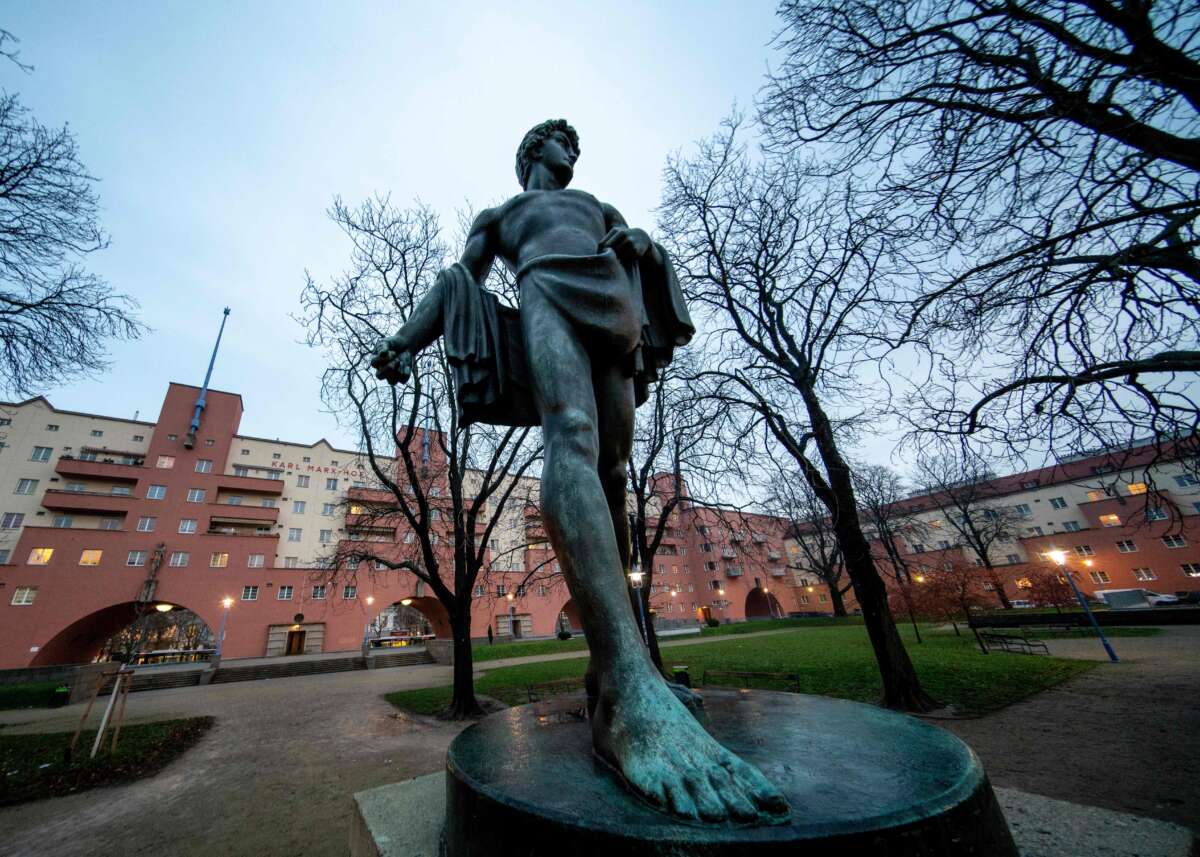
Cohen witnessed the model’s accomplishments firsthand on a delegation trip to Vienna; this experience provided the initial impetus for the CCI report. The city’s leadership on housing is the legacy of Red Vienna, a period of leftist governance lasting from 1919 to 1934, which laid the groundwork by building 64,000 units of municipally owned housing, funded by progressive taxes on property and on luxury goods. These efforts helped resolve a disastrous turn-of-the-century tenement and slum crisis and produced, among other legacies, the iconic Karl-Marx-Hof.
The statistics certainly bear out claims of the model’s longstanding success: as the CCI report notes, Vienna has the lowest rent of any major city in Western Europe; per square meter, it is roughly three times cheaper than London, and its income distribution is far more equitable than New York City’s. Social housing has benefits that redound to many further realms of society. It is a state and community platform on which a civil service, public goods, sustainability and better lives have been built for a century.
Working Households
Vienna’s social housing is divided into two primary types: a large supply of both municipally owned housing units and what the CCI researchers call “limited-profit” housing. The former is entirely state-owned and run; the latter, as the report describes it, is “publicly subsidized, privately developed, and heavily regulated.”
Each type accounts for 21 percent of Vienna’s total housing stock, which consists of roughly 40 percent social housing, with the remainder being privately owned rentals and owner occupied units. Both varieties of social housing are affordable and sought-after. Unlike the developments pejoratively referred to as “projects” in the U.S., Vienna’s limited-profit housing is attractive to people across the financial spectrum. The report notes that, though limited-profit rents are higher than that of the municipal-owned units, “on average, new limited-profit social housing rents are 27 percent lower than private rentals.”
The key to the success of the system is the interdependence of its two main components. For the social housing model to function — and function “as a pro-worker model, not just as subsidized units for the middle class,” Cohen stipulated — municipal housing must serve as a frontline solution to accommodate the tenants in the greatest need. “Most people from migrant backgrounds who live in social housing (and not enough of them do, but of those that do) live in municipal housing,” he added. Applications for municipally owned housing are simpler, and again, the rent is lower. It’s there that immigrants and the working class tend to secure shelter.
Cohen emphasized that to provide the best social outcome and house all segments of society, the dual systems are crucial. “We don’t actually want to just take the limited-profit model. We also need to have some version, in the U.S., like public housing, that assures a very substantial production for people who need that housing the most.”
But an entrenched pattern and legal structure has for decades sent the U.S. spiraling in the opposite direction, towards diminution and decay of the public housing stock. The Faircloth Amendment has capped the total number of public housing units since 1998 and has prevented the office of Housing and Urban Development (HUD) and local Public Housing Authorities (PHA) from building any increase over the number of units that existed on October 1, 1999. Faircloth was effectively a giveaway to the real estate industry, which enjoys the benefits of severely constrained competition along with an open rental market share — a segment that disproportionately contains people of color, the poor, the elderly, disabled people, and the otherwise vulnerable — from which the industry can draw profit.
And the profits are enormous: Research published in the American Journal of Sociology in 2019 found that the owners that operate low-quality housing in impoverished areas — in a word, slumlords — often charge more, “relative to the market value of a property” than those operating units for people with higher incomes. Contrary to the prevailing vision of slums as a social byproduct of urban dysfunction, they persist, in effect, by design: the slum is a “prime moneymaker,” the researchers wrote, exploited by “those who saw in land scarcity, housing dilapidation, and racial segregation the opportunity to maximize their rate of return.”
Rent in poor neighborhoods has become endemically unaffordable across the country as a result. Meanwhile, the supply of public housing has fallen far behind the times. The intertwined crises of rent, homelessness and poverty are in many ways traceable back to the adoption of the Faircloth Amendment, alongside decades of federal disinvestment and the real estate industry’s profitable predation.
Historically, “federal public housing has not been mixed-income. But that could be introduced,” said Cohen. Indeed, building appealing units that house a wider income range of Americans would create constituent buy-in and help diminish the widespread stigmatizing impression of public housing as a place that wealthier (and whiter) people would want to avoid. The means-tested model — together with decades of market fundamentalist, neoliberal smears against public goods — has created this stereotype, bound up in all manner of confusion and myths about welfare, state programs, and race. Inevitably, income limitations hamper social programs and open them to attack. Universally open programs, conversely, remove the need for burdensome income-filtering bureaucracy and enjoy broader legitimacy: built into their very structure is the acknowledgment that the benefits are shared by all. And by eliminating the bureaucracy, universal programs often actually cost less.
Any application of Vienna-style solutions to the United States context — i.e., instituting mass social housing available to people of all incomes — will demand both the embrace of the limited-profit housing model and major investments in new and existing municipally owned housing. “What we would like to see [in the U.S.] is an expansion of that fully public stock,” said Cohen. “Because it’s publicly owned, you have much more control and [can fund] really well-regulated projects built, ideally, by non-profits or cooperatives. That’d be more flexible … what we’re looking for in the U.S. is a balanced-portfolio approach.”
Cohen himself was involved in the initial planning of Alexandria Ocasio-Cortez’s Green New Deal for Public Housing Act, which would revamp, repair, and extend the nation’s decaying public housing stock, construct new units and implement emissions reduction technologies, creating jobs in the process. As he added, “Even at the bare minimum, we need to repair, retrofit, upgrade, and basically save the almost two million units of public housing that are available in the U.S. right now.”
If the U.S. were to build more state-owned public housing as well as adopt the limited-profit model, this would meet the needs of a large segment of the working class, potentially from the lowest up to higher-middle incomes. With adequate regulatory policy like rent control in place, the devastating crises of housing and homelessness could finally be confronted. (It is worth reiterating here that an enormous number of the unhoused people in the U.S. are among the “invisible homeless,” crashing on couches or in vehicles, holding jobs but simply unable to meet their needs thanks to crushingly low wages and impossible housing expenses.)
Some rough analogues of the limited-profit model do already exist in the U.S. — but Cohen says they remain inferior to Vienna’s approach for a number of reasons. Tax credits and grants for affordable development are patchwork, “[while] Section 8 gives tenants vouchers, which they bring to landlords, so the government is subsidizing the rent.” A better approach could be to “tie the voucher to the building, instead of the tenant, and then you can finance really good buildings.” Doing so would require regulatory overhaul — but, as Cohen put it, “we’re not talking about bringing an alien language to planet Earth.”
In the Vienna model, developers of limited-profit units are paid for their work, but those developers are not accumulating any excess profits, Cohen explained. “The quote-unquote ‘profit,’ which is the revenue in excess of expenditure, has to be recycled back into housing upgrades.” (The “limited-profit” concept is fairly comparable to the U.S. “non-profit” model; the report authors gave it a distinct name to reflect its distinct context.)
In Vienna, many developers maintain dual wings of operation: one for profit in private housing, with another dedicated to limited-profit projects. Though such work might lack exorbitant returns on speculative investment, it’s not as if developers are working for free — the company is still paid by the state, and its workers draw paychecks. Limited-profit work still provides opportunities for income and can be used as paid employee training. In other words, there are still meaningful incentives to build units under this model. It’s just not driven by the incentive of massively enriching investors, like many developments in the U.S.
The Innovation Confusion
Vienna’s housing triumph is a testament to the power of state planning to produce meaningful, positive social outcomes that catalyze positive feedback cycles of quality-of-life improvement and generate better living environments for everyone in the city. It’s also a potent counterexample to the deeply inculcated U.S. narrative that insists innovation can only happen in conditions of deregulation and state retreat.
As Cohen summarized: “The way that I think about it, as an outsider to Vienna, is that in the U.S., almost all housing is a high-risk, high-reward business. In Vienna’s social housing system, you have a lot of companies, and their workers get paid, and it is very often just a stable, low-risk, low-financial reward business.”
In fact, Vienna disproves other received wisdom about market forces. “You would think,” he said, “that if so much of the Viennese housing sector [is] lower-income, and no one’s making a killing in social housing, that it’d be staid and ‘boring.’”
“But you can see from the photos — it’s spectacular! I think one of the interesting lessons from Vienna is that it deconstructs this myth in the U.S. that innovation and deregulation go hand in hand. The idea that creativity and technological ingenuity rely on an unregulated Wild West market is just not true.”
“What you have [in Vienna] is highly regulated developer competitions,” Cohen continued, “with public agencies doing everything from the heat pumps to the sewer system … You are basically getting technological marvels out of a state-supervised, heavily planned system.” Indeed, one of the latest green innovations is the creative repurposing of Viennese buildings’ gas heat lines for air conditioning by filling the lines with cold water in the summer. The report approvingly cites these and myriad other green solutions.
Such victories put the lie to the ostensibly common-sense notion that innovation is predicated on deregulation and anarcho-capitalism. “You don’t need to have that Silicon-Valley level of ‘everything goes’ in order to get ingenuity,” Cohen said. “In fact, it’s more the opposite. The public sector setting the boundaries, setting the framework, saying: I’m going to give you the cost you can bid me at, but now you’re going to compete with each other on quality — that’s when you’re going to get innovation and quality.”
Commentators in the U.S. are always keen to tout the motivating benefits of competition. Vienna’s example provides a more nuanced approach. Of course, it is true that competition can spur progress. But to whom the benefits of that progress return is determined by existing relations of power. It’s in the interest of free-market ideologues to conflate those two questions. The Vienna housing market, though, makes the difference clear. Enlisting the incentives of competition on metrics of quality, rather than pathological cost-cutting, is producing stunning results.
Vienna, of course, is not a utopia, and Cohen and his fellow report authors are clear-eyed about its failings. As the report text notes, “We must also confront the model’s weaknesses. Discrimination against immigrants, and people descended from immigrants, is widespread in Vienna, and even more so in Austria generally. The city’s efforts to tackle this racism, overall and in its social housing system, have had mixed results. People living in Vienna can now move into social housing after residing in the city for two years, but the social housing system has not, on the whole, welcomed residents with migrant backgrounds at rates comparable to their population share.”
To better meet the needs of immigrants, Vienna still needs to increase the supply of the very low-cost apartments. The bureaucratic barriers to obtaining a unit remain too high for the decentralized, limited-profit model. “It’s got to be easier to access the service, and the service has to be more affordable,” said Cohen. “From a U.S. point of view, [to adopt such a model here,] you [would] have to build that in.” (And concerningly, in keeping with the worldwide lurch towards reactionary revanchism, some of Austria’s left-liberals are devolving towards a populist anti-migrant stance in coalition with the right — an inhumane and reactionary position that seeks to undermine social welfare by limiting it to what the right labels “real” Austrians.)
Better Visions of Home
In the U.S., adopting some version of the Vienna model would certainly come with vast challenges. However, the most severe obstacles are not physical. Building structures and housing more people is well within our capabilities. Reforms and regulations that can help mitigate inequality and discrimination are just as conceivable. The primary challenge is the extreme opposition that programs of this sort would face in the U.S., especially in the current climate. The failure of President Joe Biden’s “Build Back Better” program foreclosed the possibility of billions in housing relief. And Ocasio-Cortez’s and Bernie Sanders’s Green New Deal for Housing Act, while it was reintroduced last year, shows no signs of advancing at our current disastrous political juncture.
Nevertheless, seeking real resolution of the housing crisis could be a winning political platform, says Cohen. Indeed, public opinion, as Data for Progress research has found, is firmly in favor of policy intervention. It’s perhaps most viable to pursue a state level approach, though again, malicious opposition from the federal administration represents a severe obstacle.
Still, “If we could build housing, that would create a political constituency that would be a winner,” said Cohen. “There are all these little reforms [possible] here and there, but the main thing is that [Vienna] just kept the policy commitment: housing is a human right, we’re going to keep building it.”
Cohen’s words present a compelling vision of a world in which our human rights crises are confronted, rather than exacerbated in the interests of profit. Robust public housing programs (including appealing and innovative new developments based on promising ideas like shared land trusts) can and do exist in the U.S. But it takes a great deal of community and institutional backing and expertise to realize and sustain them. Vienna possesses a century of momentum to readily facilitate beautiful developments by the dozens. The U.S. failure to strengthen and expand public housing is owed not to some innate flaw in the concept, but rather to decades of racist stigma, state abdication, and sabotage by private real estate interests.
Social housing can be a vehicle for justice on numerous fronts, helping to mitigate racism and discrimination, homelessness, mental health crises and inequality writ large. Such meta-issues can form powerful coalitions across divides. Moreover, it is an urgent moral necessity as the crisis of homelessness enters catastrophic proportions with hundreds of thousands of Americans abandoned on the streets on any given night — an unfathomable toll of suffering. In this demoralized and fearful time, the public is in need of ways to join collectively to combat our most grievous social problems. We can do so only by fighting not just for ourselves, but for all those around us. Cohen memorably frames it this way: “Social housing is solidarity you can touch.”
Yet active, New-Deal-style programs to address poverty and suffering — together with increased unity among the working class — are things the reactionary right will fight tooth and nail to undermine. This is as true in Austria as it is anywhere else; Vienna’s social housing, for all its success, is “constantly pilloried in the right-wing press… It gets accused of being housing for poor people and migrants,” Cohen said.
“And I say, great — let’s build more.”
Trump is silencing political dissent. We appeal for your support.
Progressive nonprofits are the latest target caught in Trump’s crosshairs. With the aim of eliminating political opposition, Trump and his sycophants are working to curb government funding, constrain private foundations, and even cut tax-exempt status from organizations he dislikes.
We’re concerned, because Truthout is not immune to such bad-faith attacks.
We can only resist Trump’s attacks by cultivating a strong base of support. The right-wing mediasphere is funded comfortably by billionaire owners and venture capitalist philanthropists. At Truthout, we have you.
We’re in the midst of a fundraiser, and as of right now, we have until midnight to raise $13,000. Please take a meaningful action in the fight against authoritarianism: make a one-time or monthly donation to Truthout. If you have the means, please dig deep.