Truthout is an indispensable resource for activists, movement leaders and workers everywhere. Please make this work possible with a quick donation.
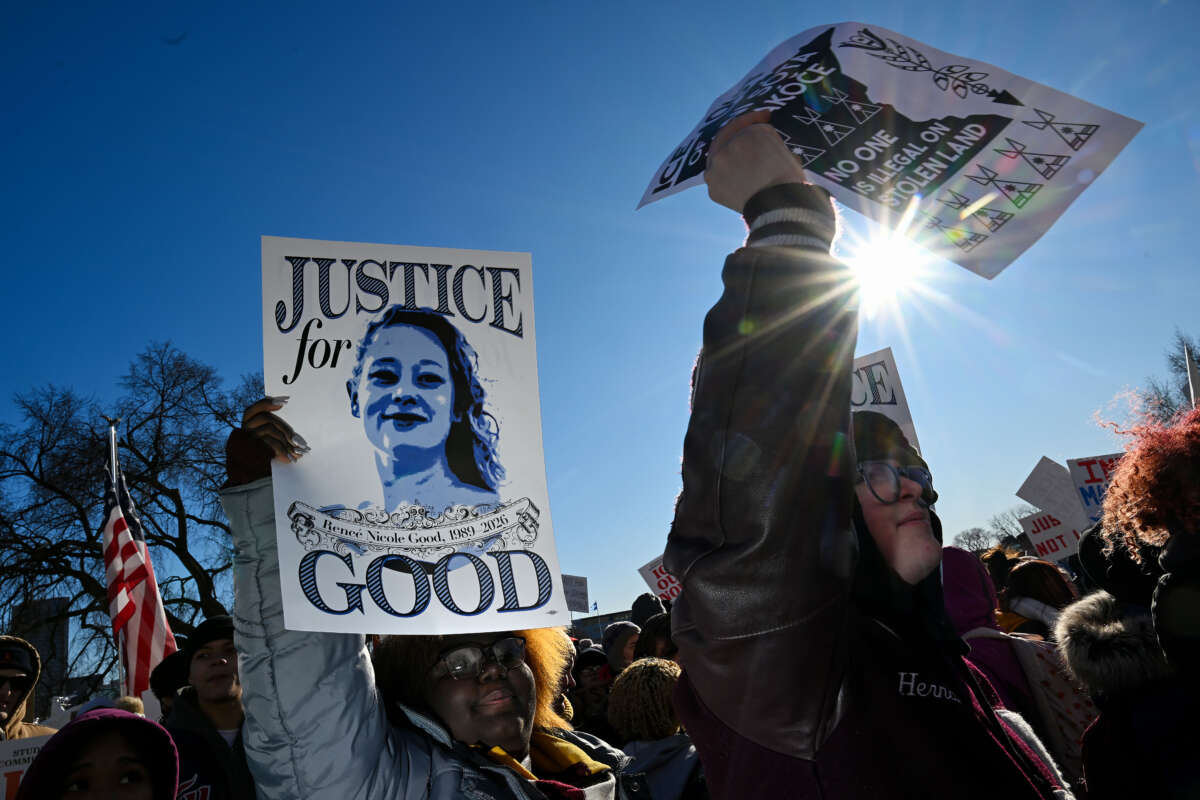
Renee Nicole Good’s tragic murder in Minneapolis at the hands of an Immigration and Customs Enforcement (ICE) agent has become a turning point in the criminalization of community-based resistance to the Trump administration’s campaign of neo-fascist state repression.
Vice President JD Vance has gone so far as to lionize Good’s alleged killer, and Homeland Security Secretary Kristi Noem has scrambled to demonize Good, accusing her of having engaged in an act of “domestic terror” because of her support for her immigrant neighbors who were being targeted by ICE.
In reality, the murder of Good should best be understood as a public extrajudicial execution — an action that is deemed a crime against humanity under international law.
From this perspective, it is the administration’s policies and practices (which constitute a pattern of state terror) that culminated in Good’s murder. This is further compounded by efforts to criminalize the peaceful activities of Good, her wife, and others like them who take principled stands in solidarity against such abuses.
The Minnesota-based organization Community United Against Police Brutality recently told Reuters that Good was one of hundreds of community members who had volunteered to take part in a network of “neighborhood patrols” involved in tracking, monitoring, and documenting the deployment of ICE agents in Minneapolis.
City council members have similarly asserted that she was murdered in cold blood while “out caring for her neighbors.” And local and state public officials have confirmed and paid tribute to Good’s personal, faith-based commitment to acting in solidarity with her neighbors, including the city’s besieged Somali, Latino, Haitian, and other migrant communities.
This has recently been affirmed too by the Presbyterian Office of Public Witness in a statement issued in Good’s memory:
As Presbyterians, we hold a twofold connection to Renee Good. First, we are bound by our shared faith in a God of justice, who calls us to engage the powers of this world and to counter hate with love. Our tradition compels us to oppose injustice with a prophetic word from the Lord and to participate in the transformation of the world God loves.
Our second connection is more personal: Ms. Good was one of us. She was a fellow Presbyterian. Edgewater Presbyterian Church in Illinois remembered her with these words: “Renee Nicole Good lived out the conviction that every person deserves kindness, regardless of their background. … Her story is a testament to the power of the Presbyterian mission and a challenge to our conscience. We mourn a fellow Presbyterian whose quiet smile and creative spirit touched lives from Colorado to Northern Ireland to Minnesota.”
The federal government’s response to Good’s killing — its decision to frame someone who opposed ICE’s brutal mandate as a “terrorist” — underscores the crucial role that community-based organizing plays in pushing back against the Trump administration. This kind of organizing from below is more urgent than ever as we work to protect the rights of migrants who have been targeted, and more generally resist the intensifying national onslaught on fundamental rights and dissent.
The Increasing Role of Community Observers
Since ICE escalated what has amounted to an armed occupation of multiple cities across the U.S., thousands of ordinary people, including hundreds in Minneapolis, have been trained at churches,temples, mosques, and community centers to observe and document ICE’s actions, in an attempt to protect neighbors from abduction.
I am personally involved in this work too, organizing through the network known as Witness at the Border. Since 2019, we have trained, accompanied, and supported the deployment of observers (“witnesses”) throughout the U.S.-Mexico border region, and at detention sites and immigration courts throughout the country, and to the Darién Gap in Panama. We’ve also organized vigils and protests. Local, regional, and national rapid response and “ICE Watch” networks like ours embrace solidarity and mutual aid as acts of individual and collective conscience. They also attempt to counter the terror instilled by Trumpian policies by seeking to draw public attention to, document, and disseminate information about serious human rights abuses.
Following Good’s killing in Minneapolis, Democracy Now! interviewed Edwin Torres DeSantiago, the network manager for the Immigrant Defense Network, which monitors ICE actions and supports communities after ICE seizes people. He said:
We were making our way to Bloomington around 9:15, when I got a message from an observer that happens to have been walking on a morning walk between 34th and Portland, with the text message just being “Someone was shot.” We did everything possible to send constitutional observers to that area quickly. Within minutes of sending the alerts — and that’s something that the Immigrant Defense Network does. We are a coalition of over 100 organizations across the state of Minnesota. We’ve been responding to ICE activity every single corner…. I arrived closer to 9:40. I saw them wield the body into an ambulance.
Thanks to the presence of observers, we have multiple videos, eyewitness accounts, and in-depth reporting that document how ICE agents were primed to violently respond to the presence of Good, her wife, and others who were seeking to observe ICE’s deployments that morning. Perhaps that is why the Trump administration is so eager to weaponize her death to further criminalize civilian observers and rapid-response networks.
ICE agent Jonathan Ross, who allegedly fired the three shots that killed Good at close range, brought the border with him, along with his Iraq counterinsurgency skills: he had eight years of frontline experience in El Paso, where impunity for the use of excessive force by the Border Patrol and ICE has always been the rule, and where excessive force is deeply embedded in organizational policies and practices. Good’s murder was, in this sense, sadly predictable.
Drawing on History to Inform Our Resistance
There is a longstanding tradition in revolutionary and radical movements of developing methods of self-defense to resist state and patriarchal repression or danger. This has often included the training and deployment of neighborhood patrols, as well as observers and defenders of the rights of community members.
“Vigilance committees,” formed by militant abolitionists in the 1850s in Northern states to resist enforcement of the Fugitive Slave Act, have often been compared to contemporary sanctuary city or state organizing in defense of the rights of undocumented immigrants against ICE raids.
The Black Panthers in Oakland, California, in 1966 had their origin in neighborhood patrols which carefully documented police misconduct. Those laid the groundwork for “Cop Watch” initiatives today, which have become especially widespread thanks to the movement for Black lives.
The practice of legal observation has roots in Alabama and Mississippi during the most contentious periods of the civil rights movement in the early 1960s. It was adapted to contexts such as the Free Speech Movement at Berkeley in 1964, and it took a formal structure through the National Lawyers Guild during the student strike at Columbia University in April 1968.
This methodology of legal observation was further developed within the context of the Attica prison rebellion and massacre in September 1971 and the occupation of Wounded Knee by the American Indian Movement in 1973. In this way, from the perspective of the National Lawyers Guild, tasks related to legal observation can become intertwined with those of mass defense and the defense of broader First Amendment rights to freedom of expression and freedom of association.
This became especially evident as free speech — and the National Lawyers Guild itself — was persecuted and repressed under McCarthyism during the 1950s due to its close association with the Communist Party, and again more recently amid the crackdown on free speech and academic freedom related to Palestine solidarity. National Lawyers Guild legal observers have played central roles throughout these periods at the front lines of repression and resistance.
I have experienced firsthand the challenges of being a legal observer in high-conflict situations in my role as a longtime active member of the National Lawyers Guild; as a veteran legal observer; and as someone who has trained, coordinated, and supervised the training and deployment of hundreds of National Lawyers Guild legal observers throughout the U.S and within the context of international human rights delegations.
As the Trump administration increasingly criminalizes resistance and dissent, organized resistance is nevertheless growing in response. Nodes of especially intense struggle in Los Angeles, Chicago, New York, D.C., the San Francisco Bay Area, North Carolina, Memphis, New Orleans, and most recently in Minneapolis and Portland have ebbed and flowed and gradually spread nationally.
All of this has taken on varying forms and methodologies. One form is rapid response networks, which coordinate hotlines in multiple languages to alert communities to ICE and Border Patrol deployments and raids. Another is the training and deployment of neighborhood patrols, often with whistles. Yet another involves civilian observers (people prepared to act as “upstanders” rather “bystanders” because they are committed to active engagement through solidarity). Others identify themselves as “constitutional defenders,” closer to the “legal observers” described above. Another form of involvement is that of “witnesses,” as understood in the work of Witness at the Border or of many faith traditions. Many of these converge or overlap. All are vital, evolving, and still unfolding in response to the challenges of this historical moment.
Martyrdom has come to mean death because of one’s religious beliefs. But the word’s original meaning has reference to an act of witness. Renee Good’s death can be understood as something beyond martyrdom — a seismic wave that opens a path for all of us to act as witnesses and engage in collective solidarity and responsibility, and thus transformation. Renee Good refused to obey, to conform, to be complicit. She chose to draw the line and to resist. Will we do the same? The next step is in our hands.
Media that fights fascism
Truthout is funded almost entirely by readers — that’s why we can speak truth to power and cut against the mainstream narrative. But independent journalists at Truthout face mounting political repression under Trump.
We rely on your support to survive McCarthyist censorship. Please make a tax-deductible one-time or monthly donation.