Did you know that Truthout is a nonprofit and independently funded by readers like you? If you value what we do, please support our work with a donation.
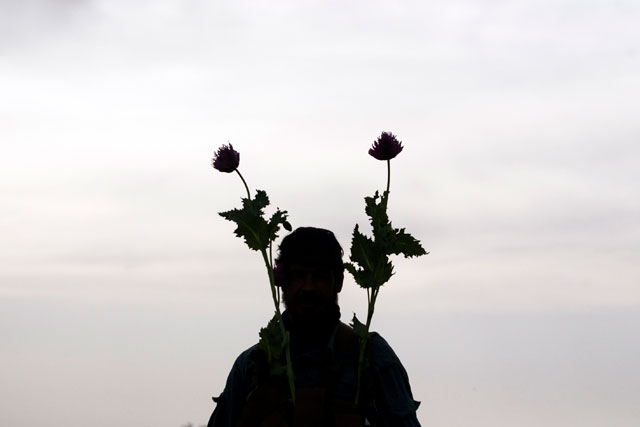
The US Commander in Afghanistan announced several airstrikes on Sunday against opium production facilities, marking a shift in the Pentagon’s approach toward the booming illicit drug industry in the country.
Army Gen. John Nicholson reported that roughly ten opium laboratories in the Northern Helmand province were destroyed in the barrage.
The purported aim of the strikes was to cut off Taliban insurgents’ revenue streams.
The Washington Post noted the assault was the “first significant use” of new authorities President Trump bestowed upon the Pentagon, giving military commanders more latitude in targeting decisions.
Nicholson added that more strikes against Afghanistan’s opium network “will continue.” The Drug Enforcement Administration reports there are as many as 400 to 500 such facilities across the country.
Since the US occupation of Afghanistan began at the end of 2001, the Pentagon has been unable to get a handle on illegal opium production — despite spending vast sums on counternarcotics. In some cases, officials turned a blind eye to illegal drug activity when it was conducted by warlords who had forged alliances with the US during the war.
According to Special Inspector General for Afghanistan Reconstruction (SIGAR) John Sopko, the US has spent $8 billion trying to stem the flow of Afghan narcotics.
Last year, Sopko told the House Oversight and Government Reform Committee that he feared Afghanistan was descending into a “narco-terrorist state.”
One of the largest recipients of federal dollars to dismantle opium production in Afghanistan was the defense contracting firm Academi — formely known as Blackwater. According to data from SIGAR, Academi was paid $309 million between 2002 and 2013 to clamp down on drug manufacturing.
During that time, opium production steadily increased, and the total value of the crop grew by roughly $1 billion between 2012-2013.
Sunday’s strikes were carried out in conjunction with the Afghan armed forces.
“We’re determined to tackle criminal economy and narcotics trafficking with full force. It’s the main source of financing violence and terror,” Afghan President Ashraf Ghani said on Twitter Monday.
Important Message: Please Read
For 25 years, Truthout has survived by publishing impactful investigative journalism and analysis; distributing full editions 365 days a year; and building a community of readers who support us with small, hard-earned donations.
Eighty percent of our $3 million yearly budget comes from small donors alone. Of those, 8,000 readers support us with monthly donations. Back in 2018, when Facebook decided to suppress the circulation of posts made by organizations, thereby cutting readers off from seeing many articles shared by the news organizations they had intentionally decided to follow, Truthout’s total traffic declined by 40 percent, as nearly all of our traffic from that platform disappeared.
Now, Google has recently rolled out its AI search bar, providing AI summaries instead of directing readers to our site. Google Search is our single largest source of traffic; it’s the route by which nearly one third of our readers find us. Much like in 2018, a shocking 40 percent of our Google traffic has disappeared overnight.
It will not be easy for Truthout to shoulder this blow. Nor will it be easy for our peers and collaborators — news sites that depend on traffic and aren’t bankrolled by large corporations.
If you can support Truthout with a donation today, you can help us resist the AI onslaught. Please give today.