Did you know that Truthout is a nonprofit and independently funded by readers like you? If you value what we do, please support our work with a donation.
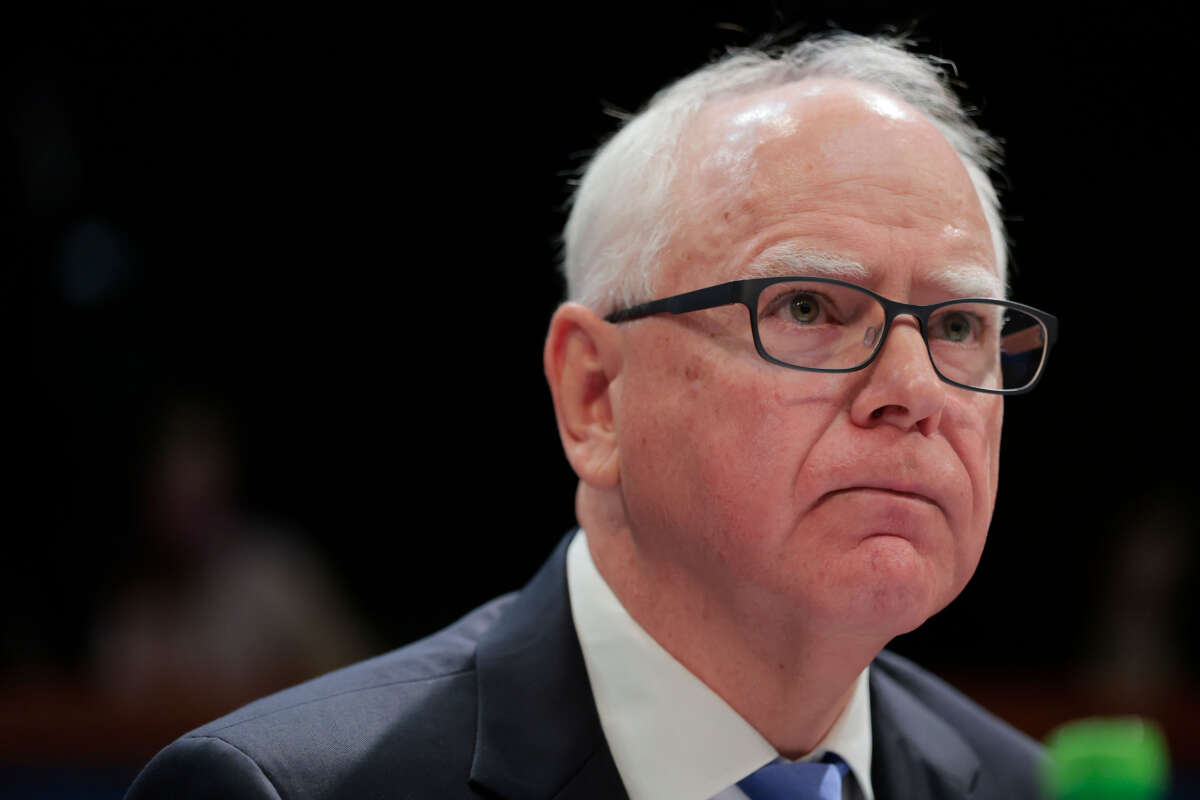
President Donald Trump told reporters on Air Force One on Tuesday that he wouldn’t call Minnesota Gov. Tim Walz (D) following a series of shootings targeting Democratic lawmakers in the state.
Trump’s comments — riddled with insults directed at Walz, who ran as vice president on the Democratic Party’s presidential ticket last fall — represent a stark departure from presidential norms, as presidents typically disregard partisanship and reach out to state or local leaders to express their condolences or offer assistance after tragedies.
On Saturday, an individual named Vance Boelter impersonated a police officer and appeared at the homes of two lawmakers from the state’s Democratic-Farm-Labor Party. He shot and killed Minnesota State Rep. Melissa Hortman (D) and her husband; he also shot State Sen. John Hoffman and his wife, who are expected to survive their injuries.
According to a manifesto discovered by authorities, Boelter had a “hit list” of several other Democratic lawmakers he intended to assassinate. Police captured him on Sunday.
Trump was blunt in his message to media following the shooting, saying he saw no reason to call the Minnesota governor.
“Why would I call him? I could call and say, ‘Hi, how you doing?’ The guy doesn’t have a clue,” Trump claimed, mocking Walz just days after the shootings took place. “He’s a mess. So I could be nice and call, but why waste time?”
The blatant disregard for the governor of a state that is dealing with the aftermath of a traumatic and emotional tragedy has drawn criticism, including from members of Trump’s own party.
“People have lost their lives, you make the call, you show the empathy,” former New Hampshire Gov. Chris Sununu (R) said in response to Trump’s words.
Walz has largely avoided commenting on the president’s insults, though he has expressed disappointment through a spokesperson over the matter.
“Governor Walz wishes that President Trump would be a President for all Americans, but this tragedy isn’t about Trump or Walz,” said the governor’s spokesperson, Teddy Tschann. “It’s about the Hortman family, the Hoffman family, and the State of Minnesota, and the Governor remains focused on helping all three heal.”
In a Minnesota Public Radio interview on Monday, before Trump publicly mocked Walz, the governor said he wasn’t surprised that the president hadn’t contacted him after the tragedy.
“I think I understand where that’s at,” Walz said at the time.
Important Message: Please Read
For 25 years, Truthout has survived by publishing impactful investigative journalism and analysis; distributing full editions 365 days a year; and building a community of readers who support us with small, hard-earned donations.
Eighty percent of our $3 million yearly budget comes from small donors alone. Of those, 8,000 readers support us with monthly donations. Back in 2018, when Facebook decided to suppress the circulation of posts made by organizations, thereby cutting readers off from seeing many articles shared by the news organizations they had intentionally decided to follow, Truthout’s total traffic declined by 40 percent, as nearly all of our traffic from that platform disappeared.
Now, Google has recently rolled out its AI search bar, providing AI summaries instead of directing readers to our site. Google Search is our single largest source of traffic; it’s the route by which nearly one third of our readers find us. Much like in 2018, a shocking 40 percent of our Google traffic has disappeared overnight.
It will not be easy for Truthout to shoulder this blow. Nor will it be easy for our peers and collaborators — news sites that depend on traffic and aren’t bankrolled by large corporations.
If you can support Truthout with a donation today, you can help us resist the AI onslaught. Please give today.