Support justice-driven, accurate and transparent news — make a quick donation to Truthout today!
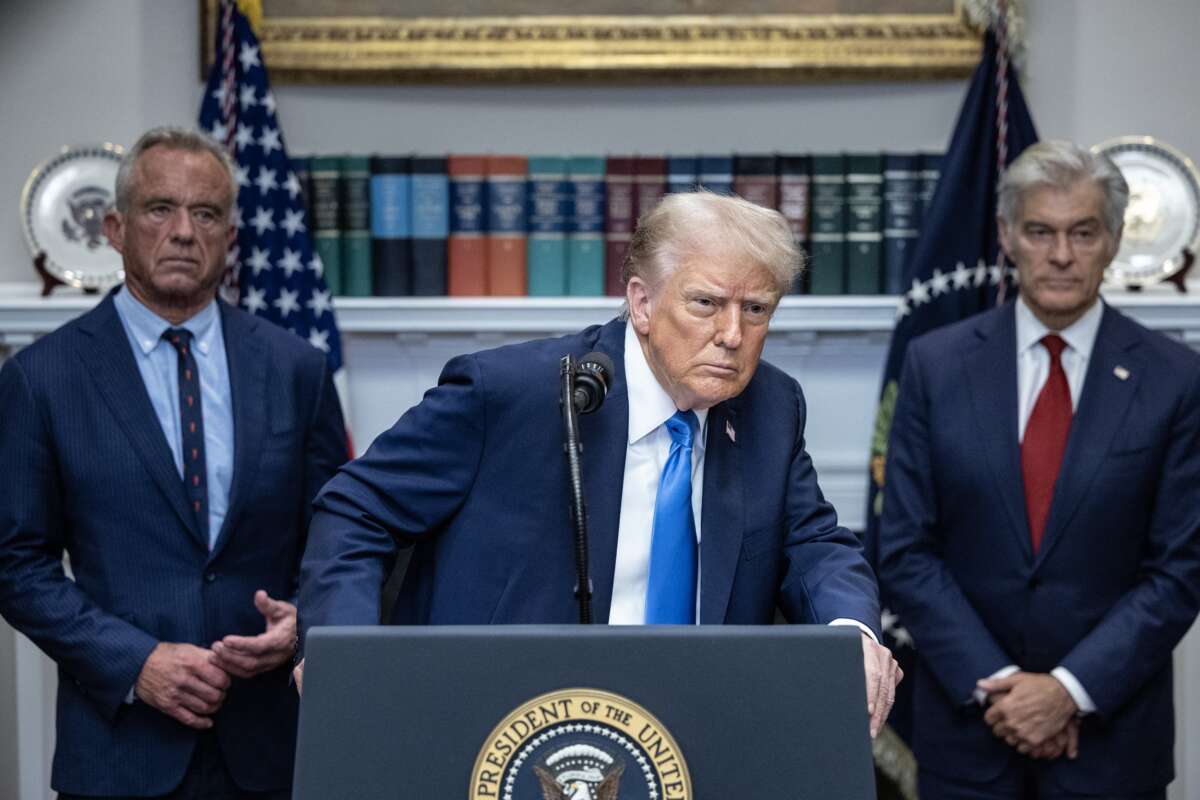
On Monday, President Donald Trump advised against the use of acetaminophen during pregnancy, baselessly suggesting that there is a link between the over-the-counter painkiller (also known by its brand name, Tylenol) and rising rates of autism.
His comments were condemned by international health experts, who have warned that untreated fever during pregnancy can lead to dangerous complications, including congenital disabilities in the fetus. Experts have also noted that increasing autism diagnoses in recent years can largely be attributed to wider testing and professionals broadening the definition of autism.
During his speech, the president announced that government agencies, including the Food and Drug Administration (FDA), would be “strongly recommending” that pregnant people stop using acetaminophen “unless medically necessary.”
Trump then went further than the official guidance, instructing people not to give children Tylenol at all.
“Taking Tylenol is not good. Alright, I’ll say it: It’s not good,” Trump said, citing no evidence.
Instead, pregnant people should “fight like hell” if they feel pain or have fevers during term, Trump said, falsely claiming that there is “no downside” to foregoing pain medication.
Several studies contradict Trump’s statements. A recent analysis examining more than four dozen studies on acetaminophen use during pregnancy advised against broad limitations on the drug, arguing for a “balanced approach” and noting the risks of untreated fevers and pain. Another study, released in Sweden this summer, analyzed 2.5 million children born in the country between 1995 and 2019 and found no correlation between acetaminophen use during pregnancy and post-birth autism rates.
Trump acknowledged during his speech that his advice wasn’t doctor- or expert-approved.
“I’m just making these statements from me…I’m not making them from these doctors,” he said, dubiously claiming his administration’s recommendations were based on “common sense.”
Leading medical experts and health organizations have spoken out against the president’s disinformation.
“There is no direct evidence that linked Tylenol to any kind of intellectual or developmental disabilities post-pregnancy. [The scientific consensus still holds that] Tylenol is safe to take during pregnancy,” said Jenny Phan, an autism researcher at George Mason University, who is autistic herself and has two autistic children.
Former Centers for Disease Control and Prevention (CDC) official Debra Houry also blasted the Trump administration’s guidance, taking note of the Swedish study that seemed to disprove fears about acetaminophen use during pregnancy.
“As of three weeks ago, we hadn’t seen evidence that acetaminophen was linked with autism, so it’s curious to know how quickly that was developed,” Houry said.
Trump’s claim is “not backed by the full body of scientific evidence and dangerously simplifies the many and complex causes of neurologic challenges in children,” said Steven Fleischman, president of the American College of Obstetricians and Gynecologists. “It is highly unsettling that our federal health agencies are willing to make an announcement that will affect the health and well-being of millions of people without the backing of reliable data.”
“The fearmongering will prevent women from accessing the appropriate care during pregnancy,” warned Monique Botha, associate professor in social and developmental psychology at Durham University.
Other countries’ health leaders also warned their residents against heeding Trump’s advice.
“Don’t pay any attention whatsoever to what Donald Trump says about medicine,” United Kingdom Health Minister Wes Streeting said, adding:
I trust doctors over President Trump, frankly, on this. I’ve just got to be really clear about this: there is no evidence to link the use of paracetamol by pregnant women to autism in their children. None.
World Health Organization spokesperson Tarik Jašarević described any statement linking acetaminophen use during pregnancy to autism as “inconsistent” with the existing body of evidence.
Trump has a history of promoting unsubstantiated and often widely dangerous medical advice to the public, particularly during his first term as president amid the spread of COVID-19.
For example, Trump advocated for those infected with the virus to consider treating themselves with hydroxychloroquine, a medication commonly used for malaria, which had not been proven to be effective in treating coronavirus. Later studies found that use of the drug resulted in higher rates of people dying from the virus versus those who disregarded Trump’s advice.
Trump also wondered aloud at a press briefing during the pandemic whether bleach could be used by “injection” to somehow treat COVID-19, leading to a spike in bleach-based poisonings across the U.S.
Urgent Appeal for Your Support
Truthout relies on individual donations to publish independent journalism, free from political and corporate influence. In fact, we’re almost entirely funded by readers like you.
Unfortunately, donations are down. At a moment when independent journalism is urgently needed, we are struggling to meet our operational costs due to increasing political censorship.
Truthout may end this month in the red without additional help. We still need to raise $7,000. Please make a tax-deductible one-time or monthly donation if you can.