Truthout is an indispensable resource for activists, movement leaders and workers everywhere. Please make this work possible with a quick donation.
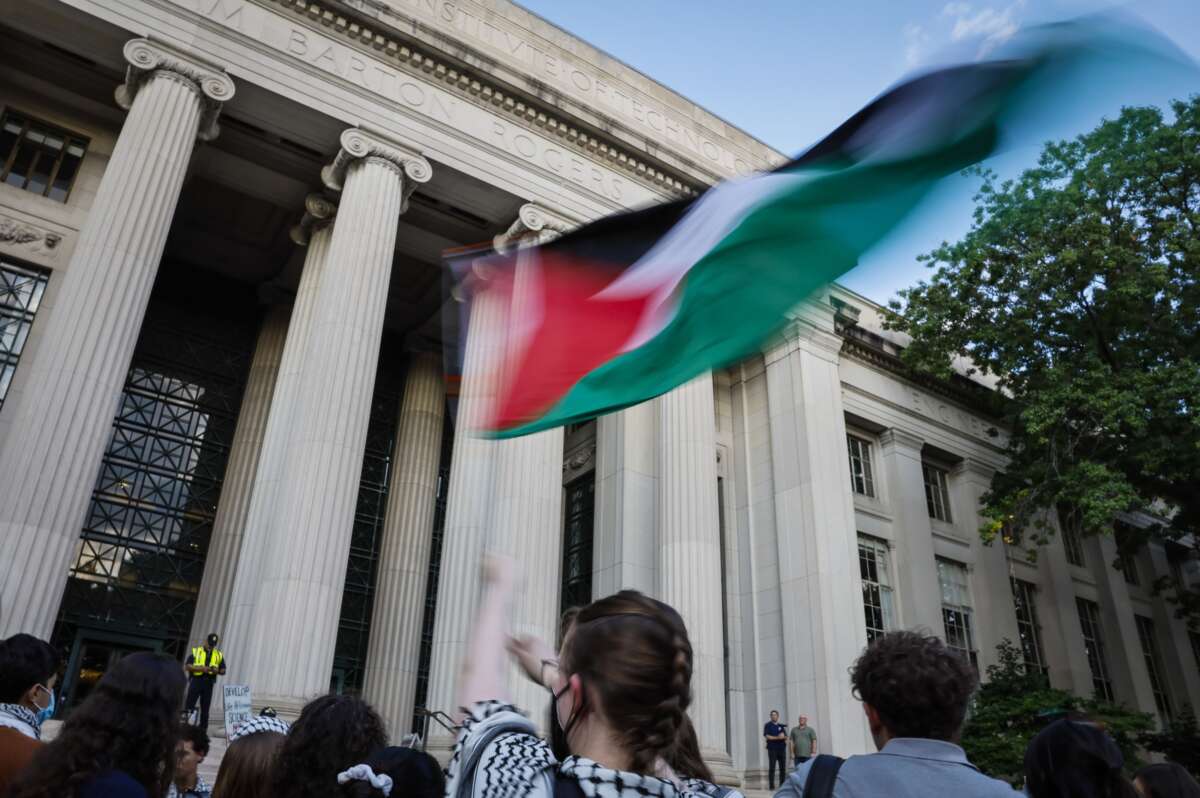
It has been more than a year since the tents and banners of 2024’s pro-Palestine student encampments came down. But dozens of faculty members, staff, and students nationwide are still navigating the backlash that followed, fighting continued campus repression.
“This is not a time to be timid; it’s not a time to be overly cautious,” Anna Feder told Truthout. Feder had been working for Emerson College in Boston, Massachusetts, for 17 years, a dozen of them spent curating a popular public film series, when administrators terminated her employment and barred her from campus in August 2024, according to a civil rights lawsuit she has since filed against the college.
That suit alleges that Emerson College violated Feder’s free speech rights when it fired her after she screened a film critical of Zionism and criticized the college’s response to Palestine-related speech on campus in an op-ed for the campus newspaper.
Almost a year into the grueling legal process, Feder told Truthout she remains committed: “With the state of the country, the state of the world right now, we all need to find ways in which we can leverage what power we have to fight back.”
The recent sharp rise in attacks on faculty, staff, and students is part of what the American Association of University Professors (AAUP) and the Middle East Studies Association characterized in a November 2025 report as a top-down campaign of “unprecedented steps to suppress campus speech — including scholarship, advocacy, and protest — opposing the state of Israel’s genocidal war against the Palestinian people in the Gaza Strip.”
That report, titled “Discriminating Against Dissent,” details how accusations of antisemitism are being weaponized as a pretext to advance a regressive agenda in higher education. It includes data showing a sharp rise in complaints of antisemitism lodged under Title VI of the 1964 Civil Rights Act against colleges and universities since October 2023. More antisemitism investigations were opened in the last two months of that year than in all previous years combined, and a new record number of investigations were filed in 2024, according to the report.
“This is not a time to be timid; it’s not a time to be overly cautious.”
Isaac Kamola, a political scientist who studies campus repression and is director of the AAUP’s Center for the Defense of Academic Freedom (CDAF), told Truthout that the spike in antisemitism investigations is the result of the same “out-of-control right-wing ecosystem that for two decades now has basically been publishing lies about what takes place in higher education.”
For years, that political infrastructure, captained by right-wing activists like Christopher Rufo and billionaires like Marc Rowan, has been wielded against educators who research and teach about race or gender issues. Now, Kamola told Truthout, it has pivoted to lobbing accusations of antisemitism at professors as a means of intervening in curricula and campus life. “You have this confluence of this right-wing attack machine that had been focusing on higher education for two decades that now is able to move away from the language of race and gender and also weaponize accusations of antisemitism.”
Many of these new accusations focus little on anti-Jewish speech and more on criticisms of Israel and its actions in Gaza, according to Kamola and the “Discriminating Against Dissent” report. Out of more than 100 antisemitism complaint letters analyzed in that report, almost all focused on speech critical of Israel. Close to 80 percent contained allegations of antisemitism that simply described criticisms of Israel or Zionism with no reference to Jews or Judaism. At least half of them consisted solely of such criticism.
Many of those who found themselves targeted in the complaints, as well as in a parallel surge in private lawsuits alleging antisemitism (also documented in the “Discriminating Against Dissent” report), have been forced to bear steep personal and professional costs.
“It is a big deal to lose your livelihood, to lose your health insurance, and it’s a big deal to be forced out of your community.”
Feder told Truthout she received no severance after nearly two decades working for Emerson College because the school conditioned it on withdrawing a union grievance she had filed and on agreeing not to file a lawsuit or speak publicly about her situation, concessions she was unwilling to make. “It was important for me to be able to tell my story; it was important for me to be able to fight this,” she said.
Meanwhile, another educator — a former adjunct professor at Brooklyn College, a campus in the City University of New York (CUNY) system — told Truthout, “It is a big deal to lose your livelihood, to lose your health insurance, and it’s a big deal to be forced out of your community.”
The adjunct, who asked not to be named due to concerns about their ongoing fight for reinstatement, is one of four Brooklyn College adjuncts who were fired or barred from reappointment in June 2025, around the same time that CUNY student organizer Hadeeqa Arzoo Malik received a one-year suspension. Organizers later said they believed the moves were meant to quell pro-Palestine student organizing and recent efforts that had brought together faculty union members and student groups.
Of that group of adjuncts, who came to be known as the “Fired Four,” three were reinstated in January 2026. The fourth adjunct is still campaigning for reinstatement with the support of their union and pro-Palestine campus organizing groups, which have nicknamed them the Fired Fourth. “Fighting this takes a huge psychological toll,” the Fired Fourth told Truthout. “Part of the repression is not just the firing, it’s the toll that it takes on activists to fight it.”
Kamola told Truthout that these attacks harm not only those targeted but also the public. “The premise of academic freedom at its core is that universities can only serve the common good if faculty are free from external interference,” he said.
“The name of the game is for people to feel isolated, for people to feel shame, so it’s really important to see yourself as part of this larger movement.”
“If the governor of Florida gets to determine what sociology textbook is taught in Florida, then those sociology classes are no longer about trying to understand the complicated social phenomena that make up the world and empowering our students,” Kamola said. “Instead, that class becomes an extension of the power that’s held by the governor of Florida and his MAGA allies.”
Michel DeGraff, a tenured professor at the Massachusetts Institute of Technology (MIT), told Truthout he has seen this harm to students firsthand as they are denied opportunities to learn about Palestine. Since spring semester 2024, DeGraff has been proposing an elective course on the language of decolonization in Palestine and Haiti, which he has long studied.
But the linguistics department has not allowed him to teach it, citing what DeGraff called “flimsy pretexts.” He said he believes the real reason the department does not want to offer the course is its focus on Palestine. The decision is “not only affecting me as faculty,” he said, “but it’s also affecting students.”
DeGraff has also faced significant repercussions for pursuing the course and speaking out about Palestine on campus. After his proposal was first denied and he objected, DeGraff was removed from the linguistics department, had a pay raise withheld, and had his salary frozen. Then, in June 2025, in a separate case, DeGraff was sued alongside MIT by a pro-Israel law group on behalf of that group and Jewish students who alleged DeGraff had harassed them. The legal complaints against him were dismissed in January.
Although the stakes are high, staff and faculty who spoke to Truthout said the struggles for their rights to free speech and academic freedom on campus and for recourse after retaliation are too important not to wage. “We only have the rights that we fight for,” Feder told Truthout. “You can have a right on paper, but unless you’re actually willing to defend it, unless you’re willing to challenge attacks on your rights, then what good are those rights?”
The CUNY adjunct said the reinstatement of their three colleagues shows the battles are winnable. “That’s an important first win, and so I think it shows that through a dedicated and strong campaign, it’s possible,” they told Truthout.
“It’s much more difficult to build a movement if everyone is afraid of being repressed, and it’s another thing to build a movement if we understand that when there’s repression, we’re going to fight it with everything we have.”
To help share stories like these with a broader audience and emphasize the importance of academic freedom, CDAF contracted Feder to lead a video and podcast series, called Faculty on the Front Lines, that launched in October. It features discussions with faculty who have faced repression, many of them for Palestine-related speech. DeGraff shared his story on an early episode.
Kamola said the project is “an effort to create a space for faculty to speak in their own terms about what they experienced and the kind of repression that they faced because of their speech.”
Feder said it is also an effort to help those who have been targeted on campus find community. “The name of the game is for people to feel isolated, for people to feel shame, so it’s really important to see yourself as part of this larger movement,” she told Truthout. “There are a lot of really brilliant principled people out there that you can connect with that will welcome you with open arms.”
The Fired Fourth told Truthout they believe that building that solidarity is vital to pushing back not only on campus crackdowns but wider threats to democracy. “There has to be organizing against repression consistently across campuses,” they said. “It’s much more difficult to build a movement if everyone is afraid of being repressed, and it’s another thing to build a movement if we understand that when there’s repression, we’re going to fight it with everything we have.”
Please support movement journalism
Independent media is a pillar of democracy and a powerful force for justice. We rely on reader support. Please make a tax-deductible one-time or monthly donation to Truthout if you can.