Truthout is a vital news source and a living history of political struggle. If you think our work is valuable, support us with a donation of any size.
Photos of Palestine solidarity encampments have disappeared from the news, replaced by pictures of immigration agents kidnapping university students and community members, but the campus-based battle to force universities to divest from Israel and weapons manufacturing is still underway.
This a long-term, smoldering battle. “The campuses are definitely as active as they were a year ago from my purview,” says Akin Olla, communications director for the anti-militarist youth organization Dissenters. But, he adds, “The actions look different and are generally less media-friendly.”
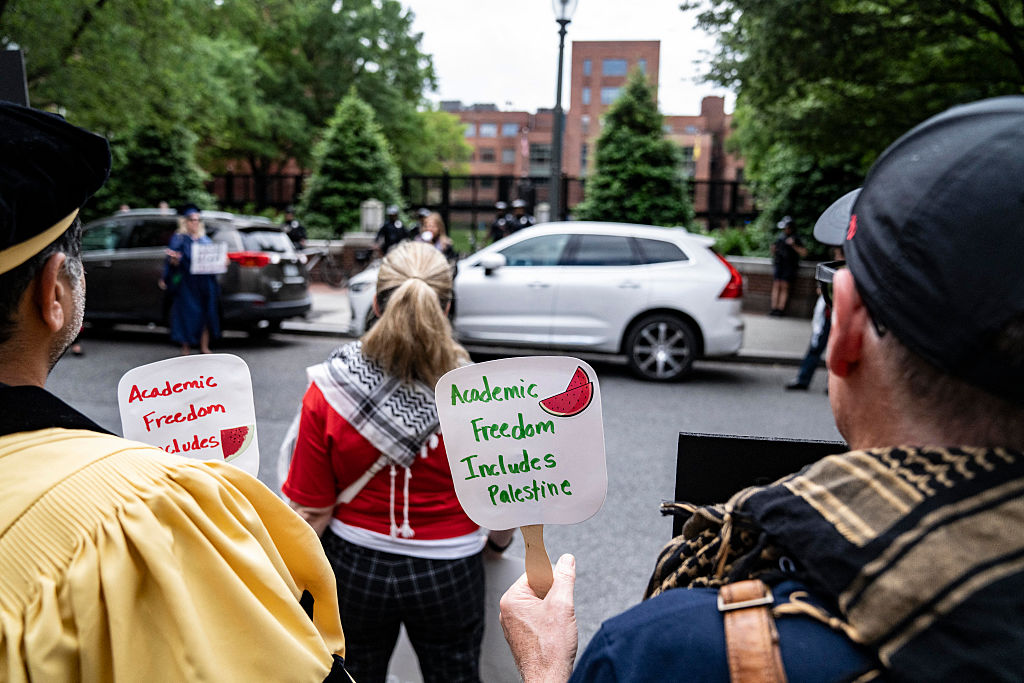
While this struggle continues, its shape has shifted, as students who were initially on the front lines of pro-Palestine activism experience additional vulnerability due to the Trump administration’s attacks. Many of these students are Muslim immigrants or from immigrant families, while others are queer or trans and confronting a different series of attacks. As a result of these changes, the shape of the work has changed. For one thing, faculty who spoke to Truthout said that campus student groups are working more in coalition to provide some shielding to targeted students, like Students for Justice in Palestine or Muslim student associations.
Faculty across the United States continue to organize: They’re supporting students and their movements; organizing their own events; building aboveground and underground safety networks in response to the presence of immigration police on campus; and pushing their own unions and scholarly associations to take political positions.
Attacks on International Students and Faculty
Since Donald Trump took office in January 2025, people on campuses have experienced a series of rollercoaster events around the status of international, immigrant, and undocumented students and staff. In March, there were a series of high-profile kidnappings of students on visas and green cards like Rümeysa Öztürk and Mahmoud Khalil in retaliation for their activism on Palestine. These widely publicized kidnappings were accompanied by the sudden revocation of 6,000 student visas around the U.S., the majority of which were not related to activism or political opinions.
The dramatic crisis of the spring has given way to other forms of exclusion: This summer, the administration made a dramatic reduction in the number of student visas that were issued, leading to a 30-40 percent drop in international students attending school in the U.S. this fall. Then on September 19, the Trump administration issued an executive order about H-1B visas that initially made it seem as if H-1B visa holders would no longer be able to come and go from the U.S. without their employers paying a $100,000 fee. There are currently around 120,000 faculty and university workers holding H-1B visas across the U.S., many of whom travel internationally professionally as part of their research.
There does not seem to be an end in sight to attacks on immigrant, undocumented, and international students, faculty, and staff, nor does there seem to be an obvious line that will not be crossed as the administration escalates its attacks. Jenna Loyd, co-founding member of Sanctuary Campus Network, says that in addition to a spillover from the administration’s attacks on immigrants more broadly, the logic is to “attack the whole idea of universities being international spaces.”
Universities Are Not Left-Wing Bastions
Contrary to Republican talking points, universities are not hotbeds of radical leftism. In reality, governing boards react swiftly and punitively to events that rock the boat.
At a small private liberal arts college in the Northeast, a political theorist is facing dismissal for her activism. “Laura,” who chose not to give her real name because she is on the job market, found herself on the wrong side of her institution when she organized a series of speaking events about Palestine. The events featured high-profile speakers and highlighted the interconnectedness of Palestine to other issues, including campus repression of free speech, in an effort to build more solidarity with Palestine on campus.
Faculty active in the pro-Palestine struggle are generally frustrated at the lack of support and activism from their colleagues. Many faculty, says Laura, have an “easy posture of learned helplessness” around difficult issues, insisting disingenuously that the university is not a political space. “It’s racism masked behind civility politics,” Laura says.
At the University of Central Florida, Talat Rahman, faculty union president and professor of physics, says that there is unfortunately not nearly as much support for organizing against the genocide as for resisting Immigration and Customs Enforcement (ICE), although the two causes are interrelated. Rahman says there is a lot of fear on campus, but that “people can only be afraid for so long. At some point you have to live with your own conscience.”
It’s no coincidence that the attacks on students and immigrants on campus began with those speaking out against the genocide in Palestine, says Bill V. Mullen, professor emeritus of American Studies at Purdue and secretary-treasurer for American Association of University Professors local 6741. “The opposition to the war against Palestinians has become a hammer to destroy academic freedom…. Whatever your position might even be on Palestine and Israel, you have to acknowledge that this is the mechanism that’s being used to try to reshape higher education. The discussion of Palestine is actually a discussion about our work conditions.”
In other words, the repression of pro-Palestine protesters on university campuses, under Joe Biden and under every previous presidential administration, created the opportunity for the anti-immigrant attacks by the Trump administration, as well as other attacks against diversity, equity, and inclusion, and independent governance.
Creating Sanctuary at the Grassroots
Despite mission statements extolling the benefits of diversity and care for their students, campus administrations have offered little other than platitudes to protect international and undocumented students, leaving it to faculty staff and students to organize and protect each other. The overwhelming majority of university administrations are too risk-averse to offer real support to students facing an expanded immigration dragnet, so some faculty are responding to administrative compliance with ICE and the Department of Homeland Security by forming their own support networks.
One national coordinating group is the new and growing Sanctuary Campus Network, which aims to pool ideas and resources so that faculty on any single campus don’t need to reinvent the wheel. The network has been holding large Zoom meetings on the first Friday of each month since December 2024. These meetings often involve a training or presentation from a partner organization, like Muslims for Just Futures or Palestine Legal.
One early project of Sanctuary Campus Network was to develop an immigration-focused Know Your Rights training and slide deck that was adapted specifically for the campus environment. The network encouraged members to give the presentation on their own campuses to disseminate this information as widely as possible while reducing the time that individual faculty need to spend developing materials.
Similarly, the network has a large drive of materials for printing and use by faculty, like signs that can be placed on office or classroom doors indicating that these are private spaces (and therefore closed to immigration agents without a signed judicial warrant). The goal is to use these signs to indicate to students and others who may be targeted which faculty are supportive and where they will be harbored in the event of a raid on campus.
Sanctuary Campus Network is broken up into five regions, and members meet regularly in smaller groups. Rachel Ida Buff, a writer and working historian currently teaching at University of Wisconsin-Milwaukee, who is part of the Midwest region, says that these regional meetings have been “really, really useful,” and validating, allowing faculty to commiserate, share tactics, and build camaraderie with each other. These regional network meetings are especially important as a space to build a collective effort since the number of active faculty on an individual campus may be quite small.
Tending the Soil to Build a Fertile Organizing Space
Organizing on campus, like organizing more generally, does not always look like what it looks like in the movies. Laura says that a big part of her role in mentoring student activists is teaching that “activism is not always the flashiest thing.” Instead, it’s often about “illuminating how power functions” and other less obvious goals, she says.
Dana Morrison, member of Faculty and Staff for Justice in Palestine at West Chester University in Pennsylvania, explained that one of the group’s goals is politicization. On regional public campuses like West Chester, most students work and many live far from campus, leading to a relatively apolitical campus. “How do you [participate in coordinated national events] if on your own campus, nobody has even uttered a political thing in the public space?” Morrison says that “you have to have the soil correct for anything to happen.”
It’s not just students on campus who are sometimes relatively apolitical. Sanctuary Campus Network co-founding member A. Naomi Paik pointed out that some faculty have little experience with activism and are just learning to organize. There are places to learn, however: A focus of the network as well as of the American Association of University Professors has been to offer trainings on the various components of organizing, and there are usually at least a small group of faculty members on each campus who do have this experience.
Mullen, who helped organize the second National Day of Action for Higher Education on April 17, 2025, as part of the Coalition for Action in Higher Ed (CAHE), says “overcoming hopelessness is a crucial organizing problem.”
The Day of Action featured scores of actions on a diverse range of campuses, as well as a full day of online programming organized by CAHE. Mullen says that one of the goals of this year’s events was to bring Palestine more directly into the focus of higher ed organizing. CAHE is beginning to transition to an organization from an ad hoc coalition, and is already planning for April 17, 2026.
Negotiating Long-Term Struggles Amid High Turnover
One of the main challenges of campus activism is the churn of leadership in student groups. Campaigns like divestment struggles are long, much longer than the average tenure of a student activist. Several faculty members mentioned that student organizations that led earlier protests on their campus are in a process of reformation after all the leaders graduated at once.
Faculty have much lower rates of turnover and can be present for a longer campaign, but activist faculty are careful about their role in relationship to students. Morrison says that she and her colleagues are careful to develop campaigns of their own rather than drive campus-wide divestment campaigns. “If we were to define the campaign, name the target, and all that kind of stuff, we’d be taking up space in terms of how we teach students,” she says. Faculty would end up teaching students that their participation is not important.
Instead, Morrison’s Faculty and Staff Justice in Palestine chapter organized a successful divestment campaign focused on their labor union. Other faculty have engaged in pressure campaigns within their scholarly associations, like the Sociologists for Palestine campaign.
On some campuses, student groups have merged with off-campus community groups so that students who’ve graduated can stay involved. This is the case with the Dissenters chapter at North Carolina State University, says Chelsey Dyer, assistant teaching professor of anthropology who serves as the faculty adviser for the group. Dyer says this joint community/campus structure also allows her and other involved faculty to show up to the group more as peer activists than specifically as faculty mentors.
Similarly, Buff says campus sanctuary organizing on her campus in Milwaukee has benefited from collaborations with deeply rooted immigrant organizing in the city, and that Buff herself has benefited from looking to other activists as peers rather than often-fearful faculty colleagues.
The struggle to protect international, immigrant, and undocumented students is deeply entwined with the longer-term struggle for a free Palestine and to build a more liberatory version of higher education itself. Mullen puts it this way: “If both parties have been willing to consent to supporting a mass killing of a population, it’s not a shock that both parties participated in the firing of college presidents and the arrests of students.”
The odds are daunting, but faculty like Mullen emphasize that building cross-campus and national networks reduces their isolation — and their fear.
An important fundraising appeal: 72 Hours to raise $28,000
Truthout is one of only a few platforms for justice-oriented, grassroots journalism. Today, as political censorship from the right intensifies, we have no choice but to ask for your help.
We are fundraising right now to cover our basic operating expenses. If you can support Truthout with a one-time or monthly donation, you will make a significant impact on our work. Anything you can do makes a difference — we appreciate your support.