Support justice-driven, accurate and transparent news — make a quick donation to Truthout today!
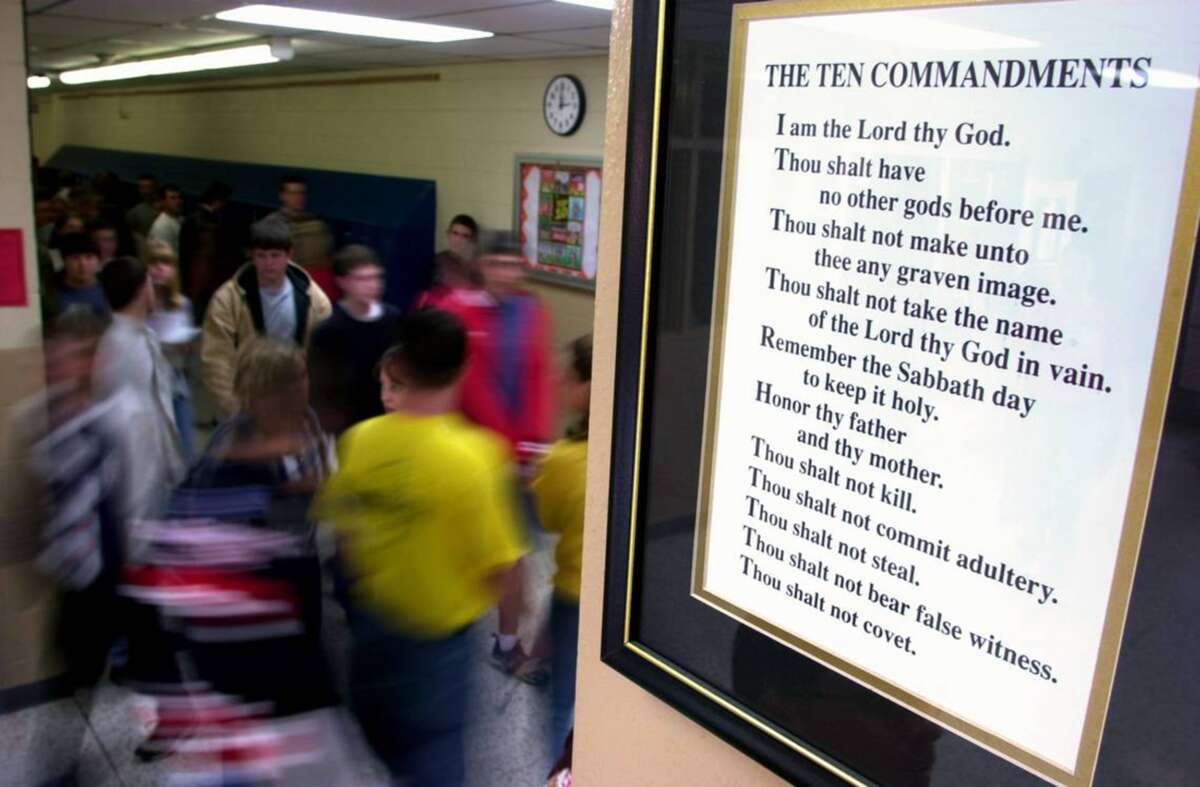
A federal judge has placed a permanent injunction on a law in Arkansas that requires the display of the Ten Commandments in every public school classroom and library, ruling that the statute violates Supreme Court precedent and the First Amendment’s Establishment Clause.
The ruling does not affect the entirety of the state, but rather six specific school districts where the children of seven families named in the lawsuit currently attend school. Still, the decision, if it passes the appeals process, could be cited in the future, expanding its scope to the rest of Arkansas’s classrooms.
The law, sometimes referred to as Act 573, was passed by the state last year. Seven families from differing religious and nonreligious backgrounds filed a lawsuit against it, resulting in a temporary stay of its enforcement in their children’s schools.
On Monday, U.S. District Judge Timothy Brooks made the stay permanent, finding the law both unconstitutional and absurd in its reach.
“Nothing could possibly justify hanging the Ten Commandments — with or without historical context — in a calculus, chemistry, French, or woodworking class, to name a few,” Brooks pointed out in his ruling.
Brooks noted that legal precedent has already been established on religious displays in school settings, writing:
The Supreme Court has already determined that a state law mandating the posting of the Ten Commandments in public schools — without integrating such displays into the curriculum ‘in an appropriate study of history, civilization, ethics, comparative religion, or the like’ — violates the Establishment Clause. This precedent has not been explicitly overturned and is binding upon all lower courts — including this one. The facts in the case at bar are identical in all material respects to the law that was deemed unconstitutional by the Supreme Court.
The judge also disagreed with the state’s arguments in favor of the law, writing that they all “fall flat.”
One such argument stated that past rulings by the Supreme Court — including those allowing the placement of the Ten Commandments near a government building and prayer in public spaces — should be applied to Act 573. Brooks rejected that premise, noting that in those rulings, the court had included in their findings that people had the opportunity to avoid those spaces.
“Children cannot similarly avoid reading the Ten Commandments posted in their classrooms for thirteen years of compulsory schooling,” Brooks wrote.
Brooks also disagreed with state arguments positing that the display of the religious text was in support of students learning history.
“Discussing history [as an argument] is both unhelpful and irrelevant when the challenged law is coercive, applied universally in the public-school context, and has no educational, secular purpose,” Brooks wrote. “Even so, there are no historical practices and understandings to support the posting of the Ten Commandments in the public-school context.”
The law doesn’t even include the words “curriculum” or “educate” within it, Brooks further explained.
The stay applies to the six school districts in question. Classrooms within those districts are prohibited from displaying the Ten Commandments, per Brooks’s ruling.
State lawmakers, including Republican Gov. Sarah Huckabee Sanders, said they plan to appeal the decision.
“In Arkansas, we do in fact believe that murder is wrong and stealing is bad,” Sanders said in a statement, wrongly implying that restricting the commandments’ display would promote the opposite values.
“I look forward to appealing this suit and defending our state’s values,” Sanders added.
Several religious freedom organizations, which helped families formulate the lawsuit and argued on their behalf, applauded the decision.
“Today’s decision honors the Constitution’s promise of church-state separation and religious freedom,” said Rachel Laser, president and CEO of Americans United for Separation of Church and State. “It will ensure that Arkansas families — not politicians or public-school officials — get to decide how and when their children engage with religion.”
“We are delighted that reason and our secular Constitution have prevailed, and that children will be spared this unconstitutional proselytizing,” said Annie Laurie Gaylor, co-president of the Freedom From Religion Foundation.
John C. Williams, legal director for ACLU of Arkansas, noted that the First Amendment of the Constitution “protects every student’s right to learn free from government-imposed religious doctrine.”
“Arkansas lawmakers cannot sidestep the First Amendment by mandating that a particular version of the Ten Commandments be displayed in every classroom,” Williams added. “As the court recognized, this law served no educational purpose and instead placed the authority of the state behind a specific religious message.”
Media that fights fascism
Truthout is funded almost entirely by readers — that’s why we can speak truth to power and cut against the mainstream narrative. But independent journalists at Truthout face mounting political repression under Trump.
We rely on your support to survive McCarthyist censorship. Please make a tax-deductible one-time or monthly donation.