Truthout is an indispensable resource for activists, movement leaders and workers everywhere. Please make this work possible with a quick donation.
The resistance to Operation Metro Surge in Minneapolis was a courageous response to our nation’s ongoing moral crisis in immigration policy. Acts of civil disobedience over the last couple months have raised public consciousness of corporate collusion with state violence, encouraged people to take risks in defense of their neighbors, and even elevated the role of love in resistance.
Most media attention has justifiably focused on the mutual aid efforts and frontline Immigration and Customs Enforcement (ICE) patrols. Daily calamity led to an appropriate focus on daily needs to safeguard the people most impacted: food, rent, patrols against abductions, and the documentation of conditions on the ground. But in addition to this vital work of material survival, faith leaders, students, and union members brought their demands — alongside their laments about moral survival — to the doorsteps of corporate actors that have enabled this violence in the first place. In doing so, they have given us all profound models of how we can resist rising authoritarianism.
The Power of Public Lament
An ICE agent shot and killed Renee Nicole Good in Minneapolis on January 7. A week later, Christian clergy were occupying the lobby of Target headquarters in the city, in protest of the company allowing ICE to stage operations in its store parking lots. The faith leaders refused to leave until they were allowed to talk to the then-CEO of Target, Brian Cornell. (He left that role on February 1, 2026.) Together the clergy sang in harmony:
We can stay here all day. We shall not be moved. Just like a tree planted by the water. We shall not be moved. We are shopping elsewhere. We shall not be moved.
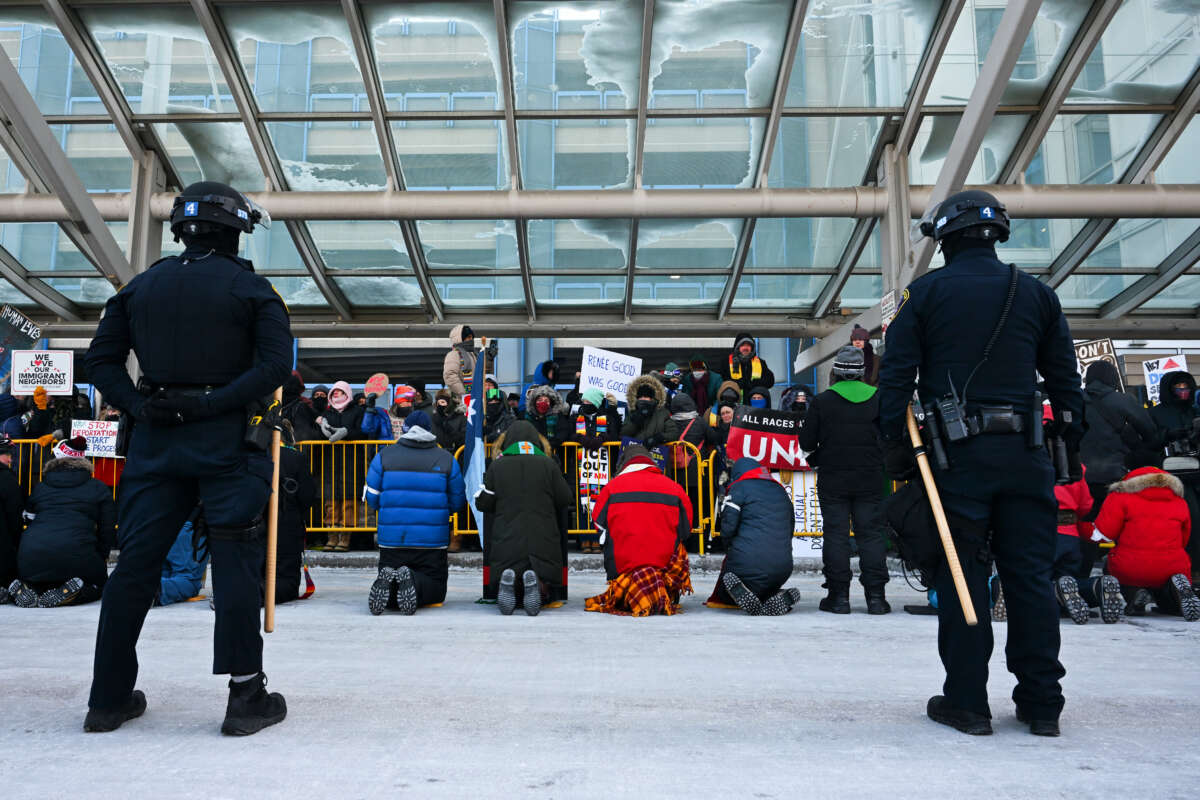
In an escalation of tactics, ISAIAH, a statewide interfaith social justice organization, and Unidos MN, a local multiracial organization born out of the Dreamer movement, organized an action on January 23 at the Delta terminal of the Minneapolis-St. Paul International Airport (MSP) to protest deportation flights from the Twin Cities to immigrant jails in Texas. Thousands of additional protesters flooded the taxi pickup lane outside Terminal 1 at 10:00 am, interrupting airport operations. Ninety-nine clergy lined up on their knees on the slushy ground, their arms open in prayer, in what Pastor Ali Tranvik would later tell me was a “public lament.”
The public lament is distinct from other forms of resistance that arose during Operation Metro Surge — such as marches, mutual aid, and patrols — because of how it challenges moral authority. It weaves together clearly articulated demands, real stakes of an action that risks arrest, and an expression of grief. The images of the faith leaders, meditative and supplicant in prayer and grief, made for a stark visual contrast with the federal agents dressed for war, masked and in body armor, holding machine guns with noise suppressors, trailed by ghostly plumes of tear gas. Many national and state leaders, including Minnesota Gov. Tim Walz and Minneapolis Mayor Jacob Frey, have primarily focused on ICE’s horrifying tactics of removal, rather than the violence at the heart of these removals themselves. The clergies sought to expose how corporations enable the state violence of deportation.
“We held pictures of those who have been abducted from MSP. We were lamenting [their abductions], praying for them, praying for their families,” Tranvik said.
The airport terminal is a zone of government bureaucracy, but it is also a commercial space where the proud icons of each major airline are emblazoned over numbered doors. In their public lament, faith leaders brought the community’s grief over their disappeared neighbors to these companies and their customers, the throngs of travelers attempting to carry on with the business of their day, despite the federal occupation. Their demands included “calling upon all corporations to become 4th Amendment businesses, cease economic relations with ICE and refuse ICE entry or using their property for staging grounds, and lobby congress to freeze funding for ICE/DHS.”
After protesting for hours, they were arrested, zip-tied, and packed into yellow school buses by local law enforcement. Later that afternoon, more than 50,000 people came out in subzero temperatures to protest in downtown Minneapolis as part of the ICE Out of Minnesota: Day of Truth and Freedom.
Civil disobedience was widespread in Minneapolis in the wake of Good’s killing. Riley, who prefers I only use his first name, was among 67 other college students who were arrested at the Graduate hotel during a “Wide Awake,” one of several noise demonstrations organized in part by Sunrise Movement Twin Cities and Students for a Democratic Society. From videos shared on social media — which include impromptu bands of musicians pounding on drum sets and wailing on guitars, singers and saxophones — the scene seems raucous, even giddy, but he told me the Wide Awakes are particularly meaningful because of their immediacy, that there was only “a brick wall” between the student protesters and the federal agents. The goals of Wide Awakes are to keep immigration agents from sleeping, and to highlight hotel groups like Hilton as corporate collaborators which have facilitated Operation Metro Surge. But they also allow protesters to exercise their sorrow and anger in public. These too are public laments. Riley described the emotional function that the Wide Awakes fulfilled:
Everyone gets a moment where they can be mad. There is nothing stopping them from screaming at the top of their lungs, because it’s so loud anyway. They’re [ICE agents are] right there, and, you just want to cuss them out, and you can, no one’s gonna stop you. I think that a lot of people are harboring a lot of rage in them.
The rage in Minnesota was born out of heartbreak. These college students were bearing witness to roving bands of masked agents carrying military-grade weapons and cruising in caravans, hunting, profiling, and encircling their neighbors. These agents targeted people’s daily movement in and out of schools, care centers, workplaces, and hospitals. They used extreme and excessive force, throwing people’s bodies into hardpacked snow and ice. They shot and wounded Julio Cesar Sosa-Celis on Minneapolis’s Northside, and during the subsequent protests, tear-gassed a minivan with six children inside. The neighbors who stood by to film the evidence of the detainments were threatened, pepper-sprayed, had their car windows smashed in, and were violently arrested by ICE agents.
The University of Minnesota remained neutral in the face of immigration agents’ assault. On February 6, a few days before Riley and I spoke, students chained themselves to Morrill Hall, which houses the office of the university president. Among their demands, released on social media via prerecorded video following their arrest, was a call for the University of Minnesota to become a sanctuary campus. “Protect your friends, protect your classmates, protect the faculty and those that we love,” one of the arrested students said in the video.
Riley’s social world seemed interwoven with his organizing. He described a student movement in which collective courage was the obvious, inevitable output of grappling with the harm that has been done to real people in our city and finding it intolerable. “I’m always just like, people are dying … I know people are dying, but I don’t want to sit on a bus for a few hours and get cited and released and then go to court? This really is not the worst thing that could happen.”
He is right: We are certainly seeing worse things that can happen. And yet, after the night of mass arrests, student activists returned to the Graduate hotel, spurred to again put their laments into public space. Riley cautioned against romanticizing arrest as an end in itself:
Don’t take risks just for anything. It’s important to think about: OK, is what I’m doing actually beneficial? That’s why I feel like if you’re getting arrested by a cop, you probably shouldn’t struggle because then you just have an additional charge and then you have to spend more time in court when you could be doing something else a lot more beneficial … more productive.
In addition to tending to emergency needs, like fundraising for rent and legal fees and groceries, faith leaders and the student movement in Minneapolis emanate deep clarity that guides their attempts to interrupt the daily commerce that supports Donald Trump’s deportation machine: If you rent hotel rooms to ICE agents, they will play music outside until they are arrested. If you fly deportation flights, they will pray outside your sliding glass doors until they are arrested. I asked Pastor Tranvik about how she located and sustained the courage to participate in an action that will likely lead to arrest. Her bright eyes lit up with a laugh in response:
I have a family, two little kids at home, but the scriptures say that my family is not just my biological family … my dear children are my dear children and my dear spouse is my dear spouse but, my dear sisters and brothers who are getting taken, are my dear sisters and brothers.
Pastor Tranvik left her children at home to be arrested because her faith calls her to treat every person detained as family, a person for whom she laments. She asked that Target and Delta Air Lines lament for them too.
In contrast, business leaders in Minneapolis eventually released a letter after Alex Pretti’s murder that called for the “deescalation of tensions,” without assigning blame. Underneath their warm words on hoping to “resume our work to build a bright and prosperous future” is the hope that Minneapolis and the rest of the country will trade quieter deportations for a return to normalcy. They hope consumers can be assuaged by fewer awful videos of federal agents dogpiling people in the street and go back to availing themselves of their cheerful coupon app. Yet disruptive acts of civil disobedience have continued here in Minneapolis because of the deep moral injury caused by immigration agents’ sustained occupation and murders.
Behind the stories of resistance from students, faith leaders, and organizers during Metro Surge is love. And out of that love comes bravery. There are tens of thousands of people in ICE detention right now, including children. Each person is separated from the people they love. ICE has separated people through detention, deportation, and death. At a February press conference, Minneapolis City Council Member Soren Stevenson, rage in his voice, said, “We actually want our neighbors back. The ones that they took … we actually want to bring them back.” These deportations represent the maiming of whole communities, their attempted destruction. All the while, an insistence on “business as usual” inside Target and the airport aims at restoring sunny normalcy, even as chained deportees are flown from their very runways, as expressed in the call from mainline Democrats for modest and largely failed reforms to ICE.
Pastor Tranvik calls on us to reject a return to normalcy:
We can easily go about our lives … not needing each other, not thinking we do, and that slowly kills us. But slowly, in ways that we don’t always notice and I think crisis thrusts us into the truth that we are connected and that our life and well-being is intimately tied up with those around us and that our neighbor’s life and well-being is intimately tied up with ours.
Public laments are vivid refusals of state violence and corporate complicity. But they also enact an intimate politics around the ways we need each other. The lamenters insist that their neighbors’ real and complex lives should not be erased, blurred into the statistics of people ICE detained, injured, deported, or killed. In facing that grief, the public lament also asks us to recall and insist on our own humanity.
Urgent Appeal for Your Support
Truthout relies on individual donations to publish independent journalism, free from political and corporate influence. In fact, we’re almost entirely funded by readers like you.
Unfortunately, donations are down. At a moment when independent journalism is urgently needed, we are struggling to meet our operational costs due to increasing political censorship.
Truthout may end this month in the red without additional help. We still need to raise $7,000. Please make a tax-deductible one-time or monthly donation if you can.