Truthout is an indispensable resource for activists, movement leaders and workers everywhere. Please make this work possible with a quick donation.
When Donald Trump made Minnesota an epicenter for his aggressive anti-immigrant assault, Minnesotans offered the nation a powerful and effective model of loving resistance and solidarity. Throughout the sustained resistance to Trump’s occupation of Minnesota, LGBTQ+ residents and activists have played a central role.
That role was thrown into sharp relief after Immigration and Customs Enforcement (ICE) agent Jonathan Ross killed Renee Nicole Good on January 7, 2026 — a turning point in the Minneapolis uprising against federal immigration agents. Good, who was survived by her wife and children, quickly became a target of right-wing extremists such as Matt Walsh who fixated on her gender and sexuality. The day after her killing, Walsh said on X, “This lesbian agitator gave her life to protect 68 IQ Somali scammers who couldn’t give less of a shit about her.” Minnesota is home to the largest Somali population in the nation.
Walsh’s virulently bigoted insult is symbolic of the way the right has combined its scapegoating of both immigrants and LGBTQ+ people in service of a white supremacist patriarchal vision demonizing anyone who isn’t a straight white cisgender man. As federal forces begin to draw down, solidarity between the immigrant and LGBTQ+ communities is stronger than ever, buttressed by a robust network of mutual aid efforts.
And indeed, there is real overlap between the communities. Minnesota is home to a significant queer Hmong community. And, news emerged in mid-February of a heartbreaking story of a Mexican couple, one of whom died of cancer after missing her medical appointments from fear of being ensnared by ICE. Her wife now plans to self-deport back to Mexico.
Shelby Chestnut — the executive director of the Transgender Law Center, which is leading a series of workshops called Beyond Borders and Boxes: Building LGBTQ+ and Migrant Solidarity — now lives in Pittsburgh but grew up in Minneapolis and returned to his hometown in early February to meet with local leaders in the movement against ICE and offer support. “The mutual aid networks that have been built in the city are like nothing I have ever seen before in my decades of organizing work,” Chestnut said.
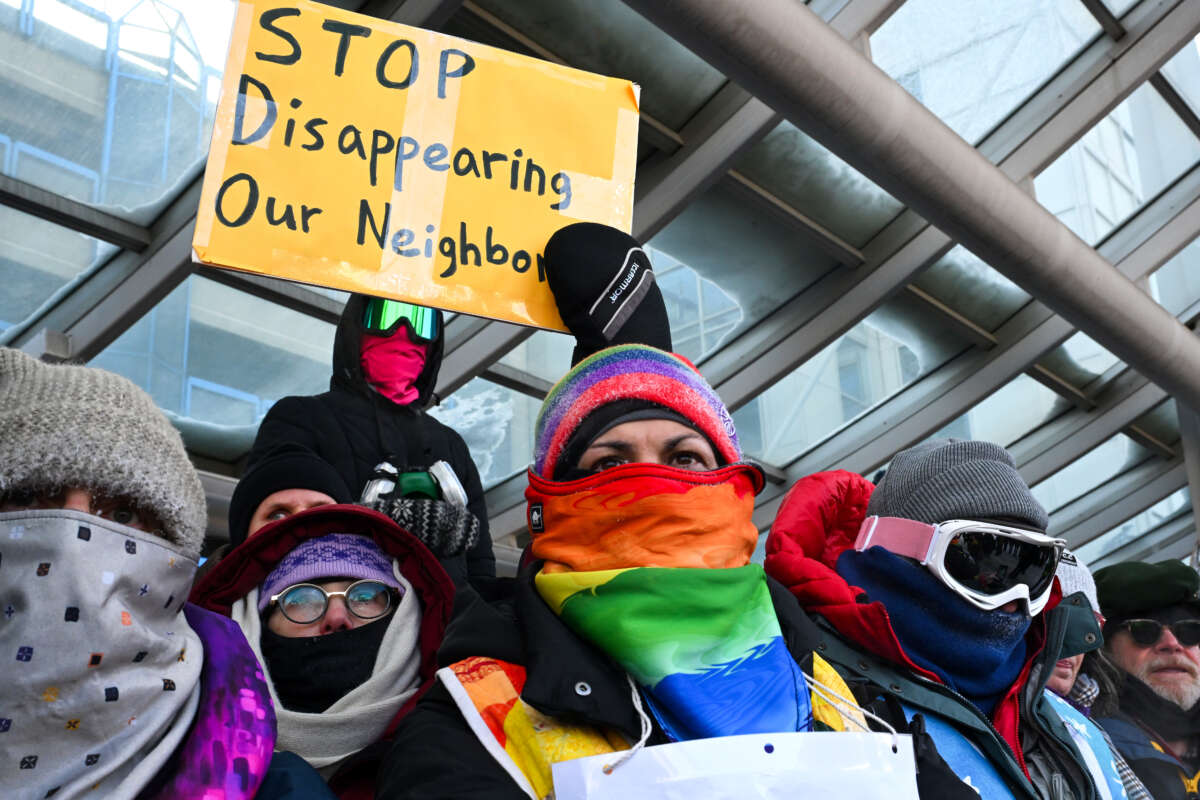
OutFront Minnesota, the state’s largest LGBTQ+ advocacy organization, cosponsored the January 23 general strike in Minneapolis that shut down the city and drew an estimated 50,000 people out to march through the frigid cold. The organization explicitly called on ICE agents to leave Minnesota and for a “full, fair, and complete investigation” into Good’s killing.
Kat Rohn, OutFront Minnesota’s executive director, said, “LGBTQ+ communities have been both deeply involved and deeply impacted by the federal occupation of our state through the current surge.” She cited the support for immigrants that her organization began galvanizing in early December 2025 through public statements of support for the Somali community, just as Trump’s racist and anti-immigrant rhetoric against Somali immigrants began ramping up. During Trump’s operation, OutFront also conducted street medic trainings for people new to protesting who “want to feel better prepared when common emergencies arise.”
“These aren’t new relationships of support,” said Rohn of the ties between Minnesota’s LGBTQ+ and Somali populations. “We’ve done previous work together addressing the impacts of bias-motivated incidents on our shared communities.”
Rohn also emphasized the overlaps between LGBTQ+ and immigrant communities in Minnesota. “Our communities are deeply intertwined,” she said. “LGBTQ+ folks are immigrants, refugees, and asylum seekers, and we are deeply committed to supporting all of our neighbors no matter who they are and where they come from.”
Anti-ICE organizing comes with great danger, as evidenced by the killings of Renee Good and Alex Pretti. Queer anti-ICE activists faced the added threat of anti-LGBTQ prejudice. One woman who was arrested during the course of monitoring federal immigration policing recalled an ICE agent referencing Good, saying, “you guys gotta stop obstructing us, that’s why that lesbian bitch is dead.”
“Many LGBTQ+ leaders have faced pointed harassment and harm from federal agents,” said Rohn. The hate is so prevalent that Gender Justice, a St. Paul–based organization, has been collecting reports of harassment from federal agents against people based on their gender, sexuality, identity, or presentation.
Such harassment hasn’t deterred residents from continuing to organize. Across Minneapolis and St. Paul, a rich network of mutual aid hubs has sprung up, centered on legal aid, food relief, rent relief, small business support, and school resources to people impacted by the ICE raids. According to Rohn, “LGBTQ+ people have been on the front lines of the community-based response to the ongoing occupation,” and are “leading many of the informal mutual aid and community organizing efforts.”
In the Powderhorn neighborhood of Minneapolis, where many of the city’s LGBTQ+ folks live, such community-based responses are ubiquitous. Among them was a February 7 fundraiser called Soup and Solidarity organized by queer-owned businesses to raised funds for Isuroon, a Halal food pantry serving East African immigrants.
Queermunity, a queer-owned co-working space and café, has a busy daily schedule of protest-related art-making, dance, massage, meditation, and yoga for people engaged in anti-ICE actions.
“It is almost block to block that people are looking after their neighbors, and a number of the LGBT leaders I met with said pretty pointedly, ‘We’re running full-scale mutual aid efforts citywide to make sure that our entire community is taken care of,’” explained Chestnut.
Smitten Kitten, an LGBTQ+-owned sex shop on the corner of Lake Street and Lyndale Avenue west of Powderhorn, jumped head-first into community organizing against ICE. As Em Cassel wrote for Autostraddle magazine, in a piece on queer-owned businesses engaging in solidarity work, Smitten Kitten became “an unlikely mutual aid hub, moving thousands of pounds of food and household items and collecting cash donations for immigrant families in need.”
The sex shop’s publicist and social media manager, Mikayla V. Stanek, explained in a message to me the impetus behind the shop’s actions: “When someone you love is under attack, you stand up and fight back.” Smitten Kitten, which has been in operation for 20 years, is using its platform to collect financial assistance for families impacted by Trump’s immigration policing. On its website, the store issued a call for cash donations to fund rental assistance.
“LGBTQ+ people are always on the front lines of every social justice movement,” said Roxanne Anderson, co-founding director of OurSpaceMN, an advocacy organization seeking to create safe spaces for LGBTQ+ communities in the Twin Cities area. Anderson has been active alongside other queer activists, “organizing locally and building power block by block, neighborhood by neighborhood, defending the most vulnerable.” Additionally, they have helped people access medical care and assisted in transporting people to and from work and school. In their words, they have been “caring for those who are caring for others.”
The federal assault on Minneapolis has driven home the fact that all city residents, immigrant and citizen, queer and straight, are relying on one another for safety and support. Other than issuing strongly worded exhortations, state and local authorities have done little to stop ICE agents from violating people’s rights. It quickly became clear that neighbors had to rely on each other to get through, and that realization sparked the rapid growth of complex and mutual webs of care.
For many LGBTQ+ activists, some of whom have personally experienced the need for mutual aid, such work comes naturally. M Nijiya, the owner of Jackalope Tattoo, told Autostraddle, “We’re used to being rejected, we’re used to having to start over and support each other.”
Chestnut sees great value in the type of organizing that has developed in Minneapolis, not just as a mechanism for surviving the current crisis but for long-term resilience. “It’s pretty profound in terms of the world-building that it’s doing,” he said. “Years from now, when people are feeling like they can go back into their communities and be safer, they’ll know that their neighbors are that much more connected and that it was the trans person that lives three doors down from them who was making sure they had groceries every day when they couldn’t leave their house.”
Trump’s assaults on LGBTQ+ and immigrant communities have been intended to divide the nation. But they’ve had the opposite effect in Minneapolis. “We’re seeing a real awakening now and across movements, whether that’s the immigrant rights movement, racial justice movements, trans movements, youth movements,” said Chestnut. “People are seeing our issues are connected, and that we all deserve the freedom to thrive.”
In the face of Minneapolis’s organized responses, the federal government finally announced an end to its violent operations (as of this writing, a third of federal forces have reportedly left the city, but there appears to be an uptick in enforcement activity in the suburbs outside the Twin Cities). In his announcement of ICE’s drawdown, border czar Tom Homan claimed, “The surge is leaving Minnesota safer.” Minnesotans know the opposite to be true — that the federal government effectively waged a 70-day war on their communities, leaving them scarred and violated. But, if the webs of connection that LGBTQ+ and others have formed with one another remain as strong as they did over the past two months, Minnesotans will have new webs of resiliency to rely on in the future.
“I would like to believe that people will hold this in their hearts for many generations to come,” said Chestnut. “Yes, it is a very dark and harrowing time for this country. But also, people chose to rise up and say, ‘Our issues are interconnected and we cannot separate them.’”
A terrifying moment. We appeal for your support.
In the last weeks, we have witnessed an authoritarian assault on communities in Minnesota and across the nation.
The need for truthful, grassroots reporting is urgent at this cataclysmic historical moment. Yet, Trump-aligned billionaires and other allies have taken over many legacy media outlets — the culmination of a decades-long campaign to place control of the narrative into the hands of the political right.
We refuse to let Trump’s blatant propaganda machine go unchecked. Untethered to corporate ownership or advertisers, Truthout remains fearless in our reporting and our determination to use journalism as a tool for justice.
But we need your help just to fund our basic expenses. Over 80 percent of Truthout’s funding comes from small individual donations from our community of readers, and over a third of our total budget is supported by recurring monthly donors.
Truthout’s fundraiser ends tonight! We have a goal to add 143 new monthly donors before midnight. Whether you can make a small monthly donation or a larger one-time gift, Truthout only works with your support.