Truthout is an indispensable resource for activists, movement leaders and workers everywhere. Please make this work possible with a quick donation.
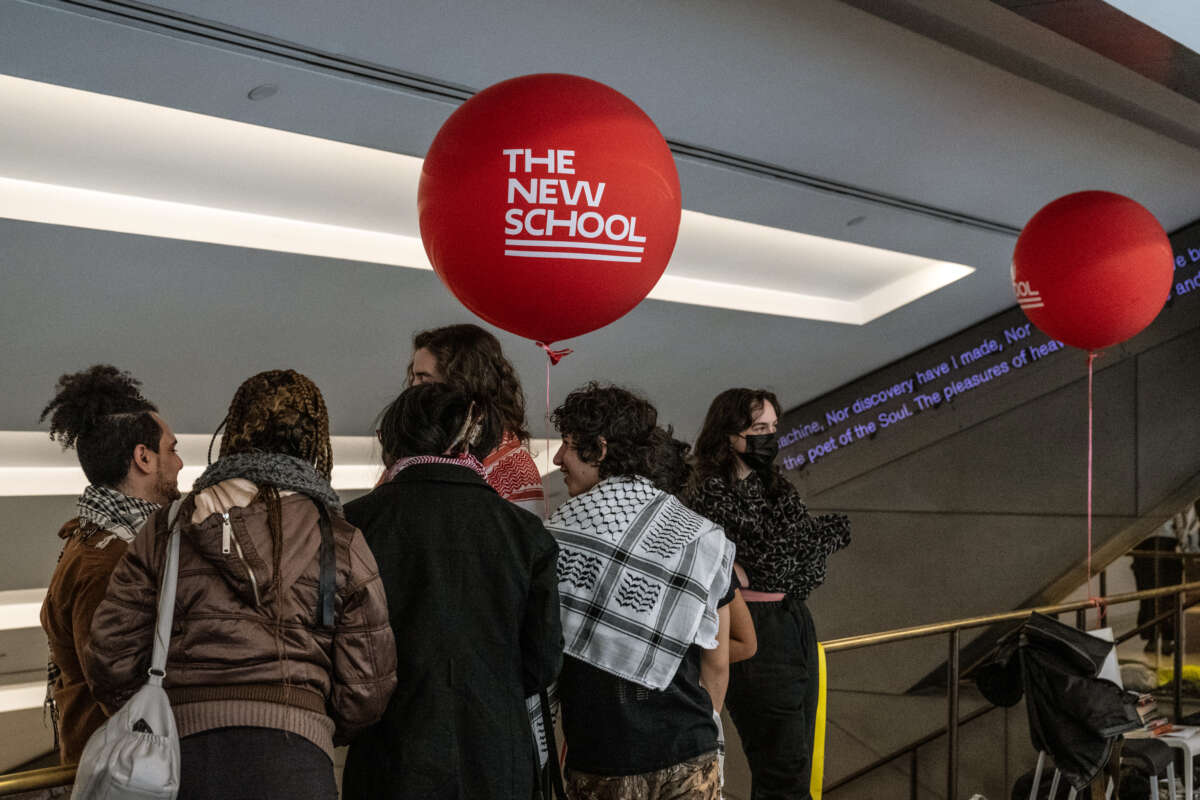
Ryder Glickman’s first day as chair of The New School University Student Senate (USS) was an eventful one. His inaugural act was to call a vote on a first-of-its-kind resolution to sanction Hillel at The New School. This vote followed the release of a 38-page report detailing Hillel’s potential violations of international law.
The report, conducted by a student committee, outlines Hillel’s participation in programs with the Israeli military. Before and during Israel’s genocide in Gaza, the campus organization was linked to a volunteer program at Israeli military bases from which attacks on Gaza and Lebanon originated.
Glickman stood in front of the student senate. “I laid out the facts of the report,” he told Truthout. “I tried to keep it brief and towards the end I said: ‘This is one of the most principled acts that you can make while you’re in the Senate. This is much bigger than us. This has the potential to change the student movement in the U.S.’”
With that, the Senate took an anonymous vote and the resolution passed with a majority — designating Hillel at The New School “not in good standing” and ineligible for student funding. The New School Student Senate’s decision signals a possible shift in the strategy of the campus movement for Palestine: Instead of attempting to sway unaccountable boards of directors, some students are finding new ways to exercise the power they hold themselves.
Mopping the Floors of Military Bases
In January, the USS outlined its strategic goals for the year, among them ensuring that all registered student organizations adhere to international law. Glickman, who was at that point a member of the USS but not yet its chair, referenced New York City Mayor Zohran Mamdani’s commitment to international law as an inspiration. “We felt that at a local scale, at a university scale, this is something we can deliver to our students, starting with the allocation of USS fees” he said.
The USS created a new body — the Registered Student Organization Compliance Committee (RSOCC) — to monitor student groups potentially in breach of administrative and student government policy and restrict student funds if necessary. The RSOCC cited university administrative policy about student organization procedures, which states that “violations of university policy, or federal/state/city law could result in an organization receiving a suspension, probationary status, or immediate revocation of their registration status — pending investigation and deemed responsibility.”
On April 17, following a vote by the University Student Senate, the RSOCC launched an investigation into Hillel at The New School. The findings were stark. Hillel at The New School, a subsidiary of Hillel at Baruch College (itself a part of Hillel International’s campus network), participates in multiple programs in which students volunteer at Israeli military bases. One of these programs is “Hillel on Base.”
Instagram content cross-posted by Hillel at Baruch and Hillel at The New School shows students clad in Israeli military uniforms at military bases performing manual labor, mopping floors, gathering trash, moving supplies, training with military officers, and socializing with soldiers who had recently returned from Gaza. Truthout independently verified that multiple students from The New School have gone through the program.
Another program that Hillel at Baruch and Hillel at The New School collaborate on is Onward Israel, a post-birthright trip during which students have the option to join Sar-El Volunteers for Israel and “directly assist Israel’s defense efforts, from organizing supplies to supporting essential logistics for the IDF.” (Hillel at The New School, Hillel at Baruch, and Hillel International did not respond to questions about these programs. In a statement to The Times of Israel, Hillel International CEO Adam Lehman claimed The New School USS was “[d]emonizing Hillel with false charges rooted in age-old antisemitic tropes.”)
Two of the Israeli bases where Hillel students volunteer through these programs are Hatzerim airbase and Tze’elim Army Base. Hatzerim is located 19 miles from Gaza and has served as a launching pad for hundreds of airstrikes on both Gaza and Lebanon. Tze’elim Army Base is an urban warfare training center in the Negev region of Israel, dubbed “Mini Gaza.” Known as an inspiration for Cop City in Atlanta, Georgia, Mini Gaza is an Israeli military training site for occupation tactics deployed on Palestinians in the West Bank and Gaza.
Based on this evidence, the RSOCC report concluded: “This is not tangential or incidental support. It is a direct material contribution to the operational capacity of an institution engaged in what multiple international bodies have characterized as the gravest violations of international law of the 21st century.”
The RSOCC recommended the University Student Senate vote to restrict funding for Hillel at The New School until it disaffiliates from Hillel International and ceases participation in Hillel on Base and Onward Israel.
International law expert, professor emerita at Thomas Jefferson School of Law, and Truthout contributing writer Marjorie Cohn concurs with the RSOCC’s analysis. “The Genocide Convention prohibits individuals (as well as states) from complicity in genocide,” she wrote in a statement to Truthout. “The New School has a duty to ensure that its organizations, including Hillel, comply with international human rights law … Restricting funding for Hillel because of its complicity in Israel’s international human rights violations is an appropriate remedy.”
The day after the USS vote, Glickman met Truthout in Washington Square Park for an interview. During the conversation, The New School President Joel Towers, Provost Richard Kessler, and Vice Provost Robert Mack released an email to the campus community responding to the USS’s decision. Glickman read the email aloud:
“The USS statement positions its action as a matter of principle and democratic process; it is neither. By distorting a qualified student organization and characterizing it as something it is not, the USS is using its platform to target fellow students in a misguided attempt to hold those students responsible for the acts of governments.”
Glickman paused to share his initial thoughts. “This is nonsense, a complete layup, the easiest thing to respond to,” he said. “It doesn’t address any of the information in the report.”
The university administration’s communication refuted the power of the USS to restrict funds to student organizations and declared its intention to continue funding Hillel. In response, the USS shared a statement reading: “The University Student Senate will continue to sanction Hillel at The New School … until [it] ends [its] direct material collaboration with a foreign military, [it] will not be receiving any funds from the student body through the Student Senate.” (President Towers, Provost Kessler, and Vice Provost Mack declined Truthout’s requests for interviews and did not respond to a detailed list of questions.)
Sydney Lopin, co-president of the Jewish Culture Club, the longest-standing Jewish organization at The New School, takes issue with the administration’s response. “Claims by the administration that this resolution is meant to discriminate against anyone [are] illegitimate. The email from our president was entirely dismissive of a lot of dedicated work and research.”
The Jewish Culture Club hosts religious services and educational events, including a recent screening of “Israelism” and a teach-in with Jews for Racial and Economic Justice. Lopin and the Jewish Culture Club support the USS’s decision to sanction Hillel. “As Jews committed to our traditions of justice, we are outraged by Hillel’s attempts to conflate Judaism with Israel,” said Lopin. “Hillel’s support for Israel’s genocide is incompatible with it being a safe and welcoming space for students.”
A Pattern of Campus Intimidation
In 2023, Rose Ottallah, a Palestinian American student who was pursuing a master’s degree in international affairs at The New School, helped revive a campus chapter of Students for Justice in Palestine (SJP). The same weekend that the Columbia University encampment launched in April 2024, The New School SJP erected their own encampment, demanding the board of trustees divest from companies contributing to Israel’s genocide in Gaza.
“People were itching to do something impactful. Within two days, we had tents, posters, food supply, you name it,” said Ottallah. “It started with the core members of SJP, but everything that happened afterwards was so organic. Teachers, students, people across the city wanted to participate. It was a true grassroots effort.”
But the administration and some members of the campus community were adversarial towards the pro-Palestine movement. On the 13th day of the encampment, former New School President Donna Shalala asked the New York City Police Department to intervene, leading to the arrest of 45 students.
Meanwhile, some of the activists’ peers doxxed their fellow students and took pictures and videos of them. “Being Palestinian, having lived in Palestine, the threat of surveillance was really nerve-wracking,” said Ottallah.
A member of Hillel at The New School even posted on social media calling for international students who participated in the encampment “to be deported to their country of origin and never be given entry into the United States ever again.” Glickman said this same student has been lobbying The New School administration to suspend him from the USS.
Immediately after the USS voted to sanction Hillel, Glickman received emails and Instagram messages with photos of donations made under his name to Israel-aligned nonprofits like Friends of the IDF, Hillel, and the Anti-Defamation League.
While the encampment ended in mass arrests and the suspension of SJP, and ultimately failed to achieve its demands, it was a point of inspiration that had ripple effects. Many students at the encampment stepped into organizing roles for the first time. Among them was Ryder Glickman.
“As we were all getting arrested, I was terrified,” Glickman said. “But seeing how steadfast and principled Rose [Ottallah] was in that moment, it changed the trajectory of my life in terms of the importance of being principled and fearless in the face of oppression. I joined the USS because of the encampments. This is me following through two years later.”
A New Movement Roadmap
The USS decision to sanction Hillel was the culmination of a textbook inside-outside strategy. A coalition of students outside the halls of student power coalesced to spread the word about Hillel’s connections to the Israeli military. Student activists distributed posters with the tagline “Hillel funds genocide,” which Glickman described as “a spark for the campus conversation.”
Members of the USS were also in contact with the international “Drop Hillel” campaign and organizations such as Jewish Voice for Peace. “It was a plurality of tactics where you can have groups with organized, principled, anti-Zionist politics, but then you also have comrades in the Senate who will advance these resolutions through recognized channels,” said Glickman.
Ultimately, Glickman believes the USS’s action will proliferate across the student movement. “The goal of this is to produce a blueprint which other schools can follow, and those talks and conversations are already happening,” he said. “In divestment campaigns, you have to tell your asset manager to divest. Students can’t just do that,” he continued. “But what they can do is pass a resolution saying: ‘We quite literally see you advertising that you are on foreign military bases, serving a military in violation of international law.’ You don’t need approval from your administration to take this action.”
While it has yet to be seen if the administration will successfully bypass the USS’s decision, Glickman said the sentiment on campus was encouraging. “The reaction was that this is the only good thing that has happened since the encampments,” he said. “This is just the beginning. The first step is to show that this is possible.”
Press freedom is under attack
As Trump cracks down on political speech, independent media is increasingly necessary.
Truthout produces reporting you won’t see in the mainstream: journalism from the frontlines of global conflict, interviews with grassroots movement leaders, high-quality legal analysis and more.
Our work is possible thanks to reader support. Help Truthout catalyze change and social justice — make a tax-deductible monthly or one-time donation today.