Truthout is a vital news source and a living history of political struggle. If you think our work is valuable, support us with a donation of any size.
Emmett Till is someone that we know through documentaries, writings, photos, and inadequate history lessons. Open Casket: Philosophical Meditations on the Lynching of Emmett Till draws us unsettlingly and lovingly close to Emmett Till, and to his mother, Mamie Till-Mobley. George Yancy’s and A. Todd Franklin’s breathtaking new anthology brings us face-to-face with the disquieting sorrow of Black death, and the unsettling reality that Emmett Till does not rest in peace.
Published to mark the 70th anniversary of Emmett Till’s death, Open Casket is a potent reminder that bearing witness to the horrors of white supremacy is a historically rooted collective grieving process that has particular resonances for Black people — and anyone with a moral conscience. Each essay upends the attempted erasure of the horrors wrought on a Black 14-year-old child by white adult men and the system designed to protect them. This collection raises questions that complicate our thinking about Emmett Till and Mamie Till-Mobley, victimhood, the politics of refusal, Black maternal militancy, Black agency, and more.
This book attests that for Black people living in an anti-Black society, our mourning and mournability are part of our story, but they are not the full story. Readers are invited to bear witness and tarry with Mamie Till-Mobley as she rejects suggestions to keep her only child’s funeral private and hidden from public view. Her act of Black maternal resistance connects us to the slave ship and bridges the gap between 1955 Jim Crow Mississippi and today.
While it rigorously interrogates the past, Open Casket illuminates the present with unflinching and piercing insight. The text unfolds with profound clarity and care. While many people have moved on because they can, our collective psychological and emotional wounds remain tender. We see ourselves in Emmett Till and Mamie Till-Mobley precisely because we know that no amount of Black suffering and Black death has been enough to unsettle white supremacy.
Yancy and Franklin’s book is conceptually rich, and analytically sharp. It honors Emmett Till and Mamie Till-Mobley by calling on all of us to see and to act.In the interview that follows the authors discuss the psychological terror of Emmett Till’s murder, the politics of Black maternal grief, unmasking the grotesque as a process of truth-telling, bearing witness, and more. Open Caskett honors Emmett Till and Mamie Till-Mobley by inviting us to engage with death and grief as communal, political, and philosophical processes while stirring us toward action.
Kim Wilson: Todd, you write about Mamie-Till Mobley’s strength and the unbearable pain that she must have felt when she saw what white racists did to her son, Emmet (aka Bobo, Bo). Can you say more about the collective psychological weight that Emmett’s murder has placed on communities that claim him? Relatedly, how does the book help to complicate our thinking about the strength required by Mamie Till-Mobley, and by extension, all Black mothers that have had their children stolen from them by white supremacy?
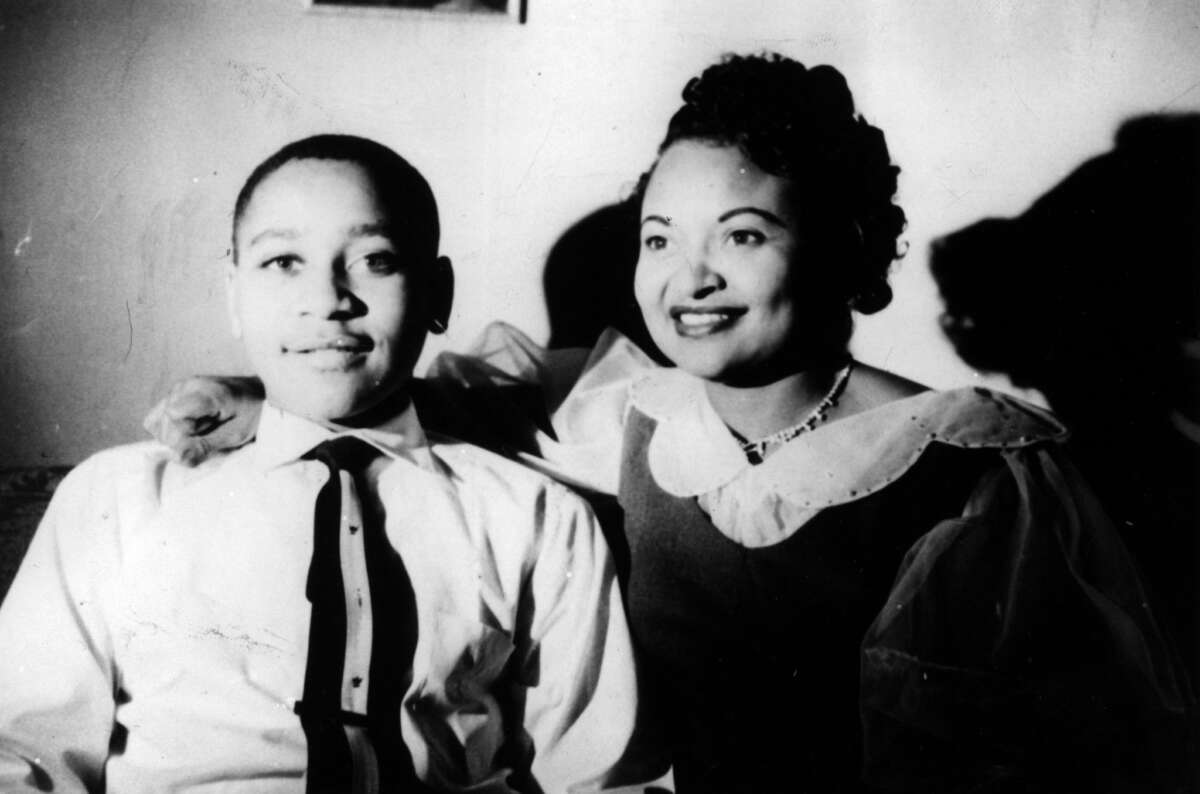
A. Todd Franklin: The image chosen for the book’s cover speaks volumes about the psychological weight carried in the aftermath of Emmett Till’s murder. In one sense, it offers a meditation on erasure. There is a mother, and there are images of a mother and her son; and yet, the son himself is not there — in his stead is a casket. As framed, he has been physically taken from us, much as our children and loved ones are taken from our own communities by the violence of white supremacy.
What remains visible is the pain of such loss. The image also foregrounds the psychological terror of being susceptible to erasure: Insofar as one can look at the images inside the casket and see oneself, one confronts the terrifying prospect of sharing in Emmett’s demise. Powerfully, though, the image also frames a refusal to be nullified. Emmett was more than a victim of white supremacist violence — he was a beloved son, and the image viscerally captures and relays his being as such in virtue of both the photographic evidence on display in his casket and the gut-wrenching reaction of his mother as she is forced to grapple with him lying in it.
Such juxtapositions were not there by accident. Mamie Till-Mobley expressly chose to have her son publicly lie in repose in an open casket so as to complicate and confound the white supremacist logics that led to his murder. In doing so, she exemplified an unparalleled strength and determination to refuse to allow that which took his life to rob him of rightful regard for his human dignity. Many Black mothers, yourself included, find similarly challenging ways to complicate and confound the white supremacist logics, practices, and systems that continue to rob us of our children.
This is a book that merits care-full reading. I found myself putting it down every few pages to make room for the feelings that arose. I wanted to honor the space between the task at hand (reading the book), and a mother’s piercing call for us to see what they did to her beautiful son. What insights do the contributors offer us into understanding the relationship between private and public grief?
Franklin: I’m grateful that you centered care. Indeed, the call is to read this text with care — not simply with sympathy, but with resolve. Put plainly, it is a call to care enough to act, individually and collectively, in ways that press society to acknowledge and confront anti-Black racism. Many contributors underscore the way the public grief of a racial community besieged by white supremacist violence emerges from a heart-wrenching private grief that extraordinary individuals like Mamie Till-Mobley refuse to be undone by. Instead, she — and others like her — belong to a long tradition of Black maternal figures and other Black folk who rise from the depths of despair to creatively transform their grief into emotionally charged and intellectually compelling airings of their grievances against the subjects and systems that trespass against us.
Black suffering is largely dismissed in the white public imagination. By putting Emmett’s battered body on display, Mamie Till-Mobley was able to not only publicly condemn white womanhood, white lies, and whiteness in general — she challenged the nothingness of Black life and rewrote the course of history. We all know who Emmett Till was. Few of us remember the names of the white people involved in his torture and death. We are in a moment in history where we are being politically collectively gaslit by people that want to erase America’s history of racial violence (arguably this has always been the case). What does truth-telling look like for us right now in light of Emmett Till and Mamie Till-Mobley?
Franklin: Mamie Till-Mobley made history — she rendered present, and ever-present, both her son and the horror that took him from her. She made Emmett matter in a way that disrupted the callous ease with which Black life, and the taking of Black life, are too often consigned to oblivion.
Following in her wake, truth telling becomes a matter of unmasking the grotesque. Many looked at Emmett and saw a grotesque face. Yet truth be told, there were many white faces — “beautiful” and “manly” — that masked a far deeper grotesqueness. Those hidden behind such faces were grotesque in their very being. Today, there are many like them: Some wear makeup and serve as broadcasters, some wear uniforms and badges, some wear dark suits and red ties, and all impugn and imperil Black people under the guise of serving and protecting what they “rightly,” or rather “whitely,” take to be the nation’s interests.
George, in the introduction to the book, you draw a distinction between bearing witness and being a spectator. Can you explain the difference, and help us understand how Mamie Till-Mobley’s decision to let the world see what she saw transformed the process of bearing witness into a political act?
George Yancy: That distinction became important to me as I thought about Saidiya V. Hartman’s text, Scenes of Subjection, where she warns against confusing indignation in response to seeing brutalized Black bodies with a form of voyeurism or fascination regarding the assault and dehumanization of Black bodies. Spectatorship, for me, can function as a form of voyeuristic pleasure, a form of Black trauma porn. Think here of those white spectators during the lynching of Black bodies. Those sites were treated as picnics, where white people came to “confirm” and “justify” their white being, their “sacred” white humanity. They were sites of a white libidinal economy where forms of white perverse pleasure and white phobias were animated. To truly bear witness to such anti-Black horror, however, is to carry the near impossible weight of that trauma, which involves a profound sense of vulnerability and shared suffering. It is a way of communicating and communing with the Black dead and dying that says, “We see you, we testify on your behalf, and we will help to carry you.” Through the open casket, Mamie Till-Mobley invites Black people to see the grotesquerie of anti-Blackness, while also loving the young beautiful Black boy, Emmett Till. And all of this, for Mamie, had to be done publicly. That public mode of bearing witness implicated and indicted the United States regarding its terrible and ugly history of gratuitous violence against Black people. The power of the collective loving Black gaze, and its refusal to look away from the results of the lie of American white “innocence,” is the political act.
For Black people living in a white supremacist settler colonial heteropatriarchal society, death is always proximate, looming, and ever-present in our lives. The ways that we are socialized to relate to death in the U.S. only reinforce our alienation from death, but not the dead. As a Black mother to Black adult children, two of whom are currently sentenced to life in prison, death is something that I think about often — more than it is healthy to do so, but not more than I believe that we (Black people) think about it, even if we never disclose our fears. Many, arguably most of us, are in a perpetual state of mourning for both the living and the dead. You write, “As I see it, Black death is, as it were, a suture that helps to protect the quotidian health of whiteness.” Can you say more about this?
Yancy: I appreciate your vulnerability, Kim. I feel you, and I bear witness to your Black maternal love and how it is painfully entangled with both Black physical and social death. I am reminded of Claudia Rankine, who writes, “Dead blacks are a part of normal life here. Dying in ship hulls, tossed into the Atlantic, hanging from trees, beaten, shot in churches, gunned down by the police or warehoused in prisons.” Black people are a death-bound people, but not because we are simply human and finite. It is because death is right there as we jog, as we shop, as we drive, as we sleep in our own homes, and as we attempt to be in a country that is hegemonically white and structurally anti-Black. This is not to deny that white people are not aware of processes of death and dying, but death haunts our Blackness because our “right to life” has never felt like an untarnishable political axiom or an undeniably upheld moral imperative in this country. I am familiar with the powerful and constant sense of mourning that you speak of. It is not enough that we mourn the murder of, say, George Floyd. We also mourn our living Black children who are always on the precipice of being killed, that is, who are always killable because of their Blackness, and whose Black flesh is always exposed to bullets fired from guns in the hands of those who are said to serve and protect. This reality dialectically affirms the existential value of white life. In other words, white people move through the world, because they are white, with effortless grace. They jog, shop, and drive with effortless grace, because death, which always hovers near Black life, secures their life, their very being, and provides for them psychic coherence and protection against the constant anguish that I experience as I fear that my Black children may not return home alive.
Black suffering has never been enough to persuade white people to dismantle white supremacy. But the power in what Mamie Till-Mobley did was to center Black people in a conversation about Black people, even if white people looked on. Her decision was an act of creative resistance. Can you help us contextualize this within the Black Radical Tradition?
Yancy: Part of the problem is that Black death secures the fiction of white supremacy and white innocence, and yet, paradoxically, Black life also secures the fiction of white supremacy and white innocence. In both cases, Black bodies function as the ontologically abject. This is a case where Black abjection metabolizes whiteness, reinforcing its power, privilege, and mythical standing as the apex of humanity. Hence, whether dead or alive, Black bodies are ungrievable. Part of that dismantlement will begin once white people — as James Baldwin made clear in his interview with Kenneth Clark in 1963 — “try to find out, in their own hearts, why it was necessary to have a ‘nigger’ in the first place.” In asking/facing that question, perhaps white people will understand the poisonous emptiness that is whiteness. But that is the responsibility of white people, not ours. However, it is our responsibility, despite the near impossible odds, to resist. In Black Marxism, Cedric J. Robinson points out that indicative of the Black Radical Tradition is the sense that as Black people we obtain freedom on our own terms. This is what Mamie Till-Mobley did according to her own revolutionary love and resistance. This is what Malcolm X did as he spoke truth plainly about anti-Blackness in the U.S. and European colonization in Africa. It is what Ida B. Wells did in her anti-lynching crusade, even though a bounty was placed on her head. Speaking about the logics of the Black Radical Tradition and its resistance to white forms of domination, Robinson points to the importance of “the continuing development of a collective consciousness informed by the historical struggles for liberation and motivated by the shared sense of obligation to preserve the collective being, the ontological totality.” This quote speaks to Mamie Till-Mobley’s effort to mobilize a sense of Black collectivity despite the violent effacement (literally, to remove the face) of Till’s humanity. As Black people looked at and looked beyond such unconscionable cruelty, they were able to express an ontological totality, a sense of collective humanity, that refused to be limited by the malicious structure of whiteness.
I’m grateful to you both for taking up the intellectual work of helping us all to see more clearly. I see the emotional labor that went into this volume. That work is visible to those of us who resist, organize, and fight like hell against the dehumanizing systems that want us to believe that we don’t matter (ontological nullity). I’ll speak for myself, as a Black mother, of Black adult children — who deeply identifies with every Black mother that has lost children (even if they are still living), thank you for this work. You remind us in so many words that our children matter, that we matter, that we have always mattered to each other! What do you want people to think of when they think about Emmett Till and Mamie Till-Mobley?
Franklin: This was a project neither of us wanted to undertake, but both of us recognized that it was one we had to. Socially, politically, and personally, it captures what is most important to us — the affirmation of Black humanity and the effort to build a world consonant with it. Our hope is that through these poignant and wide-ranging philosophical reflections on this fateful Black mother and son, readers will see the power of refusing to be rendered unseen or silent.
To read this book is to engage in an act of collective grief. I was very much aware that I had to attend to the grief that I was feeling, even if that awareness did not shield me from the feelings I held. A therapist friend reminds me that under oppressive systems we don’t live dignified lives, and that we deserve dignified deaths. But I wonder, where is the dignity in being unjustly killed? Can we reclaim, or perhaps, less ambitiously, claim dignity in the wake of horror? This book is a good place to contemplate these questions.
Franklin: Far too many Black people, like young Emmett, have been robbed of the opportunity to die dignified deaths. But the manner of death should never be mistaken for a measure of the dignity inherent in being human, or in being interwoven within a community that holds one lovingly. If nothing else, this volume invites readers to contemplate what it means to truly and fully see our own lovingly in what too often proves to be a loveless world. As you rightly note, this work is emotionally taxing — and no less so in moments like this, when we speak about it publicly. For us it is often a matter of trying to steady ourselves and hold enough of our composure to carry the conversation through. Here, however, we both lost it when you said you were shattered.
We are with you!
We both shed tears with you, and we hope readers understand that the work is not simply about claiming those violently claimed by the horrors of white supremacy, but also an act of claiming those shattered by it and left to piece together the shards in ways that forge a mirror that foregrounds a community fully committed to demanding the human dignity we are due against the background of a social world that offers us so little.
The banality of horror in our lives is precisely what obscures those horrors that are closest to us, and renders illegible (and often, invisible) the horrors that are often right under our noses. I draw parallels between the way those men terrorized Emmett that night, and my sons being sentenced to life in prison. I fight the comparisons, and at the risk of being misunderstood for admitting this, I see the way that white supremacy structures all of our lives. When I look at my sons, I see the boys they were, the stolen years that we can never reclaim, and the systematic destruction of their hearts, minds, and bodies. No, it’s not the same, but there is a shared horror. I see, in a way that I believe this book wants me to see, the glaring similarities between the slow death of incarceration and the excruciatingly torturous, and not swift enough death of Emmett, Mamie Till-Mobley’s son. I’m shattered!!! How does the book help us to understand Black motherhood and the politics of claiming?
Yancy: I think that the book encourages readers to understand that Black pain and suffering are both quotidian (as in anti-Black microassaults and microinvalidations) and spectacular (as in a public lynching). But given the history and pervasiveness of anti-Blackness, perhaps it can all be described as quotidian: routines of white bloodlust. Kim, you’re not being misunderstood at all. Black forms of death and dying ravage both the Black body and the souls of Black folk whether this is on the streets (Eric Garner), in a barn (Emmett Till), or in prison (your sons). White supremacy is like a Leviathan, and its monstrous reach is unavoidable. And it existentially and psychically shatters Black lives. The book speaks directly to Black motherhood by focusing on Mamie’s courage and daring, but not through the prism of romanticization. Those of us who are cisgender Black fathers, we can’t give birth to Black sons. Black mothers feel that ever faint kick of love from the inside, from the matrix of their bodies. It is that mode of intimacy that inflects the pain of loss, the anguish of having one’s Black child held captive by systems of oppression. In this case, Black sons are already claimed through the warmth and protection of the Black womb. That is both unspeakably beautiful and yet tragic. Why tragic? Because that intimacy is under threat by an anti-Black system that doesn’t give a damn about your womb or the thriving life within it. So, the precarity of Black life begins in utero. In this case, Black women, from the beginning of pregnancy, are intimately and silently laying claim to their Black bodies and their Black babies. Our book honors the revolutionary acts of political claiming enacted by Black women from the past, in the present, and in the future.
Media that fights fascism
Truthout is funded almost entirely by readers — that’s why we can speak truth to power and cut against the mainstream narrative. But independent journalists at Truthout face mounting political repression under Trump.
We rely on your support to survive McCarthyist censorship. Please make a tax-deductible one-time or monthly donation.