Truthout is an indispensable resource for activists, movement leaders and workers everywhere. Please make this work possible with a quick donation.
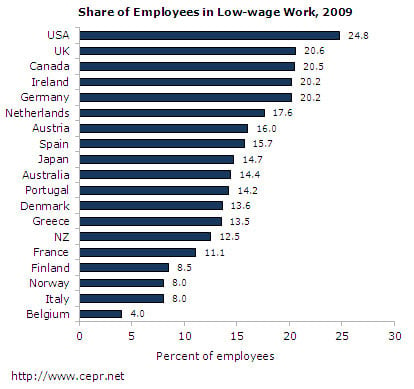
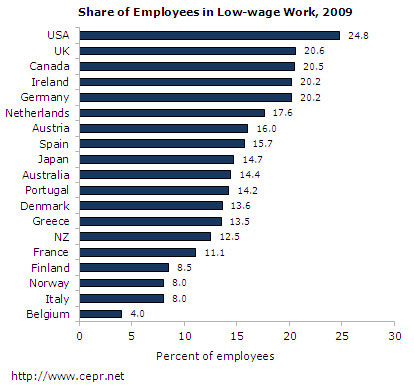
Over the last two decades, high – and, in some countries, rising – rates of low-wage work have emerged as a major political concern. According to the Organization for Economic Cooperation and Development (OECD), in 2009, about one-fourth of U.S. workers were in low-wage jobs, defined as earning less than two-thirds of the national median hourly wage (see first figure below). About one-fifth of workers in the United Kingdom, Canada, Ireland, and Germany were receiving low wages by the same definition. In all but a handful of the rich OECD countries, more than 10 percent of the workforce was in a low-wage job.
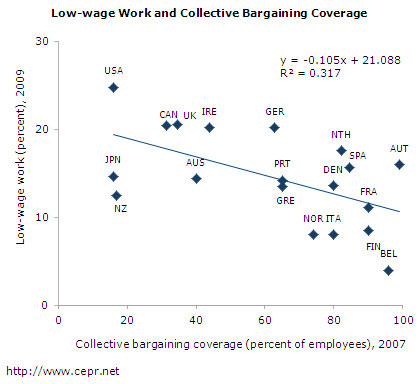
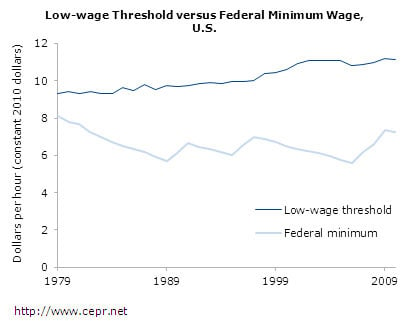
If low-wage jobs act as a stepping stone to higher-paying work, then even a relatively high share of low-wage work may not be a serious social problem. If, however, as appears to be the case in much of the wealthy world, low-wage work is a persistent and recurring state for many workers, then low-wages may contribute to broader income and wealth inequality and constitute a threat to social cohesion. This report draws five lessons on low-wage work from the recent experiences of the United States and other rich economies in the OECD.
 Read the full report here.
Media that fights fascism
Truthout is funded almost entirely by readers — that’s why we can speak truth to power and cut against the mainstream narrative. But independent journalists at Truthout face mounting political repression under Trump.
We rely on your support to survive McCarthyist censorship. Please make a tax-deductible one-time or monthly donation.