Honest, paywall-free news is rare. Please support our boldly independent journalism with a donation of any size.
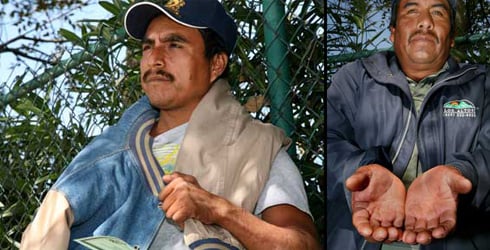
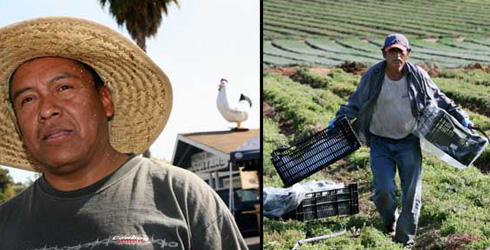
Oceanside, California – In Oceanside, Carlsbad, Del Mar and north San Diego County, immigrant day laborers wait by the side of the road, hoping a contractor will stop and offer them work. Alberto Juarez Martinez slings his jacket over his shoulder while he waits. His hands show the effect of a lifetime of manual work, plus arthritis suffered as a child in Zapata, Zacatecas. The hands of Beto, a migrant from Uruachi, Chihuahua, also show the effect of a lifetime of manual work. Juan Castillo, a migrant from Tehuacan, Puebla, waits with his friends in the parking lot of a market they’ve nicknamed La Gallinita, because of the rooster on the roof of the building.
<!— picture info —>
<!— end picture info —>
Police in north county towns have started cruising by day labor sites in plainclothes, pretending to be contractors offering workers jobs, and then citing them and turning them over to immigration agents, even those with green cards. Many community organizations are protesting this practice.
<!— picture info —>
<!— end picture info —>
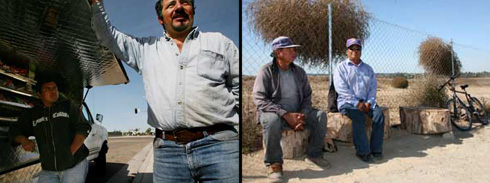
Francisco Villa operates a lunch truck that visits the areas where migrant day laborers live on hillsides and under trees. Villa hands out leaflets advising workers of their rights and letting them know that they can find help from California Rural Legal Assistance. Across the street from Villa’s truck, Zaragosa Brito and Andres Roman Diaz, two migrants from Arcelia, Guerrero, sit next to a fence where workers look for day labor, or get rides to the fields for farm work. The men sleep out in the open in the field behind the fence, and have worked on a local strawberry ranch, Rancho Diablo, for many years.
<!— picture info —>
<!— end picture info —>
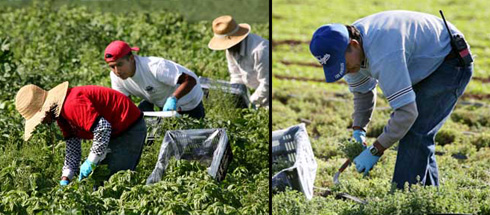
A few miles away, farm workers harvest marjoram and basil at Herb Thyme Farms in Oceanside. Harvesting marjoram means using a short knife that requires workers to work bend over double. Years of this labor can cause permanent damage to the spine.
<!— picture info —>
<!— end picture info —>
One possible future for migrant farm laborers is visible in a crew of workers picking tomatoes on the Camp Pendleton Marine Corps base. These are H2-A guest workers, recruited in Mexico by grower Harry Singh. On the base, the workers are hidden in the rows behind a barbed wire fence, and outside labor organizers or legal advisers can’t gain access. At the end of the day, these guest workers are taken to a labor camp on Singh’s ranch, where access is also restricted in order to keep them isolated from the surrounding community. H2-A guest workers can’t leave their jobs without being deported back to Mexico. They fear that if they protest or even speak with legal aid, they won’t be hired the following season. Singh used to be the only California grower importing H2-A workers, but now there are several. The number is growing.
<!— picture info —>
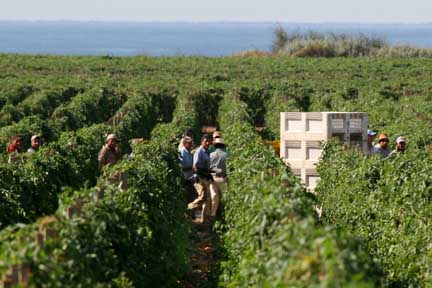
Photos by David Bacon.
An urgent appeal for your support: 5 Days to raise $34,000
Truthout relies on individual donations to publish independent journalism, free from political and corporate influence. In fact, we’re almost entirely funded by readers like you.
Unfortunately, donations are down. At a moment when independent journalism is urgently needed, we are struggling to meet our operational costs due to increasing political censorship.
Truthout may end this month in the red without additional help, so we’ve launched a fundraiser. We have 5 days to hit our $34,000 goal. Please make a tax-deductible one-time or monthly donation if you can.