Part of the Series
Struggle and Solidarity: Writing Toward Palestinian Liberation
Support justice-driven, accurate and transparent news — make a quick donation to Truthout today!
Japan is a great geographical distance from Israel’s killing fields in Gaza. But the nature of the global supply chain is bringing Israel’s genocidal assault into Japan’s orbit. Japan BDS, the local formation of the international Boycott, Divestment, Sanctions (BDS) movement for Palestine, is claiming a special responsibility to end Japanese robot makers’ complicity in Israel’s campaign of extermination.
At the beginning of 2024, Shir Hever, international coordinator of the military embargo campaign for the BDS movement, alerted Japan BDS that Japanese industrial robots being marketed globally to auto and medical equipment manufacturers were also being used in Israel’s weapons factories. Hever told Truthout this revelation merited the robots’ reclassification as a “dual-use” item — meaning that it can be used in both civilian and military contexts. Activists are targeting exports of dual-use items, like more easily identifiable weaponry, noting that their sales to Israel as it conducts its genocide could be in violation of international law. But, Hever added, there are inherent complications.
“In talking about dual-use items, the law becomes much more vague and open to interpretation,” Hever explained. “Basically, there is no single definition of what is a dual-use item. In fact, it’s only a post- or ante-definition once something has been used to make weapons or has been weaponized. But until this actually happens, and until you can prove it, it’s very difficult to say definitively.”
The issue is not isolated to Japan; other countries too have found that items more commonly associated civilian products have ended up in use by the Israeli military. For example, Hever said a Palestinian journalist found a small component with a “Made in Germany” sticker in the wreckage of an Israeli rocket attack on the West Bank last July. After posting a picture online, volunteer movement researchers recognized the piece as a pressure regulator from an air conditioner and traced it to the JUMO corporation, a German provider of industrial sensor and automation technology. JUMO did not respond to Truthout’s request for comment, but when confronted by German Jewish Voice for Peace in a social media campaign, JUMO responded in the press, explicitly stating, “We do not develop or distribute any JUMO product for military purposes.” Nevertheless, a pressure regulator can be weaponized in a rocket, making it dual-use. Hever said he found it interesting that the company took the allegations seriously, but simultaneously “claimed the Palestinians were lying.”
Meanwhile, in the Netherlands, activists pressured the government to ban weapons, components, as well as dual-use items from being exported or transited through the country. While they have yet to be fully successful, the government has tightened some controls on exports of weapons and dual-use goods.
Japanese activists are following suit, putting pressure on both industry and lawmakers to keep dual-use products from making their way to Israel. They say the robotics industry is highly profitable and can easily afford to make the extra effort required to be sure they’re not unwittingly supporting what international law considers a plausible genocide and an illegal occupation. The activists’ goal is to remove industrial robots from the assembly lines producing 155 millimeter artillery shells in and for export to Israel, preventing machines made in Oshino-mura, Mibu, Tsukuba and Hayato from dealing death to children in Deir al Balah, Jabalia and Khan Yunis.
Japanese robotics are one cog in the Israeli government’s expanding machine of weapons production. When the Knesset passed Israel’s 2025 national budget at the end of March, the largest in the state’s 77-year history, it concretized the Israeli Ministry of Defense’s strategy of onshoring weapons production. “At this funding level they’re saying ‘we can’t trust the United States to keep sending us weapons,’” Hever said, “‘so we’re going to spend tens of millions of dollars … and make all the weapons we need locally.’”
The robots were initially created to build cars for global consumers, but activists have documented their use in Elbit factories to produce weapons.
Ramping up domestic weapons manufacturing, a process that began in 2024, could afford the state and its arms industry the ability to shrug off setbacks, including BDS wins and legal fallout from the International Court of Justice’s (ICJ) July 2024 opinion on the illegality of Israel’s occupation of Palestine.
Following the ICJ’s ruling, United Nations experts, including special rapporteur on the occupied Palestinian territories Francesca Albanese, have exhorted countries to “impose a full arms embargo on Israel, halting all arms agreements, imports, exports and transfers including of dual-use items that could be used against the Palestinian population under occupation.”
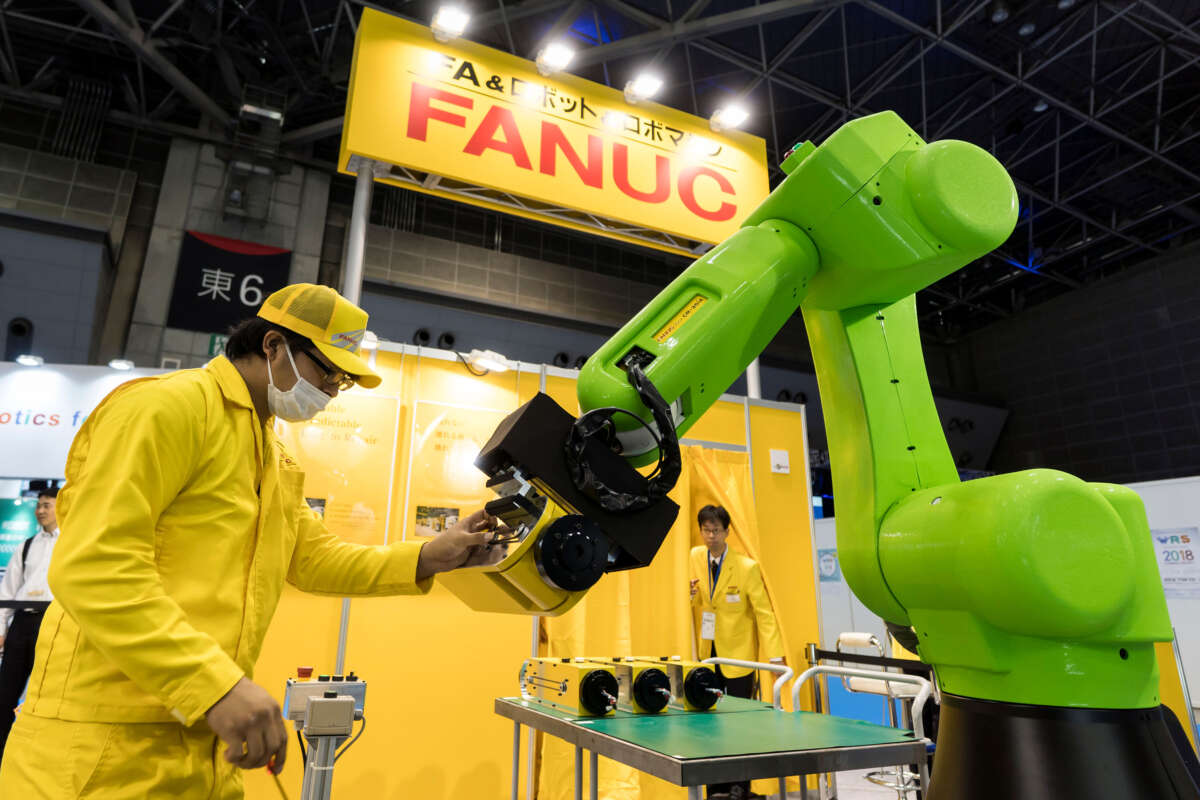
BDS activists say this dual-use categorization would apply to items such as Japanese automation company FANUC’s robots. The robots were initially created to build cars for global consumers, but activists have documented their use in Elbit factories to produce weapons.
As the country’s largest maker of weapons and surveillance apparatus, Elbit Systems has emerged as an obvious target of BDS campaigns globally: Canada’s Scotiabank divested by half from Elbit in August, the same month one of Elbit’s subsidiaries abandoned its offices in Cambridge, Massachusetts, after intense protests. Also in August, the French multinational insurance company AXA divested from Elbit, as did England’s Barclays Investment Bank in October, under pressure from Palestine Action. In April, Spain canceled $7.5 million worth of ammunition from Israeli arms manufacturer IMI Systems, a subsidiary of Elbit.
Ranked among the top 15 countries worldwide for military expenditures last year, Israel, which has an area and population equivalent to the state of New Jersey, has budgeted $36.9 billion for its military operations in 2025. Elbit received $5 billion in government contracts in 2024.
During Elbit’s most recent earnings call, held a week before Israel’s national budget was passed, President and CEO Bezhalel Machlis discussed contracts from the state as a likely source of additional revenues but avoided providing future earnings guidance. A company press release explained that, “The extent of the effects of the war on the Company’s performance will depend on future developments that are difficult to predict at this time, including its duration and scope. We continue to monitor the situation closely.” Per filings made with the U.S. Securities and Exchange Commission, the company claimed backlogged orders worth $22.6 billion (up from $17.8 billion in 2023).
Even before October 7, Israel had ordered hundreds of millions of dollars’ worth of 155 mm artillery shells from Elbit to cover deliveries in 2023 and 2024. The shells, which can be fired from cannons or short guns like howitzers, quickly became a staple of the genocide. Just two months into the war on Gaza, Israel announced it had already fired 90,000 155 mm shells into Gaza, with each round weighing 100 pounds.
In late December 2023, an anonymous informant contacted Hever, alerting him that industrial robots produced by FANUC were potentially being used to manufacture shells in assembly lines in Israel. “The links I received from them were in the open, in Hebrew, and I was able to instantly verify the use of FANUC robots in Israeli arms factories,” Hever said. “The informant didn’t give me any confidential information, just pointed me to what was already published.” He relayed the information to Japan BDS in early January 2024, and the organization began immediately working to put an end to Elbit’s access to Japanese robots. The activists were already on the verge of scoring a big win by persuading Itochu Aviation to end a cooperation agreement with Elbit, signed less than a year before, in March 2023. Back then, an Itochu executive said the company was looking forward to Elbit’s “advanced technology and combat proven systems especially in terms of autonomous capabilities and communication.”
The activists’ goal is to remove industrial robots from the assembly lines producing 155 millimeter artillery shells in and for export to Israel.
“The Itochu win was quite big news spreading in the world,” Taizo Imano, a BDS organizer in Japan, told Truthout. “So we started the petition against FANUC right after so we could draw the peak amount of attention from the public and collect many signatures.” They amassed over 35,000 signatories demanding the company adhere to its own human rights policy. “But FANUC denied their complicity in the genocide and their direct relations with Israeli arms companies,” Imano said.
FANUC has not responded to Truthout’s request for comment, and does not appear to have publicly commented on the matter since March 20, 2024, when the HuffPost’s Japanese branch reported that FANUC told them in an interview, “We and our European subsidiaries do not sell to Israeli companies for military purposes,” adding that they comply with requisite screenings, confirmations, rules and recordkeeping, “and do not sell to Israel if the products are for military purposes.”
Despite FANUC’s statement, footage shows the use of the Japanese robotics company’s products in Israeli weapons factories. A report in WIRED published photos, videos, and documents recording FANUC robots’ presence in Elbit’s factories in Israel, noting it remains unclear how the robots ended up in use. When Hever looked into it, he found that FANUC can sell freely to arms companies in what the company calls Category A countries. “The United States is, unfortunately, a Category A country,” he said, adding that it’s possible the robots were re-shipped from the U.S. to Israel.
Imano said the murkiness around how the robots got into Israeli weapons factories helped Japan BDS determine next steps — namely, to seek answers directly from FANUC.
“We went to their head office for the annual stockholder meeting; we submitted our petitions, and tried to talk with them,” he told Truthout. “But they wouldn’t discuss the issue with us. We learned we cannot directly negotiate with FANUC. We have to go around them to try to stop them, not directly but indirectly.”
Relative to the repression against pro-Palestinian activists in the U.S. and Europe, Imano says the situation in Japan is quite favorable. The lack of deeply established ties between Japanese robotics companies and Israeli arms makers makes them optimistic about their chances to successfully intervene. “We still have some space to stop, or prevent this process,” he said.
Imano holds doctorates in geography and Middle Eastern studies and is a professor teaching international relations at Chukyo University. Besides Japanese, he speaks English and Arabic, and for five years was based in East Jerusalem while working for Japan International Volunteer Center, a nongovernmental organization coordinating medical treatment for children in Gaza and providing medical support to people suffering malnutrition.
“I used to go to Gaza every month. I have colleagues and friends in Gaza as well as in the West Bank and East Jerusalem,” he said. “Many have lost family members to 155 mill shells.”
Japan BDS is currently pushing lawmakers to pursue a legislative remedy to close an important loophole: They want Japan’s parliament to restrict the export of dual-use products to countries like the U.S. that could make 155 mm shells using FANUC robots and export them to Israel, all plausibly without FANUC’s awareness. Imano said there are a few parliamentarians who are interested in this issue and they’ve asked Shoichi Kondo, a member of Japan’s House of Representatives, to discuss the issue with his colleagues.
“The Japanese government is saying they’re supporting the rule of the law, and they’re responsible for promoting more rule of the law in international spheres,” Imano said. “So we are trying to use it. We are trying to take advantage of it. It’s what we hope to push more.”
The global BDS movement is developing some ideas about economic leverage to force FANUC executives to abide by their own humanitarian commitments and responsibilities in a deeper way. Japan BDS is trying to connect with United Auto Workers’ rank and file in the U.S., who labor side by side with FANUC robots, with the hope that their union representatives could start a conversation with management about alternative sourcing. The U.S. has a seat on the company’s board – the only foreign country that does, Hever said. It’s currently occupied by Michael J. Cicco, an executive with FANUC America Corporation.
“We can achieve so much if UAW members will tell their management, ‘We don’t want to use tools of genocide of a company that supports genocide. We’re not going to strike. We’re not starting a whole industrial dispute over this. We just want you to get the robots from one of the three competing companies,’” Hever said.
Sales to the U.S. auto industry have historically been a major profit center for FANUC, Hever said. FANUC’s robots are put to work in U.S. auto factories painting, riveting, welding, assembling, and more.
Now, as Israel escalates its genocidal operations in Gaza, Imano says his Japan BDS comrades are staying true to mission. Personally, nurturing the growth of the FANUC campaign helps him keep moving forward with humility.
“I feel I haven’t done enough to stop it. This is my responsibility as well,” Imano said. “I have to do more.”
Holding Trump accountable for his illegal war on Iran
The devastating American and Israeli attacks have killed hundreds of Iranians, and the death toll continues to rise.
As independent media, what we do next matters a lot. It’s up to us to report the truth, demand accountability, and reckon with the consequences of U.S. militarism at this cataclysmic historical moment.
Trump may be an authoritarian, but he is not entirely invulnerable, nor are the elected officials who have given him pass after pass. We cannot let him believe for a second longer that he can get away with something this wildly illegal or recklessly dangerous without accountability.
We ask for your support as we carry out our media resistance to unchecked militarism. Please make a tax-deductible one-time or monthly donation to Truthout.