Truthout is an indispensable resource for activists, movement leaders and workers everywhere. Please make this work possible with a quick donation.
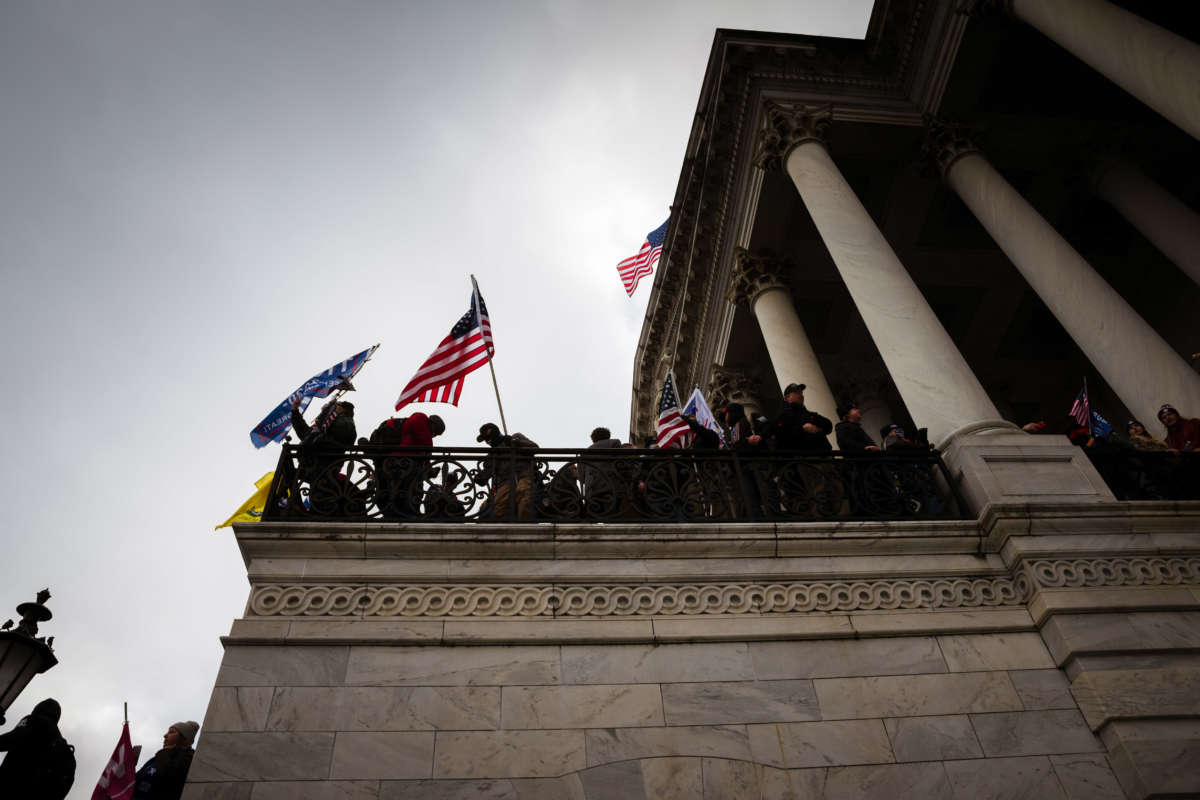
The House is set to vote this week on the formation of a commission to investigate the violent Capitol attack by Trump supporters on January 6. Lawmakers reached a bipartisan deal on the commission on Friday.
Republicans successfully won more representation on the potential commission, splitting the 10-person group evenly between the two parties. It gives both parties subpoena power by making subpoenas subject to a majority vote or by agreement between the vice chair and chair, the latter of whom is chosen by Democrats. The timeline for a Senate vote is yet unclear.
Months ago, Democrats had sought a different split for the commission. The previous makeup, proposed by House Speaker Nancy Pelosi (D-California), would have given Democrats more power within the commission. Republicans, not pleased with that configuration, held up the commission’s formation.
“It is imperative that we seek the truth of what happened on January 6,” said Pelosi in a statement on Friday.
The current deal has the endorsement of the top GOP negotiator for the commission. It makes sense that the deal would please Republicans — though the group will be split evenly between representatives from both parties, such a makeup could arguably favor the right since it was Republican loyalists and Republican lawmakers themselves who encouraged the events leading to the attack. Indeed, remarks from some Republicans in Congress, like Senators Josh Hawley and Ted Cruz, appeared to blatantly support the right-wing mob.
Still, conservative lawmakers are dismissive of the commission. On Friday, House Minority Leader Kevin McCarthy (R-California) told reporters that he was insistent on wanting the commission to focus on supposed left-wing violence as well — even though right-wing violence nearly completely eclipses any violence from the left, and the attack on the Capitol, unprecedented in the U.S., was entirely a right-wing affair.
“If this commission is going to come forward to tell us how to protect this facility in the future, you want to make sure that the scope, that you can look at all that what came up before and what came up after. So that’s very concerning to me,” McCarthy said.
The negotiations over the formation of the commission didn’t happen in a vacuum — they occurred even as Republicans spent month after month lying about the attack to sow doubt among their followers about who was responsible for the violence on January 6.
Just last week, for instance, Rep. Andrew Clyde (R-Georgia) severely downplayed the attack, saying, “if you didn’t know that TV footage was a video from January the 6th, you would actually think it was a normal tourist visit.”
But the footage from the day tells a vastly different story, one that visibly moved even the Republican senators who had voted to table impeachment back in February. Photos from the day showed Clyde himself barricading the entrance of the House chamber to protect the lawmakers — most certainly not something that happens during a “normal tourist visit.”
McCarthy may have different motives for opposing the commission, however. Two House Republicans so far have suggested that, if the commission is formed, McCarthy may end up among the group of people subpoenaed to testify.
“I think that he very clearly and publicly said that he’s got information about the president’s state of mind that day,” said Rep. Liz Cheney (R-Wyoming) in an interview with ABC. Republicans recently ousted Cheney from her leadership position within the GOP for insufficient loyalty to Donald Trump and his Big Lie about the election being stolen from him — the lie that motivated the attack on the Capitol and continues to be propagated by many in the Republican party, including members of Congress.
Important Message: Please Read
For 25 years, Truthout has survived by publishing impactful investigative journalism and analysis; distributing full editions 365 days a year; and building a community of readers who support us with small, hard-earned donations.
Eighty percent of our $3 million yearly budget comes from small donors alone. Of those, 8,000 readers support us with monthly donations. Back in 2018, when Facebook decided to suppress the circulation of posts made by organizations, thereby cutting readers off from seeing many articles shared by the news organizations they had intentionally decided to follow, Truthout’s total traffic declined by 40 percent, as nearly all of our traffic from that platform disappeared.
Now, Google has recently rolled out its AI search bar, providing AI summaries instead of directing readers to our site. Google Search is our single largest source of traffic; it’s the route by which nearly one third of our readers find us. Much like in 2018, a shocking 40 percent of our Google traffic has disappeared overnight.
It will not be easy for Truthout to shoulder this blow. Nor will it be easy for our peers and collaborators — news sites that depend on traffic and aren’t bankrolled by large corporations.
If you can support Truthout with a donation today, you can help us resist the AI onslaught. Please give today.