Truthout is a vital news source and a living history of political struggle. If you think our work is valuable, support us with a donation of any size.
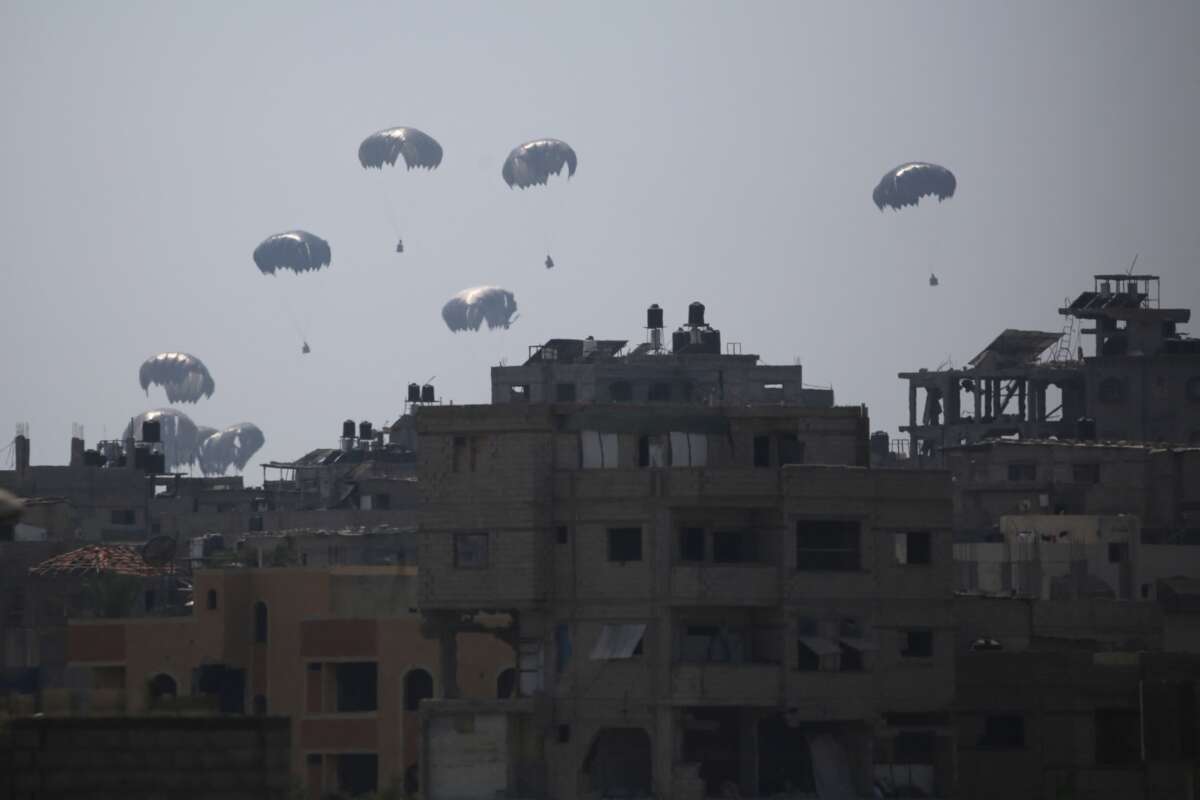
The “aid” airdrops that Israel authorized in Gaza did little to nothing to alleviate Israel’s starvation catastrophe while also injuring roughly a dozen Palestinians, with reports that they even collapsed homes and landed on tents in the region.
The UN-backed Global Protection Cluster reported on Sunday, a day after the drops began, that Palestinians across the Strip were reporting “injuries, collapse of homes, full exclusion of vulnerable groups, and a sense of loss of dignity” amid the drops.
“According to one mother in Al Karama east of Gaza City, an airdropped pallet hit the roof of her home, causing the roof to collapse,” the group said in a report. “Immediately following the impact, a group of people armed with knives rushed towards the house, while the mother locked herself and her children in the remaining room to protect her family. They did not receive any assistance and are fearful for their safety.”
Health officials have said that they have recorded roughly 11 people being injured from the airdrops, which were sent from Jordan and the United Arab Emirates.
There were roughly 25 tons of aid dropped into the region on Saturday — but Palestinians report that the aid is being dropped in Israeli military-controlled areas, and that the aid is being looted and stolen, potentially by groups armed by Israel in Gaza.
Some of the aid, dropped close to the coast, fell into the sea, a Palestinian speaking on the humanitarian situation in Gaza told Truthout. The last time Israel authorized airdrops, at least a dozen Palestinians drowned while trying to retrieve parcels from the sea.
Meanwhile, Israel has touted “humanitarian pauses” in al-Mawasi and other parts of Gaza that Israel supposedly already designated as “safe zones” to allow for the entry of aid. But Palestinians say that these have made little difference as well.
For Israel, the true goal of the airdrops is “silencing the world” in the face of growing criticism and a recent spike in starvation deaths, the Palestinian told Truthout.
“What the world calls ‘humanitarian aid’ is, in reality, a new tool of collective punishment. People are dying because they cannot access food, and these measures only deepen the crisis rather than alleviate it,” they said.
Humanitarian groups have condemned the airdrops, with UN Relief and Works Agency chief Philippe Lazzarini saying on Saturday that they are nothing more than “a distraction and screensmoke.”
“They are expensive, inefficient and can even kill starving civilians,” Lazzarini said. He previously said that the starvation catastrophe, which has killed over 120 Palestinians, is a “constructed and deliberate mass starvation” by Israel.
Lazzarini, too, said that the U.S.- and Israel-backed scheme for “aid,” under the Gaza Humanitarian Foundation, only exists to serve “military and political objectives,” and “takes more lives than it saves lives.”
UN and other humanitarian aid groups have said that a return to the UN-led humanitarian aid system, as well as a ceasefire and full access to the Strip, is the only way to end Palestinians’ starvation.
“Israel’s announced ‘tactical pause’ in Gaza is desperately insufficient while it commits genocide against Palestinians, who are facing the catastrophic conditions Israel deliberately engineered,” said Amnesty International in a statement on Monday.
Nonetheless, the airdrops and “pause” strategy have been touted by media as a solution to Israel’s starvation crisis — despite the mountain of experts saying that Israel is not interested in alleviating the humanitarian catastrophe that it has deliberately and meticulously created.
Instead, Israel is dismantling the aid system piece by piece, announcing last week that it is no longer automatically renewing visas for UN humanitarians, and will only be granting access on a one-month basis.
An important fundraising appeal: 24 Hours to raise $18,000
Truthout is one of only a few platforms for justice-oriented, grassroots journalism. Today, as political censorship from the right intensifies, we have no choice but to ask for your help.
We are fundraising right now to cover our basic operating expenses. If you can support Truthout with a one-time or monthly donation, you will make a significant impact on our work. Anything you can do makes a difference — we appreciate your support.