Truthout is a vital news source and a living history of political struggle. If you think our work is valuable, support us with a donation of any size.
Imagine the following scenario: You’re teaching Introduction to Sociology at a community college in Florida, and today, you’re trying to explain the well-documented pay gap between men and women in the United States. You check the guidance you just received from your dean, who received instructions via email from the executive vice chancellor of the Florida College System. The instructions state explicitly that explaining “unequal outcomes between men and women” in terms of “institutional sexism” would violate state law.
So how are you supposed to explain this disparity? The email includes guidance on just this question:
biological sex chromosomes determine … how females and males behave … So, in teaching this, one might point out that women and men with the same credentials enter different jobs such that certain jobs are occupied primarily by women (i.e., female-dominant) some are occupied primarily by men (i.e., male-dominant).
Did you misread the guidance? Your eyes scroll up on the page, which is a state-created curriculum for use in all non-elective Intro to Sociology classes taught in Florida’s community colleges. You are explicitly prohibited from discussing “systemic racism, institutional racism, [or] historical discrimination.” You cannot “state an intent of institutions today to oppress persons of color.” You cannot “describe when, how, or why individuals determine their sexual orientation and/or gender identity.”
Surely this is a mistake?
Far from it. Last semester, my department at Florida International University received word that the Florida Board of Governors, which oversees the state’s public university system, had determined that none of our syllabi were in compliance with state law. It seemed to many of us that the board was proceeding from a willfully broad interpretation of the law, so we asked our provost for guidance.
The law in question is Florida Statute 1007.25, which is, frankly, incoherent. If I were to try to render it intelligible, I would point out that the law prohibits any mention of “identity politics,” though it never specifies what is meant by this contested term. It also bans “theories that systematic racism, sexism, oppression, and privilege are inherent in the institutions of the United States.” What exactly “inherent” is doing in this sentence remains a mystery. Are we allowed to teach theories of systematic oppression if we historicize them, refusing to reduce them to “inherence”? Can we teach them in contexts beyond the U.S.? All of this remains unclear, as state officials read these lines as a carte blanche for purging race, gender, and inequality from the curriculum altogether.
At this point, not only are professors being told what they cannot teach; they are also being told what they must teach.
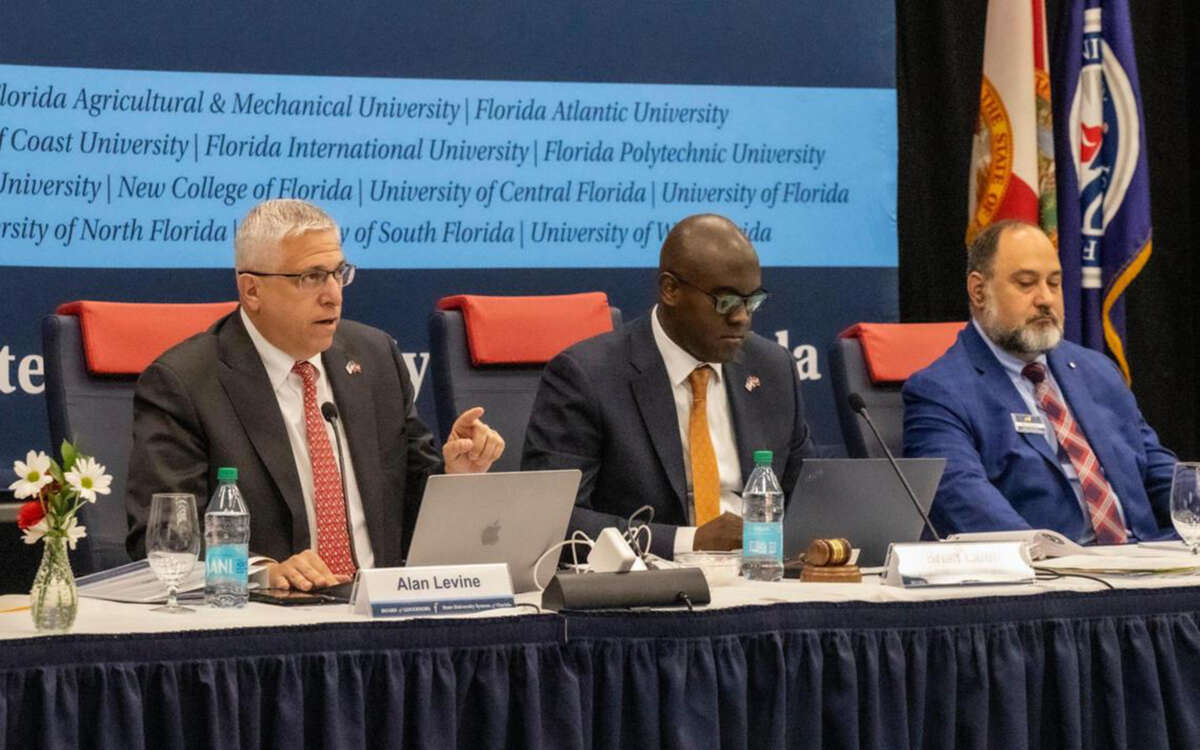
In August 2025, the provost’s office requested compliance guidelines from the Florida Board of Governors. What did faculty need to do in order to bring their curricula into compliance with state law? In response, the Board of Governors formed a committee, launched in October, that was tasked with producing two items: first, a set of guidelines for compliance, and second, a special textbook that would be compliant with the law.
The committee included two sociology professors from the university system, two from the college system, and an unspecified number of political appointees without any background in the discipline. Among these political appointees were Jason Jewell, who was appointed the state’s chief academic officer after directing a “Great Books” program at a small Christian college in Alabama; and Jose Arevalo, the aforementioned executive vice chancellor of the state’s college system. Arevalo was hired after writing a dissertation at Hillsdale College on “Great Books” proponents like Mortimer Adler and Allan Bloom. (In this context, “Great Books” is shorthand for the promotion of the Western canon.) It was Arevalo who sent the email to deans with the list of prohibited topics.
Pretty quickly, one of the four sociologists on the committee was removed — and now remains suspended from teaching at his college — for allegedly professing “gender ideology.” In practice, this professor simply referenced the existence of gender non-conformity. No matter. He was removed from the committee, which was now operating under the open threat of repression. His removal sent a message, in other words, to the other sociologists on the committee, and to those of us teaching around the state.
What happened next is hard to discern, since the working group did not operate in public view.
Political appointees from the business world, from insurance executives to roofing contractors, are dictating how professors must teach their courses and even providing state-created textbooks for doing so.
The Florida Board of Governors, which had already determined that no existing Introduction to Sociology syllabus complied with the board’s ideological preferences, also determined that no existing intro to sociology textbook was legal to teach in the state of Florida. Instead, the working group somehow decided that it would be a good idea to take an existing open-source textbook, published under a Creative Commons license, and bowdlerize it, reducing it from nearly 700 pages to just over 250.
The working group entirely jettisoned whole chapters on race and ethnicity, gender and sexuality, social stratification, and global inequality. Words like “racism” and “discrimination,” which appeared roughly 120 times each in the original, now appear 25 times combined. Countless additional topics were cut, or else mangled, and most comparisons of the U.S. to other countries were removed.
Then, immediately before winter break, in mid-December 2025, my department’s chair received a call from the provost, who had in turn been called by a staffer from the Florida Board of Governors’ office. The chair proceeded to call each faculty member who was scheduled to teach Intro to Sociology, asking them to use the state-created, censored textbook.
As a department, we pushed back, demanding the directive in writing. If this is about compliance with the law, why are these administrators and bureaucrats too terrified to issue mandates via email? The example with which I opened this column — college deans receiving a written directive from Executive Vice Chancellor Arevalo — was highly exceptional. In general, their strategy appears to be covering their tracks. As the sociologist Max Weber famously put it, modern bureaucracies are “based upon written documents (‘the files’), which are preserved in their original or draft form.” What the Florida Board of Governors is doing then is attempting to avoid bureaucratic constraints, moving instead toward personalized, discretionary power.
These phone calls amount to suggestions rather than formal orders, but many of the professors pressured in this way have been working to carry out the censorship edicts nonetheless. In other words, this is a textbook example of anticipatory compliance. Until these suggestions are put into writing, it is incumbent upon Florida educators to ignore them. Certainly, we should organize to contest them, but until they are in writing, we must refuse to acknowledge them as official directives.
Anticipatory Compliance and Authoritarian Governance
As we know well from historical precedent, authoritarian regimes rely heavily on anticipatory compliance. For that is precisely what Florida has become: an authoritarian regime. At this point, not only are professors being told what they cannot teach; they are also being told what they must teach.
These state directives are telling us to abandon professional ethics and to refuse to root our lessons in existing sociological literature.
The Florida Board of Governors, meanwhile, does not include a single academic, or even anyone with a background in education administration. These are political appointees from the business world, from insurance executives to roofing contractors, who are dictating how professors must teach their courses and even providing state-created textbooks for doing so.
What are sociologists supposed to do in this context? These state directives are telling us to abandon professional ethics and to refuse to root our lessons in existing sociological literature, abandoning the norms of our professional organization, the American Sociological Association. Instead, we are being openly threatened if we do not teach what amounts to state-produced propaganda.
The very concept of modern academic freedom first emerged in Medieval Europe as a means of safeguarding free inquiry from political interference. Its more contemporary incarnation, with origins in early 19th-century Berlin, was similarly framed: research and teaching were to be defended against local political authorities.
Here we are over a century later, trying to teach and do research in Florida, and the state is openly rejecting any semblance of academic autonomy. Instead, political appointees, working in conjunction with elected officials and, unfortunately, compliant faculty, are attempting to force politically convenient propaganda on us, insisting that such materials constitute a curriculum. They do not.
We are being openly threatened if we do not teach what amounts to a state producing its own propaganda.
Lest readers assume this is some kind of Florida exceptionalism, it is far from it. State governments and university administrations in Texas, Indiana, North Carolina, Iowa, Oklahoma, Kansas, Mississippi, Arkansas, Kentucky, West Virginia, Wyoming, Tennessee, North Dakota, Georgia, and likely other states too are currently involved in similar efforts. In New Hampshire, the House just passed a bill named after Charlie Kirk that bans the teaching of “critical theories or related practices that promote division, dialectical world-views, critical consciousness or anti-constitutional indoctrination.”
Nor is this just about sociology. References to anthropogenic climate change are disappearing from earth science departments. Historians are being told that they can only teach primary sources, with all second-order reflection on those sources — what we used to call “history” — being stigmatized or even banned. Literature professors are being told that they can only teach the “Western canon.”
All of this is to say that this fight is not about sociology in Florida; it is about resisting authoritarianism on a national scale. We must defend sociology in Florida because we defend academic teaching and inquiry, free from state interference, everywhere in our country. If we do not nip this in the bud in Florida, other states will continue to emulate this authoritarian model.
Defending Academic Freedom
What can faculty in affected states do? Two actions are crucial as a point of departure. First, they should refuse anticipatory compliance. Government officials want to terrify educators so that they act in excess of what is required. They therefore need to always demand written directives.
And second, they should talk to their colleagues. These directives always attempt to isolate them, with orders being passed through the phone to individual instructors. This is a deliberate strategy of preemptive demobilization. To push back, educators need each other. They must discuss these pressures openly in faculty meetings. They should build connections with faculty on campuses across the state to see how directives are being issued unevenly. They need to form an Academic Freedom Committee in their Faculty Senate, as we just did here at Florida International University for the first time. And they should work through their unions, or where that isn’t possible, through their local American Association of University Professors chapter. If they don’t have one, this is a perfect time to build one.
But this isn’t just about professors; it’s about all of us. This is the most flagrant attack on higher education in my lifetime. Why are politicians reducing public colleges and universities to vehicles of state propaganda? Why are self-proclaimed proponents of free speech turning around and using state repression to enforce speech codes on our campuses? Why can’t we speak openly about our social world in sociology classes? Why are unqualified appointees from the business world dictating to Ph.D.-holding academics how they should teach and which textbooks they must use?
We are not propagandists, but professors.
What we really need are people beyond the university itself — the general public — speaking out about how ludicrous this all is. We are now living through an era of state censorship, politically motivated firings, and state-produced propaganda materials. If this isn’t authoritarianism in higher education, I don’t know what is.
Giving in isn’t going to get these ideologues off our backs. They are openly telling us what they are up to, working to reduce the social sciences and humanities to an appendage of the state. We are not propagandists, but professors. If we don’t defend academic freedom with everything we’ve got, the public university will soon be a relic of the 20th century.
Media that fights fascism
Truthout is funded almost entirely by readers — that’s why we can speak truth to power and cut against the mainstream narrative. But independent journalists at Truthout face mounting political repression under Trump.
We rely on your support to survive McCarthyist censorship. Please make a tax-deductible one-time or monthly donation.