Truthout is a vital news source and a living history of political struggle. If you think our work is valuable, support us with a donation of any size.
The Department of Justice (DOJ) no longer requires temporary immigration judges to have experience in immigration law.
The new rule, which went into effect on Thursday, permits the director of the Executive Office of Immigration Review (EOIR), with the U.S. Attorney General’s approval, “to designate or select any attorney to serve” as a temporary immigration judge (TIJ) for a renewable six-month term. The notice states that the DOJ “declines to adopt any limitations on the number of extensions of the six-month periods or otherwise cap the length of a temporary appointment.” The EOIR conducts immigration court proceedings, appellate reviews, and administrative hearings.
Prior to the change, TIJs had to be former immigration judges or appellate immigration judges; EOIR administrative law judges (ALJs) or ALJs retired from EOIR; ALJs from other executive branch agencies with the consent of their agencies; or Department attorneys with at least 10 years of legal experience in the field of immigration law.
But the DOJ doesn’t appear to value that experience.
“Immigration law experience is not always a strong predictor of success as an IJ, and EOIR has hired individuals from other federal agencies and department components without prior immigration experience who have become successful and exemplary IJs,” the rule states.
Lisa Needham wrote for Daily Kos that in place of experience, “Now, all you have to do to get the gig is suck up to Attorney General Pam Bondi.”
The new rule states that it “aligns the regulatory requirements” for temporary immigration judges with requirements for permanent immigration judges.
In the same rule, DOJ also rescinded a 2024 directive to use “noncitizen” in place of “alien,” a derogatory and dehumanizing term for immigrants, and to replace “unaccompanied alien child” with “unaccompanied child,” in DOJ regulations.
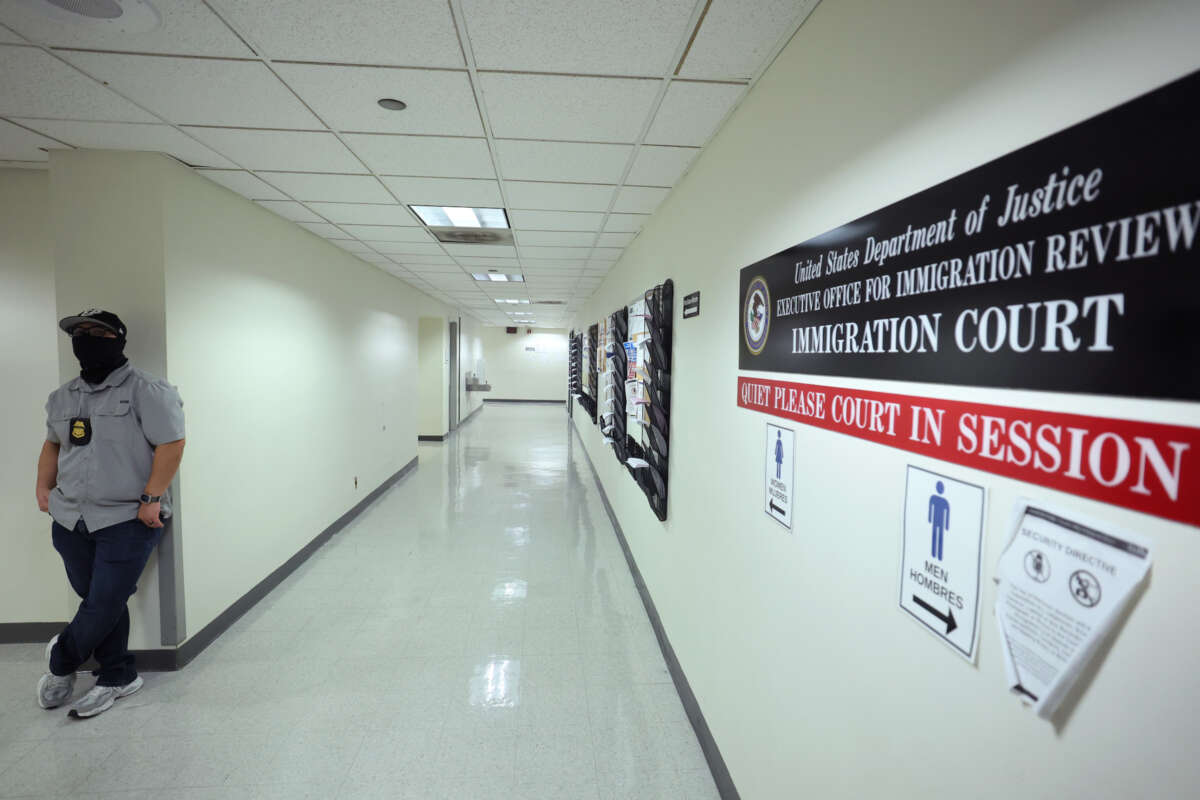
Courthouses have been integral to the Trump administration’s deportation agenda. In January, the Department of Homeland Security (DHS) rescinded a directive that had prohibited officers from making immigration arrests, with few exceptions, at or near courthouses. The new guidance permits officers to arrest their “target” at courthouses, as well as noncitizens, such as “family members or friends accompanying the target alien to court appearances or serving as a witness in a proceeding.” Masked federal agents now routinely roam the hallways of courthouses, abducting people as they leave immigration appointments and hearings.
DHS has also sought to have immigration cases quickly dismissed to clear the way for a person’s deportation. The agency has advised immigration judges that they can rule on dismissals from the bench and do not need to request additional documentation, although federal agents abduct people irrespective of what occurred at their hearing.
Eric Katz, a senior correspondent for Government Executive, wrote that the new rule, gives Attorney General Bondi “wide latitude in selecting officials to oversee asylum and other cases pending before the Executive Office of Immigration Review, the Justice Department agency that runs the nation’s immigration courts,” adding that her “authority could provide President Trump with additional power to withhold legal status from immigrants and expedite his mass deportation efforts.”
Press freedom is under attack
As Trump cracks down on political speech, independent media is increasingly necessary.
Truthout produces reporting you won’t see in the mainstream: journalism from the frontlines of global conflict, interviews with grassroots movement leaders, high-quality legal analysis and more.
Our work is possible thanks to reader support. Help Truthout catalyze change and social justice — make a tax-deductible monthly or one-time donation today.