Part of the Series
Struggle and Solidarity: Writing Toward Palestinian Liberation
Did you know that Truthout is a nonprofit and independently funded by readers like you? If you value what we do, please support our work with a donation.
For Khaled and Raneen, daily life in the Gaza Strip is marked by the steady hum of Israeli military drones buzzing over the central city of Deir al-Balah that they now call home.
The Palestinian couple from northern Gaza has been displaced more than 10 times since Israel’s war on the enclave began in 2023.
And despite a United States-brokered ceasefire that was enacted in October, they say a sense of safety continues to be out of reach.
“There are bombings around us,” Khaled told Truthout in a recent phone interview, describing the hardships of living in a tent with his wife and their 3-year-old daughter. “There is no internet access, no electricity. The basic necessities are not available. We are struggling to live,” he said.
Khaled and Raneen say their situation, though shared with hundreds of thousands of other displaced Palestinians across Gaza, is even more frustrating because they both have been accepted into a Canadian university to continue their studies in medicine.
Raneen has gained admission into a nursing Ph.D. program and Khaled has been invited to complete a research fellowship in the cardiology department, both at Western University in the Canadian province of Ontario.
But without a way to leave Gaza, which is under a brutal Israeli blockade, or the ability to complete their visa applications due to those restrictions on their freedom of movement, the couple has been forced to defer their admissions over and over again.
“Waiting [for] our dreams, it’s really difficult,” said 28-year-old Khaled.
The pair are among more than 130 Palestinian students from the Gaza Strip who have been accepted into Canadian universities yet have been unable to finalize their visas and travel to Canada to begin their studies, according to a local nonprofit group, the Palestinian Students and Scholars at Risk network (PSSAR).
Most of the students remain stuck in Gaza, where continued Israeli attacks have killed more than 600 Palestinians since the October ceasefire came into effect, the latest figures from the Palestinian health ministry show.
“I feel shame, for asking for a deferral from my professor every semester,” said 27-year-old Raneen, who, like her husband Khaled, spoke to Truthout on condition that their last names not be used due to safety concerns.
“We graduated from our faculties with excellence. We got the opportunity to complete our studies in Canada. We applied for our visa[s] … We gathered the documents during the hardest times,” Khaled added. “We [can] do nothing, just waiting.”
“I Don’t Know What to Say”
Nada El-Falou is director of student services at PSSAR, the Canada-based group that has been advocating on behalf of the students stuck in Gaza.
She said some of them have been waiting for their Canadian visas for more than 20 months, often at great personal risk.
In December 2024, for example, two Ph.D. students — twin sisters Sally and Dalia Ghazi Ibaid — were killed in an Israeli attack on Gaza as they were in the midst of applying for their permits to attend Canada’s University of Waterloo.
Another prospective Palestinian student lost both of his parents and several siblings in the Israeli bombardment, El-Falou said, while two others spent weeks in intensive care units (ICUs) after suffering critical injuries.
Like in the case of Khaled and Raneen, El-Falou said a major stumbling block has been Canada’s requirement that the students submit biometric data — fingerprints and photographs — to finalize their visa applications.
That can’t be done in Gaza, El-Falou explained, and Israel’s continued siege on the territory has meant that the students also cannot reach Egypt or the occupied West Bank, where they typically would get their fingerprints and photos taken.
While the southern Rafah crossing between Gaza and Egypt recently reopened after a protracted closure, only small numbers of Palestinian patients needing medical treatment abroad have been allowed to leave the Strip.
“So they’re unable to leave Gaza to submit their biometrics and yet the biometrics are still required of them to be submitted to complete their application,” El-Falou said.
Canada has waived biometrics before in exceptional circumstances, such as when it helped Ukrainians come to Canada.
Yet delays in Canadian visa processing also have persisted for the limited number of Palestinian students who have been able to leave Gaza amid the war.
About 30 students reached Egypt over the past two years, but their applications remain stuck at the background check stage, El-Falou said.
“We’re seeing consistently that these Palestinian students are subjected to longer processing times” compared with Jordanian or Egyptian nationals, for example, El-Falou told Truthout.
“It’s been many months since we’ve been officially campaigning, and every time the students ask me, ‘Nada, what do you think? What should I do? Do you think we’ll be able to come to Canada soon?’ I have no words. I don’t know what to say,” she said.
“I’m embarrassed to say, ‘I’m sorry I don’t have any updates.’”
Human Rights Activists Call on Canada to Waive Biometrics and Expedite Visas
PSSAR has been urging the Canadian government to waive its biometric requirements and to expedite visa processing for the Palestinian students from Gaza.
Human rights advocates have pointed to the fact that Canada has waived biometrics before in exceptional circumstances, such as when it helped Ukrainians come to Canada after Russia’s 2022 invasion of their country. Certain “low-risk” Ukrainian applicants did not have to submit biometrics overseas under that program.
El-Falou also noted that other countries, such as the United Kingdom, have been able to get some Palestinian students accepted into their universities out of Gaza.
“That Canada has not yet done this despite our requests shows me that there is a lack of political will, and I hope this could change,” she said, urging Prime Minister Mark Carney’s office to intervene directly in the students’ cases.
Since the Gaza war began, Canada has faced calls to sanction Israel over its offensive, which a United Nations commission has described as a genocide, and to close arms export loopholes to prevent Canadian-made weapons from reaching Israel.
The Canadian government also has been criticized for what lawyers and rights advocates say has been a failed special Gaza visa program, launched in early 2024, to offer temporary residency to Palestinians with loved ones already in Canada.
Like the student visa applicants, Palestinian families who applied for the special temporary resident permits have complained that Canada has done nothing to help get their loved ones out of Gaza while maintaining onerous visa requirements.
Carney’s office directed Truthout to the federal immigration ministry when asked whether the prime minister plans to intervene in the Gaza students’ cases — as El-Falou called for.
Contacted about the Palestinian students stuck in Gaza, the Canadian immigration ministry said that “anyone looking to come to Canada must meet our admissibility and eligibility requirements, including biometrics and security screening.”
A spokesperson for Immigration, Refugees and Citizenship Canada (IRCC) told Truthout in an email that the timing and results of those screenings are out of the ministry’s control because they are conducted by “Canada’s security partners, who operate independently from IRCC.”
“Additionally, biometrics can only be completed after people leave Gaza, as IRCC has no presence there. We understand that this can be challenging for residents of Gaza, but these requirements are necessary to ensure the integrity of our immigration system and the safety of Canadians,” the statement said.
While IRCC acknowledged that some Palestinian students accepted into Canadian universities “have experienced increased processing times for study permits,” it did not provide an explanation for the delays.
“After receiving their acceptance letters, prospective international student[s] must still meet all visa requirements. Where possible, our Visa Application Centres in countries neighbouring Gaza offer expedited processing,” it said.
“We continue working closely with local authorities — at every level — to advocate for the safety of people in Gaza, however we do not ultimately decide who can leave.”
The ministry said 950 Palestinians arrived in Canada through the special Gaza visa program by the end of November 2025. Another 410 arrived via other programs, it added, without providing further details.
“Light at the End of That Tunnel”
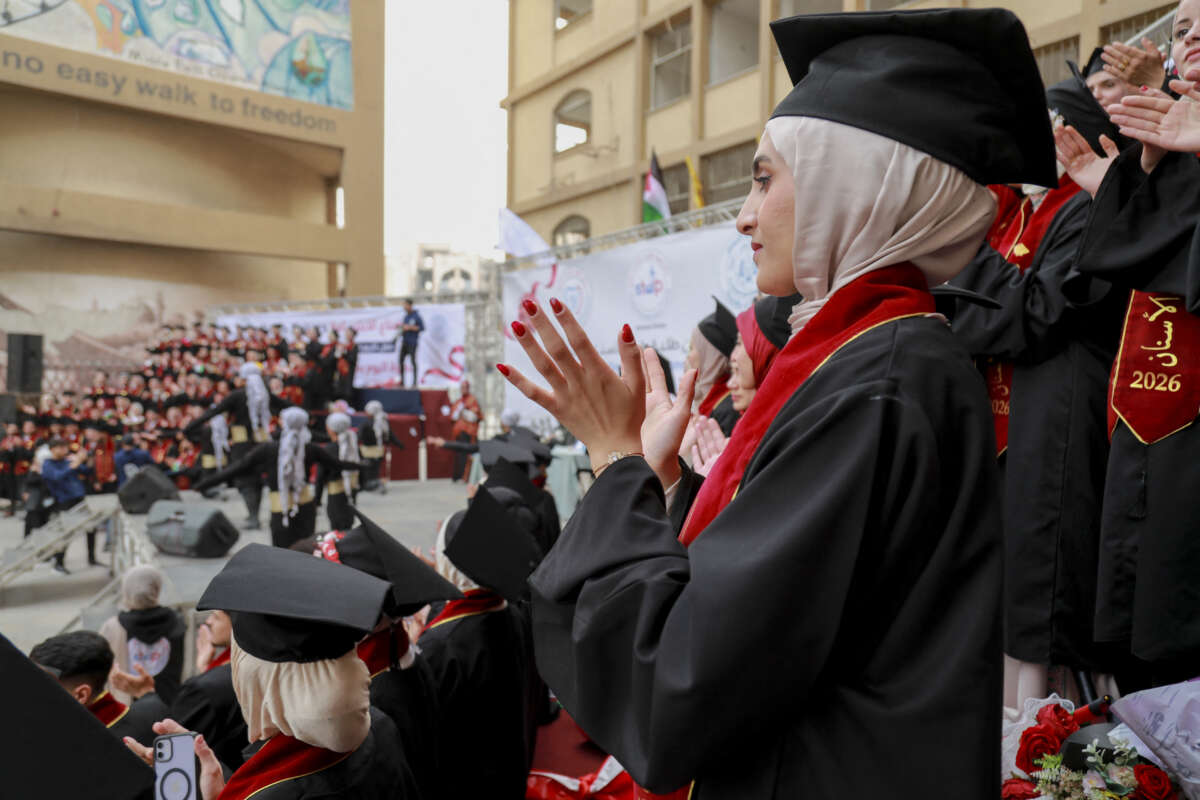
Back in Deir al-Balah, Khaled said all he and Raneen are asking for is an opportunity to continue their educations, as Israel’s war has made studying in the Gaza Strip impossible.
“We believe that we will get there, we will get our opportunities. Although we are frustrated, we still believe there is a light at the end of that tunnel.”
Since 2023, the Israeli military has destroyed more than 90 percent of the schools in the enclave, according to a UN commission that in June accused Israel of trying to “obliterate Palestinian life in Gaza” by attacking educational, religious, and cultural sites.
“The destruction of the education system in Gaza is expected to harm Palestinians for generations to come, with consequent challenges in economic development, work and social abilities,” the commission said in its report.
Yet despite those hardships, and their frustrations with the Canadian visa process, Khaled and Raneen told Truthout that they haven’t lost hope of reaching Canada.
“We believe that we will get there, we will get our opportunities. Although we are frustrated, we still believe there is a light at the end of that tunnel,” Khaled said.
The couple’s young daughter has been a source of inspiration, he said, adding that they want to make sure she is safe and has a bright future, too. “She’s the person who made us believe and dream.”
Press freedom is under attack
As Trump cracks down on political speech, independent media is increasingly necessary.
Truthout produces reporting you won’t see in the mainstream: journalism from the frontlines of global conflict, interviews with grassroots movement leaders, high-quality legal analysis and more.
Our work is possible thanks to reader support. Help Truthout catalyze change and social justice — make a tax-deductible monthly or one-time donation today.