Did you know that Truthout is a nonprofit and independently funded by readers like you? If you value what we do, please support our work with a donation.
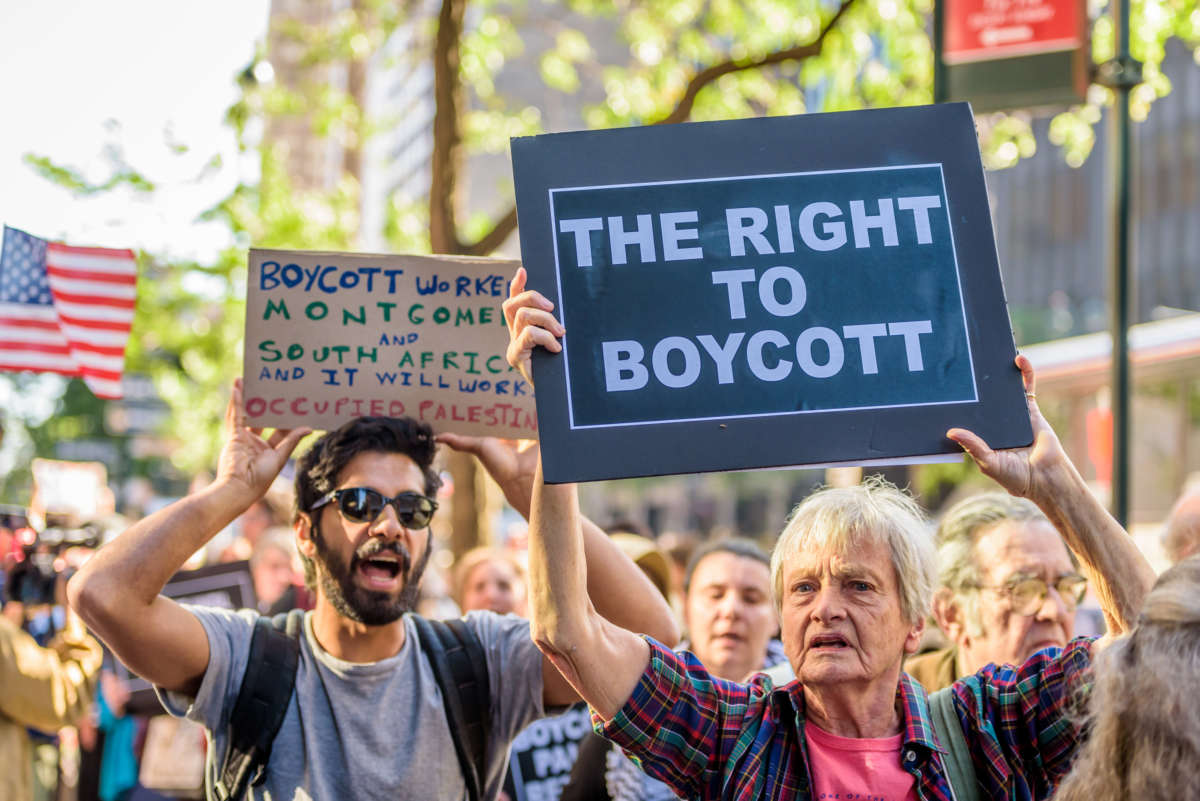
A federal appeals court has ruled that state laws punishing contractors for engaging in boycotts of Israel are not in violation of free speech rights, a ruling that advocates say will unconstitutionally chill all speech in favor of justice for Palestinians.
In 2017, Arkansas passed a law barring state contractors from taking part in the Boycott, Divestment and Sanctions (BDS) movement, which seeks to exert nonviolent pressure on the government of Israel to end the country’s apartheid system and its violent displacement of Palestinians. The legislation requires companies that have contracts with the state to sign pledges that they will not take part in the movement, or else reduce their fees by 20 percent.
Arkansas Times, a newspaper based in Little Rock that was seeking to contract with a public university in the state, refused to sign a pledge that it would adhere to the new state-imposed standards.
The paper then attempted to sue the state over the law, losing the case in a district court setting but winning an appeal after a three-judge panel of the Eighth District U.S. Circuit Court of Appeals found that the law violated the free speech rights of companies and organizations. On Wednesday, however, the full Eighth District Court issued an en banc ruling, reversing the original appellate decision.
The full court refused to recognize the free speech components of the case, claiming that economic and commercial decisions “are invisible” and “not inherently expressive” conduct — and that therefore, the law was not in violation of First Amendment speech rights.
“It’s a horrible reading, and it’s very inaccurate,” said Abed Ayoub, legal director of the American-Arab Anti-Discrimination Committee, adding that the ruling “will flip the First Amendment on its head.”
“It’s shocking to see we’re living in a time where our courts are deteriorating our rights and abilities to express ourselves,” Ayoub said.
The ruling was also condemned by Palestine Legal, an organization that protects the civil and constitutional rights of advocates for Palestine in the U.S.
“Boycotts are a powerful tool for seeking justice, as [previously] recognized by the Supreme Court,” the organization wrote. “Today’s decision ignores that history and precedent, treating Arkansas’ anti-BDS law as a restriction on purely commercial conduct that carries no political message.”
“This decision sets a dangerous precedent for anyone interested in seeking social, political, or economic change,” the group added.
In her dissenting opinion, Eighth Circuit Court Judge Jane Kelly wrote that the purpose of the Arkansas law appeared to be more political than economic — meaning that claims that the law has nothing to do with free speech are false.
“By the express[ed] terms of the Act, Arkansas seeks not only to avoid contracting with companies that refuse to do business with Israel,” Kelly wrote. “It also seeks to avoid contracting with anyone who supports or promotes such activity.”
Arkansas’s law prohibiting state contractors from exercising their speech rights through boycotts is just one of hundreds of bills proposed in recent years to similarly target organizations or individuals who advocate for Israel to end its abuses against Palestinians. Over the past seven years, 245 bills have been proposed to redefine anti-Semitism to include criticisms of Israel or to restrict boycotts against the country in support of Palestinian rights; of those bills, 52 have been passed into law.
Important Message: Please Read
For 25 years, Truthout has survived by publishing impactful investigative journalism and analysis; distributing full editions 365 days a year; and building a community of readers who support us with small, hard-earned donations.
Eighty percent of our $3 million yearly budget comes from small donors alone. Of those, 8,000 readers support us with monthly donations. Back in 2018, when Facebook decided to suppress the circulation of posts made by organizations, thereby cutting readers off from seeing many articles shared by the news organizations they had intentionally decided to follow, Truthout’s total traffic declined by 40 percent, as nearly all of our traffic from that platform disappeared.
Now, Google has recently rolled out its AI search bar, providing AI summaries instead of directing readers to our site. Google Search is our single largest source of traffic; it’s the route by which nearly one third of our readers find us. Much like in 2018, a shocking 40 percent of our Google traffic has disappeared overnight.
It will not be easy for Truthout to shoulder this blow. Nor will it be easy for our peers and collaborators — news sites that depend on traffic and aren’t bankrolled by large corporations.
If you can support Truthout with a donation today, you can help us resist the AI onslaught. Please give today.