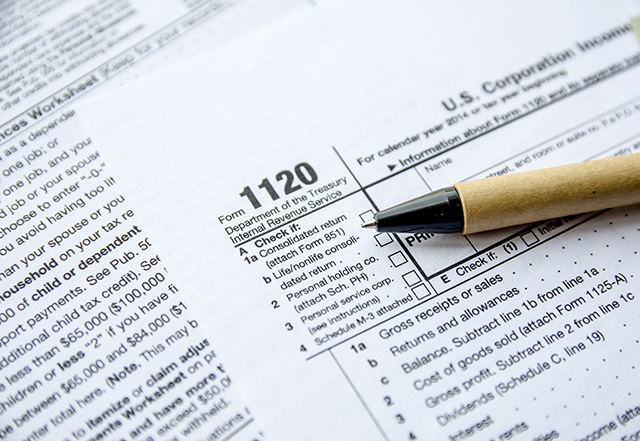
The Republicans are trying to pitch their tax cut plan as being a major step toward simplifying the tax code. While there is little doubt the plan will mean large tax cuts for corporations and their shareholders it is not clear that there will be much simplification. Corporations will still be able to have large tax savings by hiding profits overseas and other tricks.
However, it is possible to envision a change to the tax code that would genuinely simplify the system. Suppose that instead of paying income taxes each year, corporations were required to turn over a portion of their stock to the government, let’s say 25 percent, in the form of non-voting shares.
The rule would be that these shares are treated just like other shares of the company’s stock. If the company pays a $2 a share dividend to holders of its regular shares, it also pays a $2 dividend on each of the government’s shares. If the company buys back 10 percent of its outstanding shares at $100 per share, it would also buy back 10 percent of the government’s shares at $10 each. If another company wants to take over the company, buying up shares at $150 each, the company also has to buy the government’s shares at $150 each.
The only difference between the shares owned by the government and the stock held by other shareholders is that the government would have no voting power associated with its shares. This is not an effort to get government control over the means of production. It is simply an inescapable route to its tax revenue.
This should be a path that both liberals and conservatives can embrace, even if they disagree on the best tax rate. Under the current system, or the Republican proposal, companies can achieve large tax savings by gaming the system. As a result, they spend tens of billions of dollars on tax lawyers and accountants who develop sophisticated schemes to limit their tax liability.
Everyone agrees this is a complete waste of resources. From an economic standpoint, we don’t want to see highly skilled people waste their efforts trying to find ways to circumvent the tax code. Nor do we want the IRS to have to spend large amounts of resources trying to prevent this sort of gaming. It would be much better if these people’s skills were used towards some productive end that made people’s lives better.
Moving from corporate taxes to government ownership of non-voting shares should go far towards eliminating this waste. Once this system is in place, there is no way to cheat the government out of its claim to the company’s profits unless the shareholders are also cheated.
Moving profits to Ireland or Bermuda doesn’t save the company any money, the IRS still has its 25 percent stake. It is a very simple matter for the IRS to keep track of dividend payments and share buybacks. It just has to ensure that the payments to its own shares are the same.
One neat aspect of switching to a non-voting share system is that we can even make the first step voluntary. Suppose we gave companies the option to permanently avoid any tax liability by giving the government a 25 percent stake in the form of non-voting shares.
Companies that already pay roughly this amount in taxes or more should jump at the opportunity. While there would be little change in their tax liability, the company could lay off the accountants and tax lawyers needed to game the system. It could also focus on conducting its business in a way that maximizes its growth prospects, without having to worry about its future tax liabilities.
A voluntary option would also be beneficial to the IRS since the companies that opted not to take advantage of it would be signaling their intention to try to game the tax code. The IRS could then redeploy its resources to focus on these companies while paying minimal attention to the companies that take the share deal. Also, after the public has seen that owning non-voting shares is a viable way to collect taxes without interfering in the ways companies do business, there will be more support for making the share ownership route mandatory.
In short, we can get to a simplified corporate income tax system that raises the same amount of revenue with much less waste. And, the first step in the process can be entirely voluntary. To paraphrase a line conservatives have said in other contexts, what’s wrong with giving corporations a choice?
A terrifying moment. We appeal for your support.
In the last weeks, we have witnessed an authoritarian assault on communities in Minnesota and across the nation.
The need for truthful, grassroots reporting is urgent at this cataclysmic historical moment. Yet, Trump-aligned billionaires and other allies have taken over many legacy media outlets — the culmination of a decades-long campaign to place control of the narrative into the hands of the political right.
We refuse to let Trump’s blatant propaganda machine go unchecked. Untethered to corporate ownership or advertisers, Truthout remains fearless in our reporting and our determination to use journalism as a tool for justice.
But we need your help just to fund our basic expenses. Over 80 percent of Truthout’s funding comes from small individual donations from our community of readers, and over a third of our total budget is supported by recurring monthly donors.
Truthout has launched a fundraiser to add 500 new monthly donors in the next 10 days. Whether you can make a small monthly donation or a larger one-time gift, Truthout only works with your support.