Truthout is a vital news source and a living history of political struggle. If you think our work is valuable, support us with a donation of any size.
An unfathomable number of disabled people died in 2025. In the U.S. these deaths have come as political will has swayed toward limiting oversight in cases of abuse, locking away the unhoused — many of whom are disabled — instead of providing resources, and making the road to education even more difficult for disabled people. Five years ago, in 2020, we saw a disabling pandemic wreak havoc on our communities. Those ripples have now converged into a full-on tsunami of fear and pain.
Attempts to quantify the acute experience of mortality that disabled communities are facing feel both impossible and vital. For example, the Autistic Self Advocacy Network, which organizes an annual Disability Day of Mourning, has highlighted more than 60 cases of disability-related filicide, where a disabled person is murdered by a family member or caregiver.
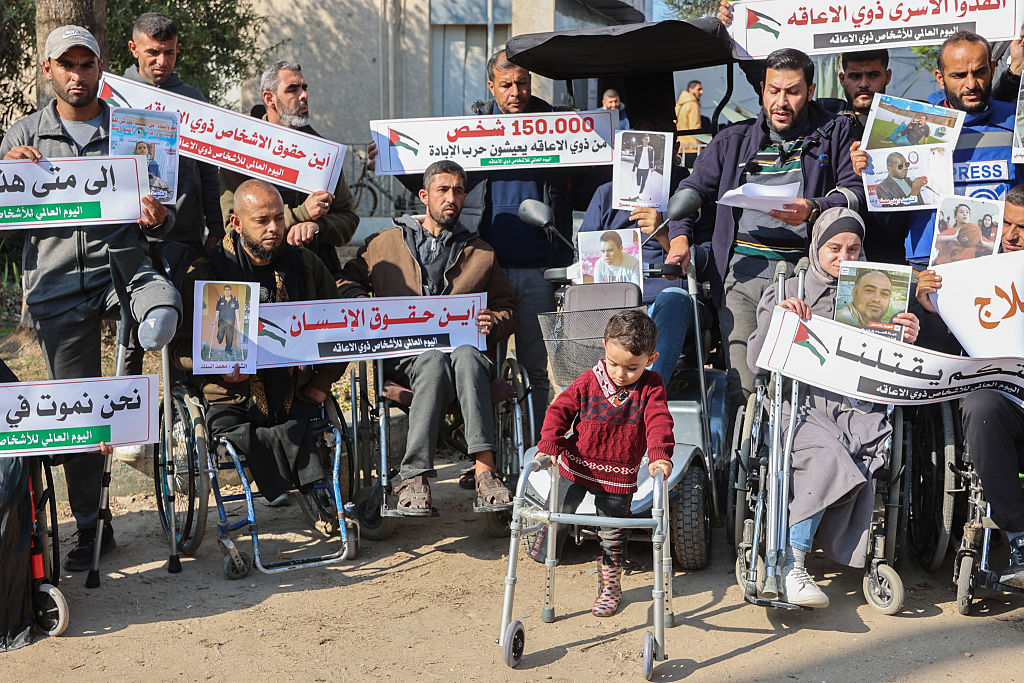
Meanwhile war and genocide across the world have also fallen heavily on disabled communities, as Russia sends disabled people to the front line as cannon fodder and Palestinian hospitals and their patients have been attacked repeatedly. And any formal numbers would likely fail to touch on avoidable nursing home deaths, or coerced medical assistance in dying cases, or the still underdiscussed death toll from an ongoing COVID-19 pandemic.
We can measure AI water usage in swimming pools, or disaster relief dollars by the number of zeroes, but there is no simple calculation for the depth or breadth of disabled death that the world has seen over the past year.
I take a small amount of solace in the ways our communities are learning to talk about the impact of these deaths. Fellow disabled journalist s.e. smith, who has an upcoming book about grief being published, penned a description of the relationship between disability and grief for Catapult in 2018 that has become one of my favorites:
Being a disabled person makes grief a constant; we have an annoying penchant for dying. We don’t necessarily mean to, but we do it anyway. Death comes for everyone eventually, but Death likes to show up early for us, knocking on the door fifteen minutes before the party is even supposed to start, looking awkward and embarrassed, holding up a bottle of cheap wine.
The reasons for untimely death in disability communities are so common that the term “pre-existing condition” is the written equivalent of a shoulder shrug to the grim reaper’s face in the public narrative. We are expected to die. For example, a report released this year by the English branch of the UK’s National Health Service (NHS) found that almost 40 percent of deaths of autistic people and those with learning disabilities in 2023 were avoidable.
Beyond headlines and statistics like those are the deaths of real people whose absences are felt deeply in our communities. Disability activist and noted author Alice Wong, who was the founder of the Disability Visibility Project, died this year, her legacy firmly entrenched among those who knew her. Patty Berne, who led Sins Invalid — the Bay-area group of advocates who coined the term disability justice — also died this year. We’ve also had to reckon with the deaths of people like Victor Perez — a non-speaking autistic teenager who was murdered by police in Idaho in April.
There is no simple calculation for the depth or breadth of disabled death that the world has seen over the past year.
The more marginalized you are, the more at risk of premature death you are, whether that be because of social determinants of health, police violence, medical neglect, or sheer bad luck. Citing research from 2017, the Center for American Progress has asserted, “In the United States, 50 percent of people killed by law enforcement are disabled, and more than half of disabled African Americans have been arrested by the time they turn 28 — double the risk in comparison to their white disabled counterparts.”
When collective grief over these premature deaths does manifest, it tends to do so in digital spaces. A few years ago, it would have been on Twitter, but after the site’s descent into technofascism, those online spaces have splintered, with Bluesky now being the most prominent gathering place to process grief together.
Studies on how to effectively process disabled grief are few and far between, with the select few out there tending to focus on how grief impacts those with intellectual and developmental disabilities. There’s also the reality that disabled people experience many different forms of grief, from the grief of missing out on an imagined future for some, to the sorrow of losing function, to the anticipatory grief of having a life-limiting condition.
The weight of disabled grief can be directed toward one’s own life as well. As writer Andrew Gurza wrote this year in a piece for The Catalyst:
It is the grieving that comes as the result of living in a disabled body that copes with more loss and abrupt changes than most… I grieve that as I age in my disabled body, the pain is becoming more apparent, and it is becoming harder and harder to do many things that my disabled body used to do. All of this has had a major effect on my mental health; I find myself becoming more irritable, quicker to upset, and quicker to fall into depression.
Researchers have terms to describe when grief becomes an all-encompassing relationship: complicated or prolonged grief. It’s when grief turns from being a regular part of the life cycle to a pathological feature of your everyday existence. It was added to the main psychiatric manual, the DSM-5, in 2022, though discussions about it as a disorder date back decades further.
Suffice it to say, 2025 has been one hell of a year for complicated grief for disabled communities. A worldwide Trumpian shadow hangs over the whole affair. Deaths can be directly tied to, in no particular order, the loss of SNAP benefits, the looming loss of health care subsidies, the proposed forced institutionalization of those with mental health disabilities, and the continued violence perpetuated against immigrants and trans people, two groups that often have disabilities themselves.
But this Sisyphean boulder of death is not just a U.S. phenomenon. Medically assisted deaths, some of which are spurred on by a lack of social supports, are rising significantly year after year in Canada; meanwhile the U.K. continues to try to slash the budget of the Department for Work and Pensions, the government agency tasked with dispersing. Our structural systems actively add to the weight of this grief by creating a cycle of premature death, resulting in grief, repeated again and again.
It’s cliche to believe that every disabled person’s life holds within it an inspirational lesson, but the lesson to take here is this: Hold close the memories of your lost kin — whether they are in your immediate circle or are disability cultural leaders who are further afield — and act on their wishes and actions. As I wrote for the Disability Debrief earlier this year, one way of doing that is to give people their flowers early and often: If you want to thank someone for the role they’ve played in your life, or congratulate them on their accomplishments, do it now.
Our disabilities hold our complicated and chaotic set of communities in connection, strung together by a version of lived experience that others just can’t grasp. Bearing the weight of grief is not going to get easier, but if we can create and build on structures of care that disability communities know well — networks of mutual aid, collective action, and creative problem solving — we can hold that grief just a little more easily.
Press freedom is under attack
As Trump cracks down on political speech, independent media is increasingly necessary.
Truthout produces reporting you won’t see in the mainstream: journalism from the frontlines of global conflict, interviews with grassroots movement leaders, high-quality legal analysis and more.
Our work is possible thanks to reader support. Help Truthout catalyze change and social justice — make a tax-deductible monthly or one-time donation today.