Truthout is an indispensable resource for activists, movement leaders and workers everywhere. Please make this work possible with a quick donation.
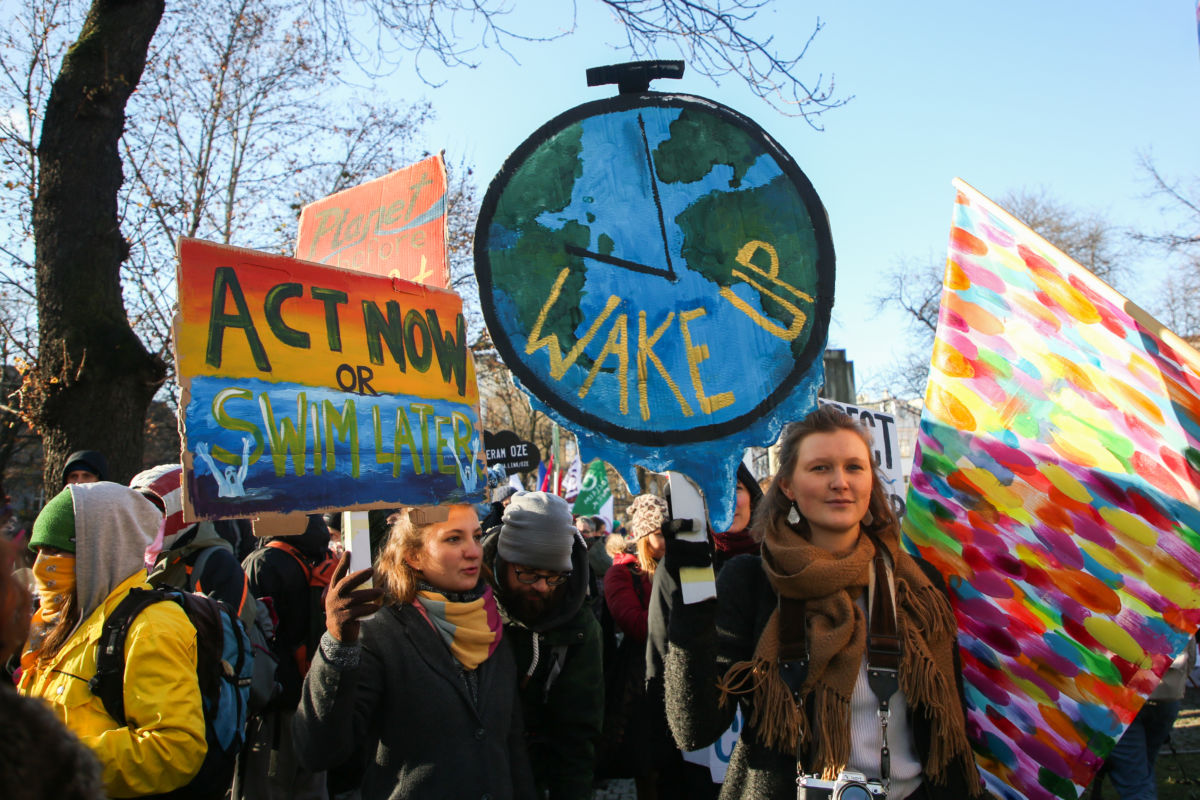
Rich countries—and the United States in particular—aren’t “paying their fair share” in terms of taking concrete actions to mitigate the global climate crisis, according to an independent review released at the COP24 talks in Poland, where world leaders are discussing how to meet the aims of the Paris agreement.
After Paris: Inequality, Fair Shares, and the Climate Emergency —produced by an international coalition of social movements, environmental and development organizations, trade unions, and various other groups—declares that “equity is not a moral or academic nicety, but a practical necessity in meeting the Paris goals.”
Although the Paris agreement’s primary objective—limiting global temperature rise within this century to 1.5°C above pre-industrial levels — “requires profound action in developing countries that cannot realistically, or fairly, be expected without meaningful levels of international support,” the report concludes that wealthier countries aren’t taking bold enough steps, which will have worldwide implications without a change in course.
These nations—including the United States, the only country on the planet that no longer supports the Paris accord — “must urgently and dramatically deepen their domestic mitigation efforts,” the report charges. “If they are to contribute their fair shares to the common effort, they must also support additional actions outside their own borders.”
And it’s not just the richest nations that are failing. The report, which “draws attention not only to the inequality between countries, but also the inequality within countries, between the rich and the majority poor,” also asserts that “if we are to achieve the critical outcome of limiting global temperature rise to 1.5°C, the wealthy (individuals and companies) in all nations must take the greatest action to both reduce their own emissions and to support the global transition.”
The report is an indictment not only of the United States—which, under President Donald Trump, has rolled back climate regulations in favor of policies friendly to the fossil fuel industry—but also the European Union and the United Kingdom, which is working toward exiting the EU. It comes as the latest projections show planet-warming emissions hitting record levels in 2018, largely thanks to the polluting practices of the US, EU, China and India.
The key takeaway from the analysis is something that’s long been emphasized by climate campaigners. As Brandon Wu of ActionAid USA put it, “Unless there is a fair deal that accounts for the legacy of climate change caused by industrialized developed countries, we will never have a sustainable global strategy.”
“We have to get some trust back into the process,” Wu added, “and that starts with rich countries making much stronger commitments to fix the climate crisis that they, and their wealthiest elites, are largely responsible for creating.”
Friends of the Earth climate campaigner Rachel Kennerley concurred.
“The cost of climate transition must ultimately be paid by the people who have the money, this is true both within countries and between them, or billions will suffer,” she said. “We have one planet, we can act together now to save it, or be the generation that passively allowed species destruction on a truly terrifying scale.”
Important Message: Please Read
For 25 years, Truthout has survived by publishing impactful investigative journalism and analysis; distributing full editions 365 days a year; and building a community of readers who support us with small, hard-earned donations.
Eighty percent of our $3 million yearly budget comes from small donors alone. Of those, 8,000 readers support us with monthly donations. Back in 2018, when Facebook decided to suppress the circulation of posts made by organizations, thereby cutting readers off from seeing many articles shared by the news organizations they had intentionally decided to follow, Truthout’s total traffic declined by 40 percent, as nearly all of our traffic from that platform disappeared.
Now, Google has recently rolled out its AI search bar, providing AI summaries instead of directing readers to our site. Google Search is our single largest source of traffic; it’s the route by which nearly one third of our readers find us. Much like in 2018, a shocking 40 percent of our Google traffic has disappeared overnight.
It will not be easy for Truthout to shoulder this blow. Nor will it be easy for our peers and collaborators — news sites that depend on traffic and aren’t bankrolled by large corporations.
If you can support Truthout with a donation today, you can help us resist the AI onslaught. Please give today.