Honest, paywall-free news is rare. Please support our boldly independent journalism with a donation of any size.
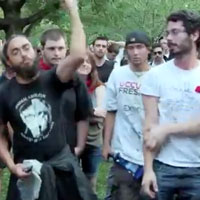 In the era of Occupy-evicted, the movement has emphasized national reunions to stay connected, such as the anti-NATO protests in Chicago, for which Occupiers were bused in from around the country. This nationalization process culminated in the Occupy National Gathering, June 30—July 4 in Philadelphia. Three Occupy Caravans traveled across the country in the three weeks leading up to “NatGat,” bearing activists from San Diego, Tucson, Wichita, Atlanta, Boston, and many other cities. Roughly 1,000 Occupiers attended the gathering’s marches, workshops (with speakers like Chris Hedges and organizer Lisa Fithian), and theatrical protest (like a 99 Percent versus Tax Dodgers baseball game). The event concluded with the daylong production of a Vision for a Democratic Future, listing the attributes of a society that those at NatGat wanted to see.
Despite many positives, the five-day gathering was rife with contention. Some Occupiers rejected the concept of NatGat outright, feeling that a movement geared towards autonomous action should not be centralizing around a national banner. In this vein, a group of Philadelphia anarchists organized a Radical Convergence the same weekend intended “for those who have felt Occupy in its current form demonizes and excludes radical dialogue, strategy, and action.” Over the five days, these theoretical divides became manifest around issues like “step up, step back,” the goals of the movement, and tactics of confrontation.
The heavy police presence, which included officers from the Philadelphia Police Department, the National Park Service, and the Department of Homeland Security, intensified the divisions around Occupy’s relationship with the police. On June 30, Occupiers were prevented from laying down any “bedding material” at the National Historic Park near Independence Mall. In defiance, a group encircled a tent and locked arms, resulting in a prolonged clash and one arrest for assaulting a federal officer. The aftermath was just as confused — some activists joined hands and hummed “ohm,” while others shouted that the cops were Nazi pigs. An ad-hoc General Assembly to discuss next steps (where they would sleep) fell apart when several Occupiers explained that they did not feel safe discussing strategy while encircled by police. On July 1, twenty-seven protesters were arrested in a nighttime jail solidarity march, raising tensions and anger further.
The mini-documentary attempts to portray the internal conflict over police confrontation at the Occupy National Gathering, particularly as it relates to the future of the movement. Interviews include former Philadelphia Police Captain Ray Lewis, Native American Un-Occupy Albuquerque activist Amalia Montoya, and InterOccupy organizer Tamara Shapiro.
We lost 15 percent of our traffic overnight.
We now have three full months of data since Google changed its search to feature AI results. The numbers are worse than we anticipated. Overall readership that comes to Truthout through Google is down 54 percent against last year. The number of new readers who discover Truthout via Google searches is down 49 percent, and returning users from Google are down 51 percent.
We lost 15 percent of our readership overnight. This was a readership we painstakingly built over decades, and it vanished because Google chose corporate greed over a healthy democracy.
We anticipate a loss of roughly $500,000 in online revenue as a result of this massive traffic plunge in the next year alone.
The only way we can keep publishing is with strong reader support. We are asking you to start a monthly donation to Truthout today — anything you can do, whether $5 or $25, makes a difference.