Truthout is a vital news source and a living history of political struggle. If you think our work is valuable, support us with a donation of any size.
Immigrant justice advocates are worried that the Trump administration’s attempt to reinstate an asylum ban at the U.S.-Mexico border through an appeal at the Supreme Court will put asylum seekers in harm’s way.
Asylum is a way for people to escape dangerous conditions such as violence, war, consequences from climate change, or persecution for their sexual orientation or gender identity. Each year, tens of thousands of people present themselves at the border to seek asylum. In 2023, the U.S. granted asylum to 54,350 people.
“People have sought safety at the border from all over the world fleeing violence, persecution, and discrimination, and that is really why asylum is so critically important,” said Amy Fischer, director of refugee and migrant rights at Amnesty International USA. “People are fleeing real life-threatening harms, and this is really the mechanism for them to find a way for safety.”
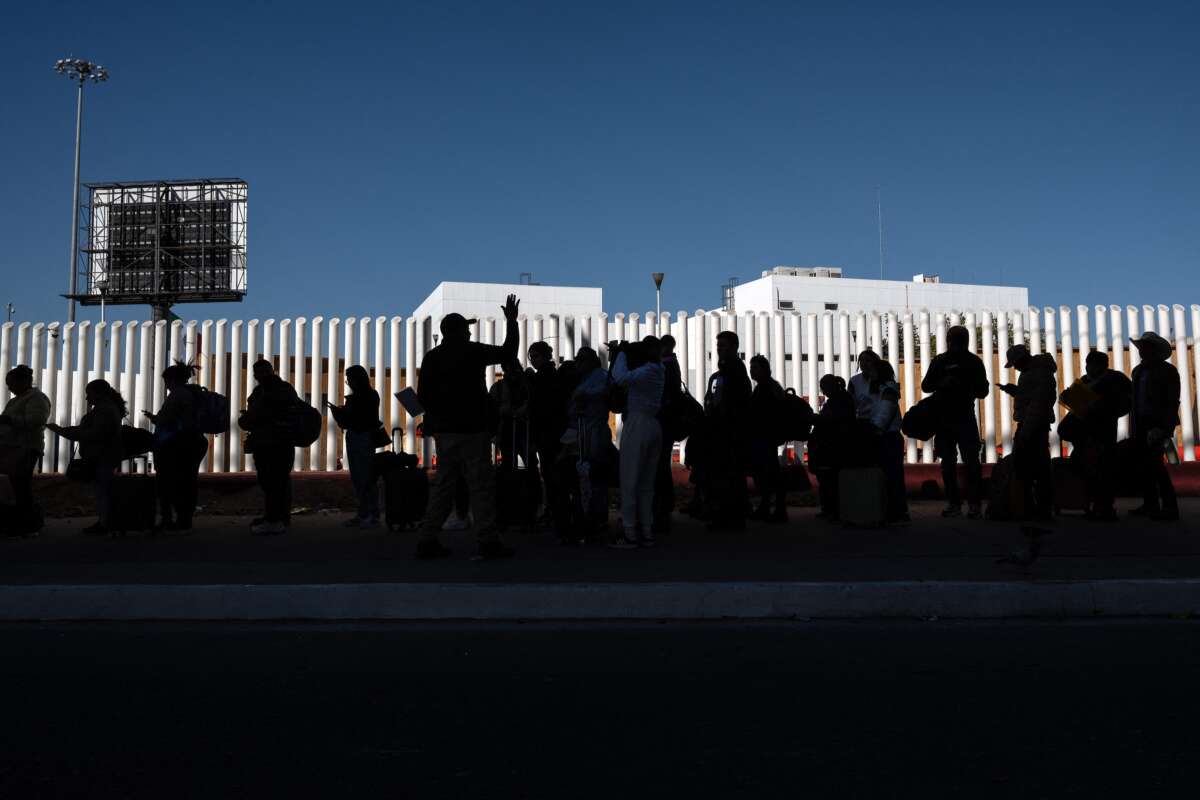
Under the first Trump administration, people seeking asylum at the United States-Mexico border would typically be met by U.S. Customs and Border Protection agents who would turn them away. While some cases of asylum seekers being turned away at the San Ysidro border crossing occurred in 2016, the turn-back policies, called “metering” by the government, weren’t written and widely instituted until the first Trump administration. This turn-back policy created a humanitarian crisis at the border that impacted thousands of people seeking refuge from danger.
In response, immigrant justice lawyers representing 13 plaintiffs sued to overturn the asylum ban in Noem vs. Al Otro Lado in 2017. The lawsuit was filed in July 2017 by Al Otro Lado, along with the Center for Gender and Refugee Studies, the American Immigration Council, and other organizations located near the border.
“Customs and Border Protection officers would confront people literally standing at the line and obstruct them from coming in,” said Melissa Crow, the director of litigation for the Center for Gender and Refugee Studies, who has been involved with the case since 2017. “They thought that would somehow make their blocking of access to the asylum process legal.”
Under the 1967 Protocol Relating to the Status of Refugees and U.S. immigration law, the U.S. has a legal obligation to provide asylum and pathways to citizenship to people who meet the qualifications for a refugee.
Crow said that when asylum seekers would try to cross the border at the time this ban was in place, they would be told that there was no capacity. She said that during the discovery phase of the trial, however, it was uncovered that the “excuses were pretextual.”
The case was originally heard in the U.S. District Court for the Southern District of California in San Diego before the federal government attempted to appeal the case to the Ninth Circuit Court, but the judge affirmed that the turn-back policy is unlawful.
The Supreme Court expects to hear arguments in the spring, with a decision anticipated for the summer.
Last month, the Supreme Court agreed to consider the case and expects to hear arguments in the spring, with a decision anticipated for the summer.
One of the plaintiffs in Noem vs. Al Otro Lado, an asylum seeker the legal team refers to as “Bianca Doe,” is a transgender woman who sought asylum at the U.S. border in early 2017 after suffering extreme physical and sexual violence in both Honduras, her home country, and Mexico. When she presented herself at an official port of entry, border officials turned her back. Fearing for her life in Tijuana and desperate to reach safety in the United States, she attempted to climb a fence on a beach to come into the United States, but a border officer threatened to call the Mexican police.
She wasn’t allowed into the U.S. until Noem v. Al Otro Lado challenged the policy keeping her from entering the country. Now, advocates like Fischer worry that reimplementing the asylum ban would bring back that desperation and fear facing many asylum seekers, including unaccompanied children, she said, which allows bad actors to profit and take advantage of those vulnerabilities at the border.
“The ability for people to seek asylum at the border is really a life-or-death issue.”
“The ability for people to seek asylum at the border is really a life-or-death issue,” Fischer said. “People must have the ability to present themselves and be able to seek this critical protection. Policies that are intended to block access to asylum or deter people from seeking asylum really only add to the violence and chaos and the real struggles that people have at the border.”
While the government wants to turn back people seeking asylum at the U.S.-Mexico border, not all asylum seekers are subject to the same crackdown. Marisa Limón Garza, executive director of Las Americas Immigrant Advocacy Center, said the targeting of the southern border specifically — while European or white South African immigrants are allowed to continue seeking asylum — is due to U.S. racism. To her, the attack on asylum did not come as a surprise.
Earlier this year, the Trump administration accepted 59 white South African refugees, affirming their assertion of being victims of “racial discrimination,” while Black and Afghan refugees have been denied refuge in the U.S.
“We’ve already seen in our detention centers people with protected status be detained and attempted to be deported, so why would they not go after the big fish, asylum at large, and just cut off that mechanism unless it’s for white folks of a certain class bracket that they would like to populate the United States,” Limón Garza said.
“We’ve already seen in our detention centers people with protected status be detained and attempted to be deported, so why would they not go after the big fish, asylum at large, and just cut off that mechanism.”
She also said that she has seen a decrease in the amount of people seeking asylum at the southern border since the start of the second Trump administration. She believes it’s due to the increased kidnappings and raids in the U.S. “People are really second guessing, like, ‘Do I want to go to the United States?,’ because if you’re leaving danger, would you go to a place that’s just as dangerous, if not more? Why would you want to go to a place where you would just end up in a detention center in horrible conditions?”
Limón Garza is also concerned that the attack on asylum at the southern border will open the door for broader attacks on asylum recipients in the U.S.: “It’s all interconnected.”
“We have to look around, look at our resources, and make a plan so it doesn’t go unchecked,” she said. “I don’t know what we’ll do yet, but we will respond.”
Fischer said that ending asylum would mean thrusting people back into the same danger they fled. Rather than trying to ban asylum, she said, the federal government should instead be building reception systems so that people who are arriving to seek safety have access to lawyers, social workers, and the resources they need to start putting down roots in their new communities, as well as more legal pathways to citizenship.
“I think as much as communities are really stepping up and stepping out to protect their immigrant friends and neighbors, it is really, really critical for the Trump administration to stop their mass deportation and mass detention machine and really turn a new lease on their treatment of people seeking safety in immigrant communities,” Fischer said.
An important fundraising appeal: 10 Days to raise $50,000
Truthout is one of only a few platforms for justice-oriented, grassroots journalism. Today, as political censorship from the right intensifies, we have no choice but to ask for your help.
We are fundraising right now to cover our basic operating expenses. If you can support Truthout with a one-time or monthly donation, you will make a significant impact on our work. Anything you can do makes a difference — we appreciate your support.