Support justice-driven, accurate and transparent news — make a quick donation to Truthout today!
The deadly war launched by the United States and Israel against Iran has led to serious military and economic impacts across the region that produces much of the world’s oil and gas. A global spike in fuel prices could further inflame an affordability crisis that President Donald Trump has repeatedly called a “hoax” created by Democrats.
However, higher oil and gas prices would be a boon for U.S. fracking companies that supported Trump’s presidential campaign. It could also fuel more profits for the rapidly expanding liquified natural gas (LNG) export industry in the United States.
After the U.S. and Israeli bombardment began, Iran announced it would close the Strait of Hormuz, the narrow body of water connecting the Persian Gulf to the Arabian Sea that sees about 20 million barrels of oil — roughly 20 percent of global consumption — pass through on tanker ships each day. Additionally, Qatar’s state-run energy firm announced it had shut down LNG production and shipping after Iranian drones struck the two major LNG complexes in recent days, putting about 20 percent of the global fossil gas supply at risk. Qatar is the world’s top gas exporter after the United States.
“With Qatar shutting down its LNG processing and LNG export capacity due to safety/security issues, the U.S. LNG export industry is primed to rake in massive profits,” said Tyson Slocum, director of the watchdog group Public Citizen’s energy program, in an email. “Natural gas prices in Europe jumped 50 percent on the news that Qatar was shutting in LNG.”
Travel and energy infrastructure across the region have shut down due to the fighting, including at a central Saudi Aramco refinery. Oil-rich Gulf states hosting U.S. bases and personnel have also been on the receiving end of Iran’s blowback, which has hit both military and civilian infrastructure, threatening a central nerve of the petrodollar economy. The spread of the war has been catastrophic for the region — but not for U.S. oil and gas companies.
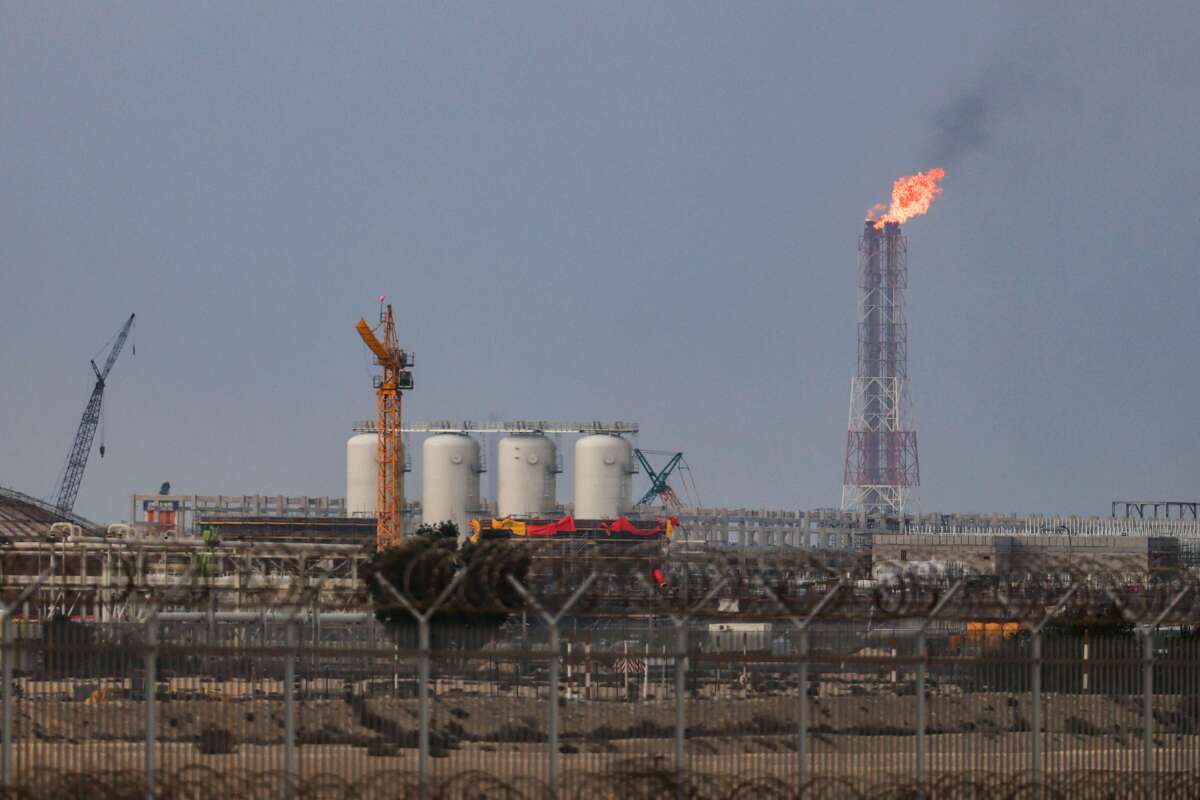
Thanks to the shale fracking boom, the U.S. is the world’s top producer of fossil fuels. Massive production created a gas glut over the past decade, causing the industry to aggressively push to expand infrastructure for liquefying gas and shipping it overseas. A rush to build giant LNG export terminals primarily along the U.S.’s Gulf Coast has trampled local fishing grounds and led to increased air pollution, fiery accidents, and protests by local residents in recent years. A portion of an LNG pipeline in Louisiana exploded on February 3, injuring at least one worker.
U.S. gas is typically destined for China as well as Europe, where the Russian war on Ukraine has constrained gas supplies. The European Union urged Ukraine for access to a pipeline carrying Russian gas this week, according to reports.
Fuel prices are determined by global market forces, and the U.S. fracking boom has not always translated to lower energy bills for households as many politicians have promised. “Under my administration, we will be slashing energy and electricity prices by half within 12 months, at a maximum 18 months,” Trump pledged to voters during a campaign speech in North Carolina in August 2024. In fact, despite being the world’s top producer, the cost of “natural” gas used to cook and heat homes has risen for consumers under Trump.
The LNG export industry consumes more gas than the 73 million U.S. households that use natural gas for heating and cooking. LNG exporters must transport, process, and liquify domestic gas supplies at very cold temperatures and then ship it overseas on tanker ships, an energy-intensive process that leaks climate-warming methane into the atmosphere. In 2025, consumers collectively spent $12 billion more for gas than they did the year before, or about $124 per household, according to a report released in December by Slocum and Public Citizen.
“With Qatari LNG off the market, U.S. gas exporters are primed to profit,” Slocum said. “At the same time, expect domestic natural gas prices to increase, exposing American families to higher energy burdens in their utility bills.”
A study published in 2025 found that inflated fossil fuel prices in the wake of global COVID-19 pandemic restrictions rehabilitated the industry’s finances and political standing after many countries, especially China and European nations, spent years investing in cleaner alternatives to combat global warming. In the U.S., 50 percent of the increased profits went to the wealthiest 1 percent of taxpayers.
“We all know the 2022 energy price shock fueled the cost of living crisis,” said Gregor Semieniuk, an associate professor at the University of Massachusetts, Amherst, in October after the paper was published. “It also caused a profit bonanza for the very rich.”
Before Trump and Israeli Prime Minister Benjamin Netanyahu launched a war against Iran that is causing the global cost of fuel to spike, oil and gas producers in the U.S. complained about rock-bottom prices. Harold Hamm, the billionaire oil driller who helped pioneer the U.S. fracking boom, announced in January that he would shut down crude oil production from the Bakken shale formation for the first time in decades due to low prices and nearly nonexistent profit margins.
Like other industry leaders, Hamm is a major supporter of President Trump, who asked oil and gas executives for $1 billion in campaign donations in exchange for favorable policies during his 2024 campaign. The industry spent lavishly, providing at least $75 million to Trump’s war chest and $11.8 million to his inauguration fund. Several oil and gas tycoons spent millions of dollars on their own and hosted fundraisers for the campaign, according to the Brennan Center for Justice.
“As promised, Trump is rewarding the industry by adopting its policy agenda as his own,” wrote Brennan Center Policy Strategist Owen Bacskai in September. “His signature legislative package — which one executive deemed ‘positive for us across all of our top priorities’ — gives oil and gas firms $18 billion in tax incentives while rolling back incentives for clean energy alternatives.”
Netanyahu and hawks in Congress have spent decades pushing for a direct war against Iran. Trump has given multiple shifting reasons for the current attack; oil and gas profits for his supporters in the industry is not one of them. However, if the war drags on and continues pushing up fuel prices, LNG produced in the U.S. will be badly needed to meet global demand. Consumers will likely face higher utility bills — particularly as more AI data centers that gobble up electricity come online — but for oil and gas profiteers, the chaos forecasts higher margins.
Fundraiser Deadline Midnight! We still need to raise $18,000
Truthout is one of only a few platforms for justice-oriented, grassroots journalism. Today, as political censorship from the right intensifies, we have no choice but to ask for your help.
We are fundraising right now to cover our basic operating expenses. If you can support Truthout with a one-time or monthly donation, you will make a significant impact on our work. Anything you can do makes a difference — we appreciate your support.