Did you know that Truthout is a nonprofit and independently funded by readers like you? If you value what we do, please support our work with a donation.
A new report from the International Monetary Fund (IMF) warns that the U.S.-Israeli joint war on Iran has stalled economic momentum for this year, and, if the war lasts for several months, has the potential to cause a global recession.
The report, published on Tuesday, blamed disrupted supply chains, primarily for oil, for its changes in projections compared to a previous report issued in January, noting that fewer ships are passing through the Strait of Hormuz as a consequence of current hostilities in the Middle East.
The global economic growth rate in 2025 was 3.4 percent, the report noted. Earlier this year, the IMF had predicted that growth would be around 3.3 percent for 2026. However, the new report downgrades the projected growth rate to 3.1 percent for the year.
That prediction is based on a best-case scenario that assumes the war on Iran will come to an end relatively soon. Under a “severe scenario,” the report said, where the war stretches for several months and perhaps into next year (with the price of oil remaining much higher than it was before the war), worldwide economic output could drop to just 2 percent, a rate that is widely considered to be the equivalent of a global recession.
Countries with low incomes and that are highly dependent on energy imports would be hurt the most, the report added.
“The global outlook has abruptly darkened following the outbreak of war in the Middle East,” Pierre-Olivier Gourinchas, chief economist of the IMF, said in the report. “The war interrupted what had been a steady growth trajectory.”
Even an immediate end to the war wouldn’t be enough for the global economy to rebound from the damage that has already been done, the report stated.
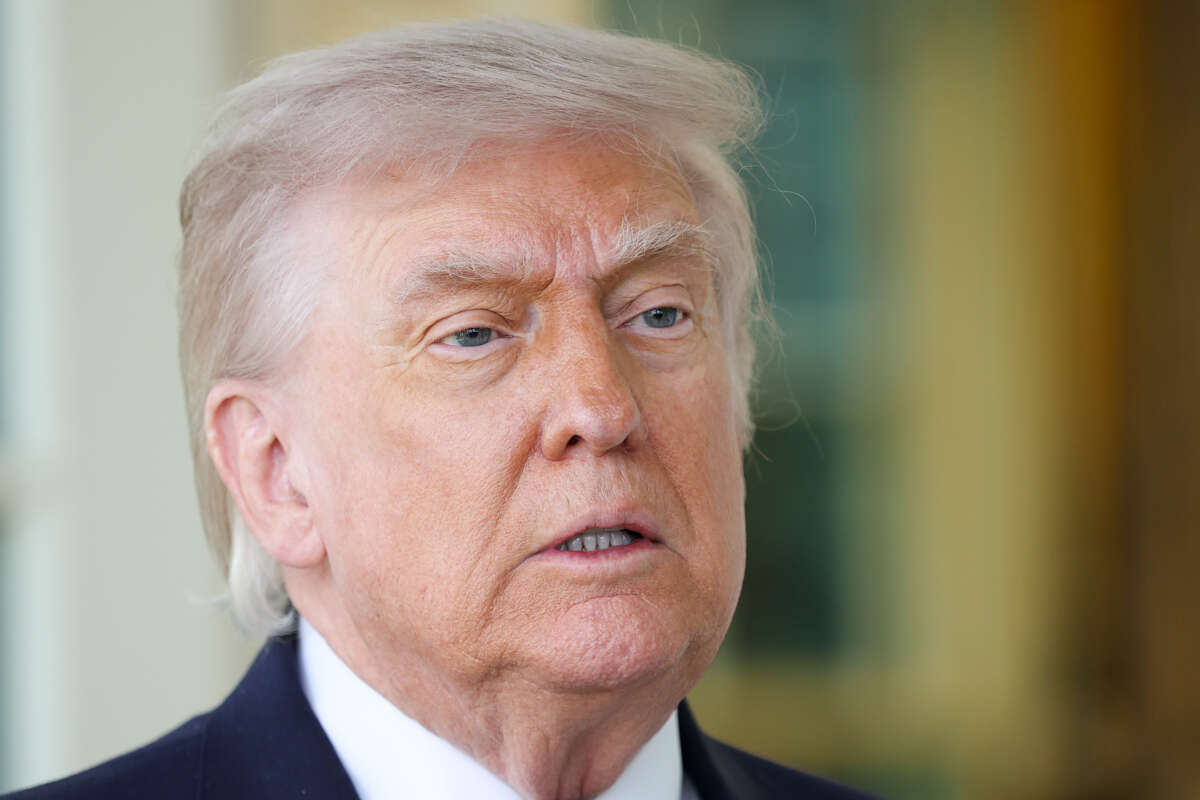
The update from the IMF showcases that the Trump administration’s decision to launch a war on Iran has come with high costs, hitting consumers especially hard when it comes to energy and gas prices, including in the United States. Despite these warnings, however, Kevin Hassett, director of the National Economic Council (NEC) and a top adviser on economic policy for President Donald Trump, downplayed the report’s findings, asserting in an interview on CNBC Tuesday that Americans should have a more optimistic look at things.
“Our economy is really running on all cylinders,” Hassett said.
His assessment, however, relied on a number of suppositions, including that the war would end soon.
“Imagine if oil prices start going back down because the situation resolves itself somehow, they you could be looking at an inflation close to zero,” Hassett said, a dubious claim given that inflation existed in the U.S. even before the war began due largely to Trump’s tariff policies.
We lost 15 percent of our traffic overnight.
We now have three full months of data since Google changed its search to feature AI results. The numbers are worse than we anticipated. Overall readership that comes to Truthout through Google is down 54 percent against last year. The number of new readers who discover Truthout via Google searches is down 49 percent, and returning users from Google are down 51 percent.
We lost 15 percent of our readership overnight. This was a readership we painstakingly built over decades, and it vanished because Google chose corporate greed over a healthy democracy.
We anticipate a loss of roughly $500,000 in online revenue as a result of this massive traffic plunge in the next year alone.
The only way we can keep publishing is with strong reader support. We are asking you to start a monthly donation to Truthout today — anything you can do, whether $5 or $25, makes a difference.