Truthout is a vital news source and a living history of political struggle. If you think our work is valuable, support us with a donation of any size.
Months before ICE agents’ tactics were put in the national spotlight by the deaths of two civilians in Minneapolis, José Castro-Rivera, a young man from Honduras, was hit by a vehicle on a busy interstate highway in Virginia. He was running to escape arrest during what ICE officers described as a “targeted, intelligence-based immigration enforcement operation.”
Castro-Rivera, 25, died on the spot.
Four months earlier, on June 10, 2025, Jaime Alanis Garcia, a Mexican immigrant, fell from the top of a greenhouse in Camarillo, California, during an ICE raid at a cannabis facility. Garcia, 56, died two days later.
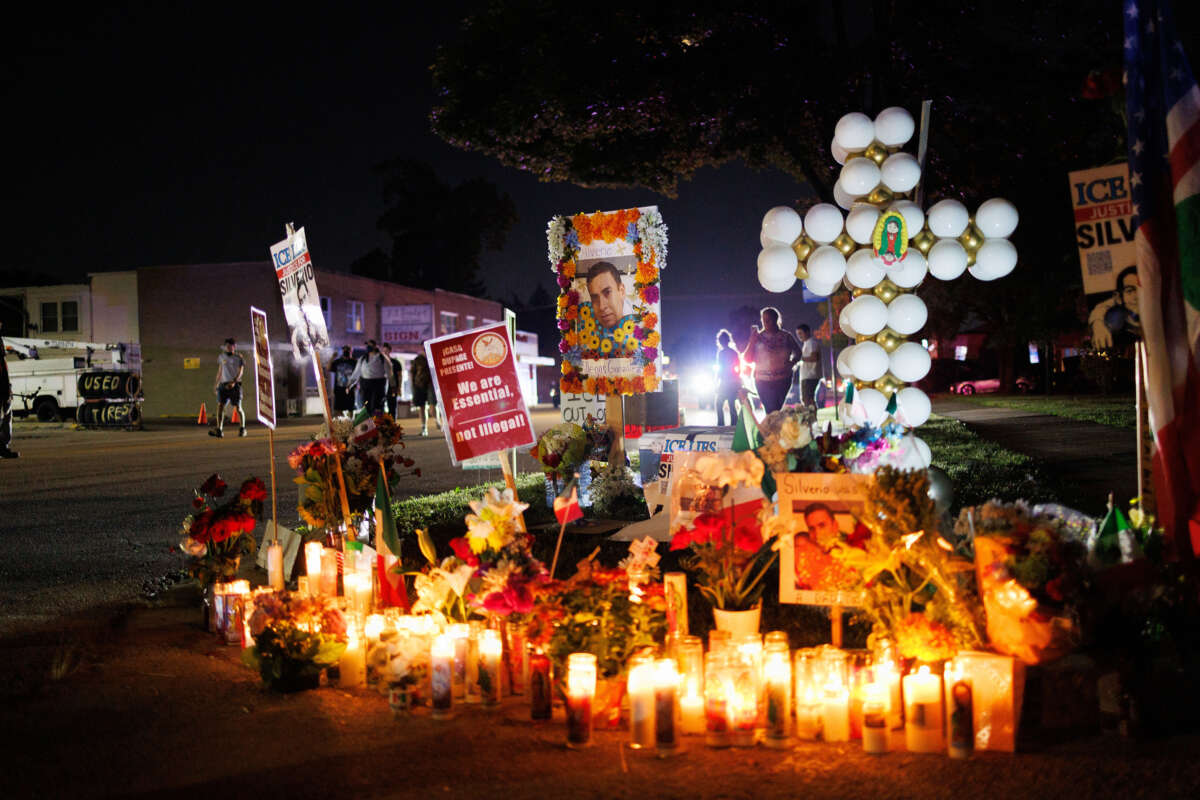
Then, in August, just over 60 miles away in Southern California, a 52-year-old Guatemalan immigrant, Roberto Carlos Montoya Valdez, was also hit by an SUV on a freeway while evading ICE officers. Less than a month later, another person was killed in Chicago by federal agents. On September 12, 2025, Silverio Villegas González was shot “multiple” times in his car by ICE agents amid the agency’s infamous “Operation Midway Blitz.”
ICE did not identify the agents involved in the killings of Castro-Rivera, Garcia, and Valdez. While the October death came with the promise of a formal report within 90 days, ICE neither publicly tracked nor logged the other fatal arrest incidents, nor did it say whether the operations were evaluated by any internal or external agency.
Through extensive scans of national and local outlets, as well as social media platforms including X, Instagram, and Facebook, as well as DHS public statements, Documented logged and analyzed more than 20 cases of violent — and sometimes fatal — ICE arrests nationwide since the Trump administration’s crackdown on immigration ramped up.
Since May 2025, Documented found, there has not been a single month in which an intended detainee was not severely injured during an ICE operation. Federal agents from Chicago and Los Angeles to Oregon and Maryland shot targets, unleashed dogs on targeted detainees, and used chokeholds and tear gas.
A complete picture of the violence committed during the DHS crackdown is unknown. While the agency is required by law to release reports after the death of detained immigrants, it is not required to report on deaths that happen during the arrest process, which makes it difficult to keep track of just how many people get injured or killed as ICE continues to arrest immigrants nationwide. Of the nearly two dozen such cases identified by Documented, DHS published official press releases for only two.
The agency has a policy to track uses of force, but it has not released data since 2024. In February 2023, DHS adopted a policy stating that it would not “tolerate” any use of excessive force. Such conduct would be “unlawful,” it said, and failing to report it would constitute “misconduct.”
Seven months later, the department established the Office of Homeland Security Statistics (OHSS). The unit was tasked with logging all instances of use of force by federal agents during enforcement operations, including “deadly force.” This included any “serious bodily injury” caused during such operations — from gunshots and strikes to the neck or head to the use of strangulation techniques.
That year, ICE officers’ use of force led to serious injuries and/or hospitalizations in nine cases. Two other deaths were also reported.
There was, however, a caveat in which cases federal agencies had to log with the OHSS. “Use of physical tactics or techniques that do not deliver a kinetic impact, such as arm holds, are not reportable incidents,” read a footnote in the OHSS report published in March 2024 — the only one produced so far.
It remains unclear how many of the two dozen incidents identified by Documented were reported to OHSS by ICE, or whether they were logged as use-of-force incidents at all.
ICE did not respond to questions from Documented about its policy to formally report injuries suffered by detainees during arrest attempts — either publicly or internally.
As far as public reporting is concerned, it has done so seemingly only to defend its officers. In most, if not all instances, injured detainees have been called dangerous in official statements.
DHS press statements, as recently seen in Minneapolis with the deaths of Renee Nicole Good and Alex Pretti, have often differed from evidence of detainees being severely injured during ICE’s arrest attempts as well.
For example, in a recent case in Washington, a video captured an ICE operation to detain 27-year-old Jose Paniagua Calderón in front of a Mexican restaurant in central Vancouver on Dec. 4, 2025.
The minute-long arrest video, shared by his sister-in-law on social media, is graphic. It shows Calderón screaming in pain as a silver SUV drives over both his legs while he is held down by a masked ICE agent. At least three other officers stand around him.
Calderón’s screams, however, were called “an Oscar-level performance” and “pure theatre” by an ICE spokesperson two days later.
In another case in Chicago last October, when U.S.-citizen Marimar Martinez was shot at five times by a federal agent, ICE issued a press release describing her as a “domestic terrorist.”
The DHS secretary, Kristi Noem, used the same label for Renee Nicole Good shortly after she was shot by an ICE agent in Minneapolis on Jan. 7, 2026.
In another case, the day before Christmas 2025, the department posted photographs on its X account showing a white van crashed into a tree. ICE officers had shot at the driver while attempting an arrest in Glen Burnie, Maryland, causing him to lose control of the vehicle and injure a passenger.
“Fearing for their lives and public safety, the ICE officers defensively fired their service weapons,” the DHS post read. “Thankfully, the ICE officers were not severely injured.”
No report was promised.
Last week, on Jan. 14, 2026, amid massive protests against the federal agency following the killing of Good, another Venezuelan immigrant was shot in the leg by an ICE agent in Minneapolis.
The federal agency said it conducted a “targeted traffic stop” of an alleged Venezuelan immigrant, Julio Cesar Sosa-Celis, minutes before 7 p.m. that evening. Sosa-Celis, DHS said, “fled the scene in his vehicle, crashed into a parked car, and proceeded to flee on foot.”
When caught, he resisted, according to the DHS press release. Sosa-Celis and two other Venezuelan immigrants who emerged from a nearby apartment, the agency said, attacked the ICE agent with “a snow shovel and broom handle.”
The agent shot Sosa-Celis.
DHS published a press release the following day. Nearly identical to the language used after the incident last Christmas, it stated: “Fearing for his life and safety as he was being ambushed by three individuals, the officer fired a defensive shot to defend his life.”
Minnesota state investigators “have been on the scene,” Governor Tim Walz posted on X a few hours later. He urged people to remain calm. “Don’t give him what he wants,” he wrote, referring to President Trump.
The federal agency, however, did not say whether it would produce any report on the shooting of Sosa-Celis.
Sign up for Early Arrival, Documented’s newsletter, here, and get your immigration and policy news from New York, Washington, and nationwide in your inbox 3x per week.
An urgent fundraising appeal: 4 Days to raise $30,000
Thank you for reading Truthout today. We have a brief message before you go —
Unfortunately, donations are down for Truthout at a time when media is under immense pressure. Trump is arresting journalists, Big Tech is censoring independent news, and economic conditions for media have been worsening for years.
Simultaneously, movement media is vital in the fight against Trump’s authoritarian reign. Our mandate to tell the truth, share strategies for resistance, and speak against fascism is ever more urgent in this deluge of political censorship. Yet, we are struggling to meet our publishing costs when our work is so urgently needed.
If you can support Truthout with a one-time or monthly donation, you will make a significant impact on our work. Please give today during our fundraiser (4 days left).