Support justice-driven, accurate and transparent news — make a quick donation to Truthout today!
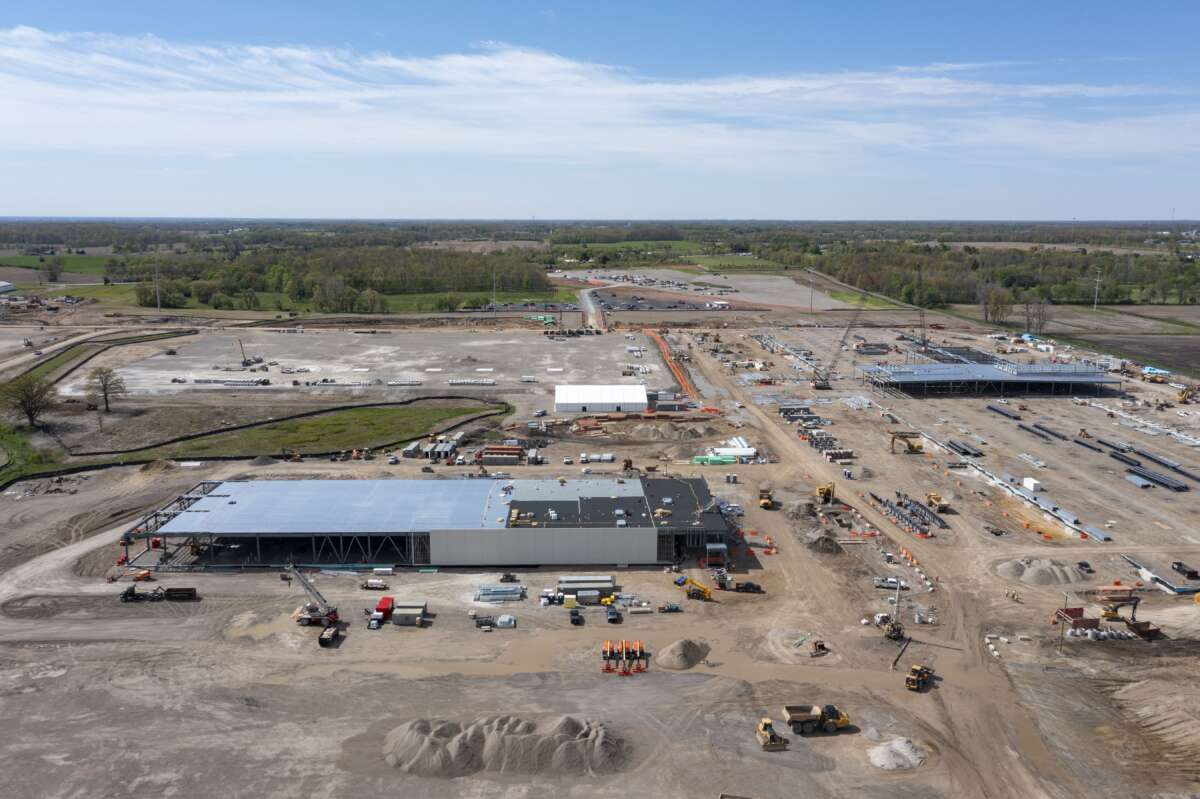
The U.S. Environmental Protection Agency announced proposed changes Monday that would allow gas power plants, data centers and factories to begin construction on non-polluting components such as piping, wiring, cement pads and other support structures before obtaining air-emission permits.
EPA Administrator Lee Zeldin said in a news release that the “proposal works to provide solutions to issues that have held up critical American infrastructure and advance the next great technological forefront.” The changes will undergo a 45-day public comment period.
The action comes as the Trump administration moves to reduce an array of environmental protections to speed construction and win a global AI race with China and other adversaries. Big Tech companies like Amazon, Meta, Microsoft and Google are furiously working across the nation to build the data centers — massive facilities with networked computer servers — to power the energy-intensive new technology.
In pursuit of winning the AI race, President Donald Trump last year issued an executive order to revoke many guardrails that could slow down AI development.
As data centers wait in long queues for grid upgrades before coming online, tech companies are increasingly seeking facilities with their own natural gas-fueled power plants, which have years-long construction times and climate consequences. As part of their grid upgrades to serve data centers, utilities are also building gas plants.
The construction definition rules announced by Zeldin would also add language to say that prohibited construction activities do not include “clearing vegetation, grading, surveying, soil compacting and stabilization … and excavating land.”
The prohibition of construction prior to permit issuance, waived under the proposed new rules for wiring, piping and cement pads, would also exempt utility services bringing electrical, water, wastewater or telecommunications services to a property site or building.
The definitions have been a critical part of the Clean Air Act that Congress passed decades ago to protect public health, said David Baron, a senior attorney with Earthjustice. Without them, Baron said, it will be “much, much harder for communities to protect the air they breathe.”
Under the current rules, small amounts of site clearing and grading could occur. But companies aren’t allowed to invest what now can be hundreds of millions of dollars and carry out extensive work before obtaining a permit. Significant investment and construction on projects prior to permit issuance only makes it more “politically difficult” to reject air permits for facilities promoted as bringing hundreds of jobs and significant tax revenues to local communities, Baron said.
“That shouldn’t be a consideration here,” Baron said, noting that the law directs regulators to determine whether the site is appropriate for the proposed facility and whether the air pollution controls are adequate. The EPA proposal “will really undermine those kinds of factors being given fair consideration.”
Keri Powell, a senior attorney for community health and the air program leader at the Southern Environmental Law Center, said under Zeldin’s proposed new rules, a gas plant could be nearly complete, except for technology central to the air permitting process.
“Once you have the layout of the plant … there’s going to be a lot of sunk costs there,” Powell said. “The political pressure that would be brought to bear on a local agency or state agency that’s charged with making those [permit] decisions would be very, very high. It’s difficult already for those agencies. They’re under a lot of pressure.”
The moves by the EPA are similar to other actions underway in Virginia, just outside the nation’s capital, which currently has more operating data centers than any other state or nation besides the U.S.
In January, the Virginia Department of Environmental Quality released guidance called “Construction Activities Permissible Prior to Receiving an Air Permit” just days before term-limited Republican Gov. Glenn Youngkin, a Trump ally and data center cheerleader, left office.
While the EPA rules apply to major new source reviews, such as larger electricity generating facilities, the DEQ guidance applies to minor new source reviews, including backup diesel generators, which virtually all of the state’s data centers rely on for power in the event of grid failures.
In that guidance, DEQ said it would be permissible to start construction on the buildings housing the computer equipment so long as the building didn’t also house the backup or electrical generators requiring the air permit. It would not be permissible to lay foundations or install and connect generators before the permit is received, DEQ explained, but it would be allowable to “extend ductwork” needed for potential emissions “several feet from building structure in accordance with good construction practices.”
The DEQ memo was the “result of receiving many inquiries from facilities regarding the interpretation of ‘begin actual construction,’” according to a spokesperson. “This clarification memo is simply a formalization of responses that DEQ had previously provided to permittees to clarify this interpretation.”
In 2024, the state’s largest electric utility, Dominion Energy, said its data center customers needed 3.5 gigawatts of power, the equivalent of electric use by almost 900,000 homes. Now, requests from data center developers exceed 70 gigawatts, almost three times Dominion’s record peak demand of 25 gigawatts in January.
Media that fights fascism
Truthout is funded almost entirely by readers — that’s why we can speak truth to power and cut against the mainstream narrative. But independent journalists at Truthout face mounting political repression under Trump.
We rely on your support to survive McCarthyist censorship. Please make a tax-deductible one-time or monthly donation.