Did you know that Truthout is a nonprofit and independently funded by readers like you? If you value what we do, please support our work with a donation.
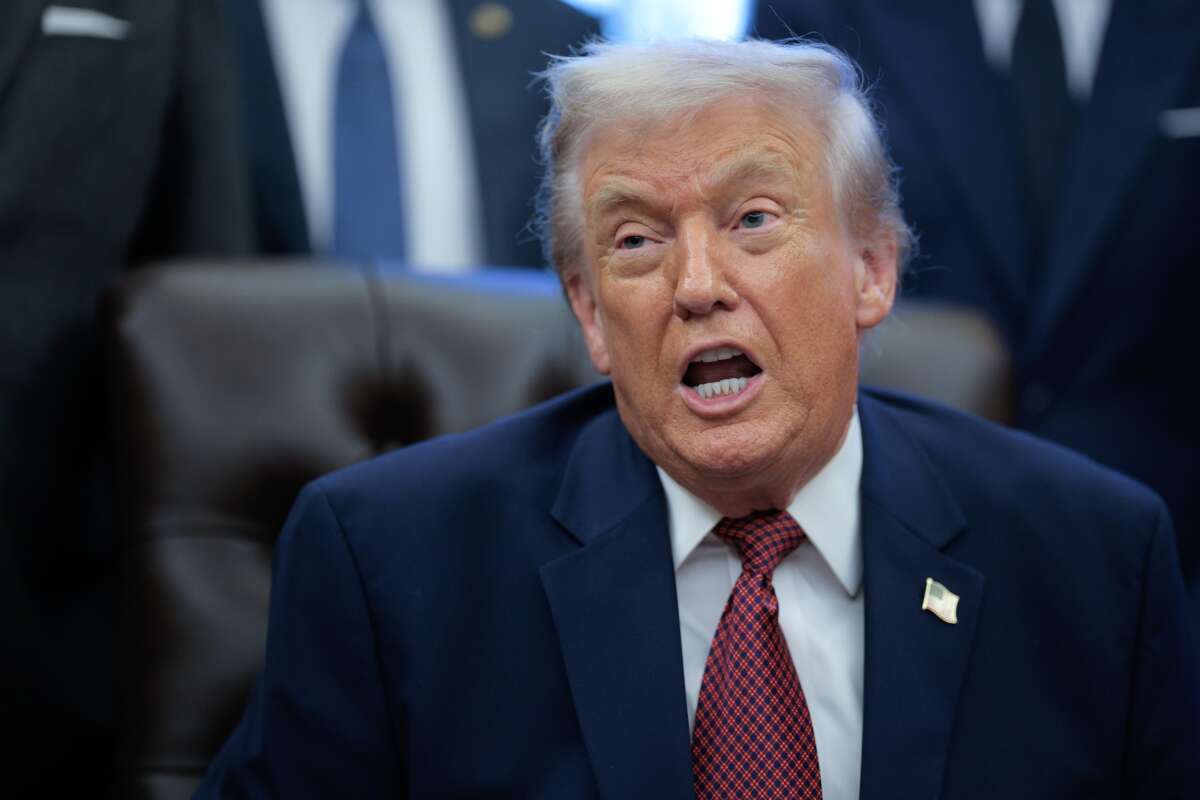
On Sunday, President Donald Trump lashed out at Rep. Henry Cuellar (D-Texas) just days after granting the congressman a full presidential pardon for federal bribery charges against him.
Cuellar and his wife, Imelda, were indicted last year on charges relating to allegedly accepting $600,000 in payments from foreign sources. Their trial was set for this coming spring, but earlier this month, Trump intervened, giving both Cuellars a full pardon.
In explaining his decision, Trump — who usually grants clemency to people based on their loyalty to him — claimed, without evidence, that Cuellar was targeted by the Biden administration over the right-wing Democrat’s views on immigration, which are similar to Trump’s views on the issue. At the time, some political observers speculated that the pardon was issued with hopes that Cuellar, who is running for reelection, would switch parties and become a Republican.
Trump’s latest Truth Social post about Cuellar all but confirms those speculations, as the president exhibited anger toward the representative over his remaining a Democrat.
“Only a short time after signing the Pardon, Congressman Henry Cuellar announced that he will be ‘running’ for Congress again, in the Great State of Texas as a Democrat, continuing to work with the same Radical Left Scum that just weeks before wanted him and his wife to spend the rest of their lives in Prison,” Trump wrote in his post.
“Such a lack of LOYALTY,” Trump continued, adding, “Oh well, next time, no more Mr. Nice guy!”
Cuellar responded to Trump’s post during an interview on Fox News on Sunday.
“I am a conservative Democrat, but I will work with the president,” Cuellar said.
Presidents have broad and mostly unchecked power when it comes to granting commutations, pardons, and other forms of clemency to individuals charged with or convicted of federal crimes. However, Congress can punish a president, through the impeachment process, if lawmakers deem their pardons to have been abuses of power.
It is unlikely that the Republican-led Congress will pursue such an action.
Several commentators have called for reforms to the pardon power, including a constitutional amendment to provide greater oversight. The Prison Policy Initiative has said that the issue isn’t the amount of pardons Trump has issued, but the fact that he’s reserving the pardons for his allies.
“While President Trump has used his pardon power far more frequently than most recent presidents, it is still not enough. There are more than 200,000 people in federal custody on any given day,” that organization’s digital communications strategist Regan Huston wrote in a blog post last week.
“The real problem isn’t how many people he has pardoned, but rather that he appears to be reserving that power just for his friends,” Huston added. “The vast majority of people who have been pardoned by President Trump are political and business allies.”
With Cuellar pardoned and running for office again, it’s worth noting he may have a difficult time winning reelection to Congress, given that Texas’s Republican-led state legislature recently gerrymandered its political maps, likely giving the party five additional seats in next year’s midterms. Cuellar, who won the district by just seven points in last year’s races, will face more GOP voters this time around.
Trump helped orchestrate the mid-census redistricting scheme in Texas earlier this year, and has pressured other GOP-led states to do the same, with the goal of staving off huge losses to Democrats in the midterms.
An appeals court later ruled that the maps were not only a political gerrymander but a racial one, blocking their use for next year’s elections. However, shortly after that ruling, the U.S. Supreme Court stepped in and said the maps could continue being used after all, with the conservative justices on the bench claiming that it was “indisputable” that the redrawing was strictly a partisan gerrymander, which the court does not restrict.
In a scathing dissent, Justice Elena Kagan found that the majority ruling from the Supreme Court “disrespects the work of a District Court that did everything one could ask to carry out its charge,” adding that it “disserves the millions of Texans whom the District Court found were assigned to their new districts based on their race.”
An urgent fundraising appeal: 9 Days to raise $50,000
Thank you for reading Truthout today. We have a brief message before you go —
Unfortunately, donations are down for Truthout at a time when media is under immense pressure. Trump is arresting journalists, Big Tech is censoring independent news, and economic conditions for media have been worsening for years.
Simultaneously, movement media is vital in the fight against Trump’s authoritarian reign. Our mandate to tell the truth, share strategies for resistance, and speak against fascism is ever more urgent in this deluge of political censorship. Yet, we are struggling to meet our publishing costs when our work is so urgently needed.
If you can support Truthout with a one-time or monthly donation, you will make a significant impact on our work. Please give today during our fundraiser (9 days left).