Honest, paywall-free news is rare. Please support our boldly independent journalism with a donation of any size.
Individuals who are managing the social media channels for the International Olympic Committee (IOC) and Tokyo 2020 organizers are reportedly being banned from posting content that shows athletes taking part in any kind of political demonstration during the summer games.
Social media teams for this year’s Olympics were delivered a message on Tuesday evening telling them they cannot share optics of athletes taking a knee, The Guardian reported, citing a source familiar with the communications.
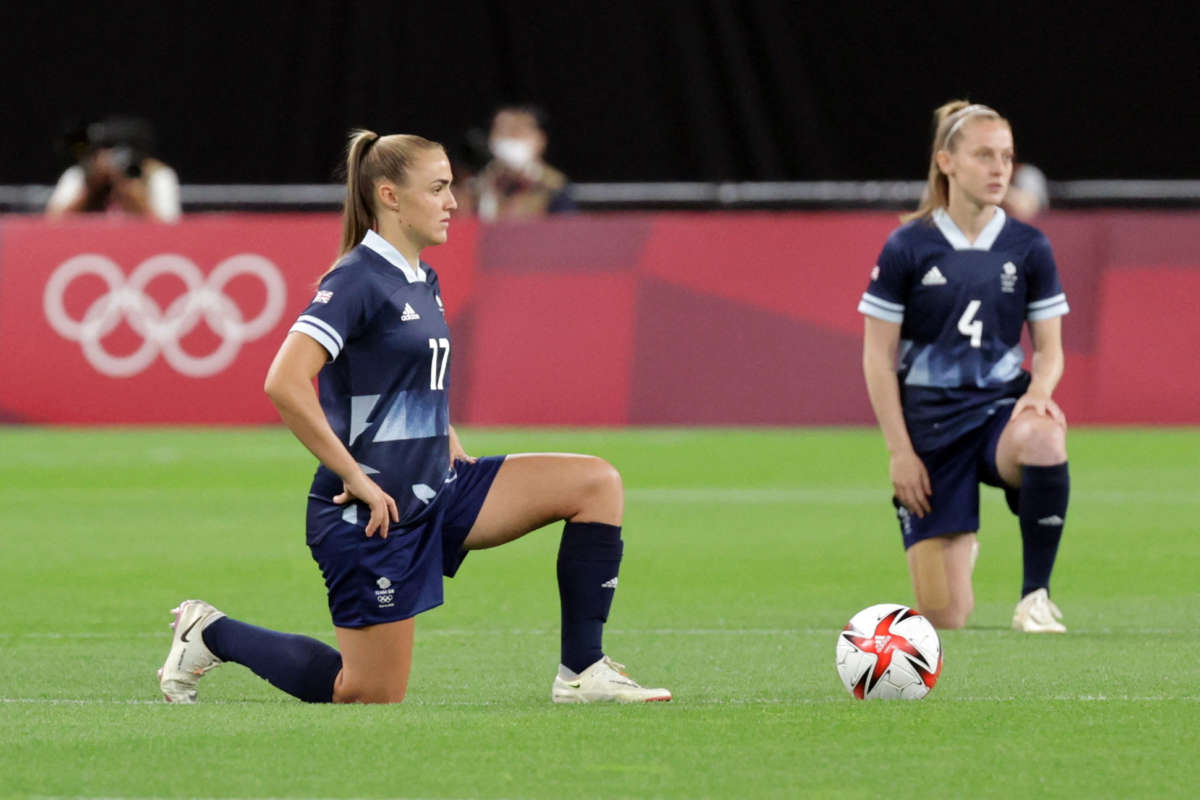
The order to not share such imagery, even in instances where there appears to be agreement to take part in the protest by all athletes involved, came after a women’s soccer match earlier this week in which players from Great Britain and Chile both kneeled prior to the game’s start. Later in the day, other teams took similar actions, including Team USA and Sweden ahead of their own contest. The players had all taken a knee to show their opposition to racism.
Images of the players kneeling were broadcast around the world on live television, but the Tokyo 2020 live blog did not publish any pictures of it happening. That organization, as well as the social media teams for the IOC, didn’t publish any images of the acts of protest later on.
The refusal to show athletes demonstrating for a political cause comes after the IOC decided to relax its controversial Rule 50, which had banned players from making any “political, religious or racial” demonstrations at all during the games. Such protests are now allowed so long as they’re not disruptive and show respect to fellow competitors. However, the IOC still plans to sanction players if they conduct any demonstrations while standing during medal ceremonies.
Before revising Rule 50, the rule had been justified by the IOC as being necessary to “ensure that each and every athlete can experience the Olympic Games without any divisive disruption.” But critics assailed the rule, calling it an undue restriction of athletes’ free speech rights and of being racist in nature.
“The Olympic podium is a media of communication to the world, and the Olympic frontier cannot be a barrier to human rights,” a statement from a progressive athlete start-up movement called Global Athlete said earlier this year.
Color of Change, a racial justice organization, also criticized Rule 50, saying its bans on kneeling or other forms of protest (including the wearing of “Black Lives Matter” shirts) were “a direct assault on the free expression of Black athletes by a commission that includes no Black members.”
The revision to Rule 50, which is called Rule 50.2, is still being criticized by many as being an unfair restriction of athletes’ right to free speech.
“Freedom of expression is an enabling right, facilitating the exercise of other human rights,” wrote Nikki Dryden, a human rights lawyer and board co-chair of the Centre for Sport and Human Rights in Geneva, in a recent opinion piece on the issue. “For women and minority Olympians, the IOC has additional positive obligations to ensure their voices and opinions are heard. Once they have earned their Olympic power on the field, there is a lot to gain from the international spotlight provided during the medal ceremony.”
Media that fights fascism
Truthout is funded almost entirely by readers — that’s why we can speak truth to power and cut against the mainstream narrative. But independent journalists at Truthout face mounting political repression under Trump.
We rely on your support to survive McCarthyist censorship. Please make a tax-deductible one-time or monthly donation.