Truthout is a vital news source and a living history of political struggle. If you think our work is valuable, support us with a donation of any size.
There are some very small similarities between Occupy and the Tea Party. Whereas Tea Partiers share a very general (albeit misdirected) rage against the political establishment, Occupy also expresses general distrust of the political-economic system. This, in my mind, is where the similarities end. On another level, the decentralized, leaderless orientation of Occupy is dramatically different from the largely centralized, heavily leader-oriented Tea Party phenomenon, which relies on pundits and political officials such as Glenn Beck, Sean Hannity, Rush Limbaugh, Dick Armey, Sarah Palin, Michele Bachmann and the Tea Party Caucuses in the House and Senate in order to set the Tea Party agenda nationally. This is a dramatic difference between Occupy and the Tea Party.
Borchert: What is the state of the Tea Party today, and what can we expect from them in the coming years?
DiMaggio: The Tea Party hit a plateau as of mid- to late 2011. As of October 2011, about one quarter of Americans consider themselves to be Tea Party supporters. This number has barely changed over the last year. Opposition, however, has increased by somewhere between 10 to 25 percentage points among the general public within the same period. This is because there were many undecideds in early 2010 who didn't know what the Tea Party was, but since then, and since the ugly summer 2011 debt ceiling debate, have come to see the Tea Party “revolution” as yet another ugly manifestation of partisan establishment politics in Washington.
Much of the public (most actually) are not too fond of the group's demands to gut popular social welfare programs such as Medicare and Medicaid, or of their demands to balance budgets on the backs of the working and middle class (and the poor), while refusing to cut America's bloated, imperialist military apparatus. Most also are disgusted at the Tea Party-Republican effort to give the rich a free pass (via the extension of the Bush tax cuts). In other words, the Tea Party has had its day in the sun; now it will likely continue at least through the 2012 elections (perhaps further), greatly mobilizing and energizing the conservative base. It is unlikely to do much else, however, since its support base is no longer growing and public opposition has increased significantly.
Still, the Tea Party has been an incredibly important phenomenon for a few reasons: One, it was instrumental in derailing what could have been historic health care reforms in the form of a public option (or even universal health care). Two, it has demonstrated that the only way the Republican Party can get back into power is through the manufacturing of false populism from the top down. The Republican Party is so unpopular today that it can only gain power by default, fostering anger against the Democratic Party and sitting back and falling into electoral victories due to growing public disenfranchisement with the Democrats.
I expect the Tea Party will serve as a lesson for the future. Expect plenty of other false populist narratives and “movements” to emerge on the right in coming years, in line with the predictions of progressive William Greider, who warned of the ever-growing “rancid populism” of the right which now seems to be standard fare in American political discourse.
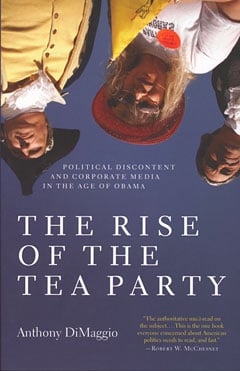
Anthony DiMaggio is the author of numerous books, including “The Rise of the Tea Party,” out in November 2011 from Monthly Review Press, and other works such as “Crashing the Tea Party” (2011); “When Media Goes to War” (2010); and “Mass Media, Mass Propaganda” (2008). He has taught American politics and international relations in political science at a number of colleges and universities and can be reached via email.
Press freedom is under attack
As Trump cracks down on political speech, independent media is increasingly necessary.
Truthout produces reporting you won’t see in the mainstream: journalism from the frontlines of global conflict, interviews with grassroots movement leaders, high-quality legal analysis and more.
Our work is possible thanks to reader support. Help Truthout catalyze change and social justice — make a tax-deductible monthly or one-time donation today.