Truthout is an indispensable resource for activists, movement leaders and workers everywhere. Please make this work possible with a quick donation.
Faster, stealthier missiles, accelerated weapons development, and the threat of an unrestrained nuclear arms race, set against the backdrop of a withering arms control regime, point to a worsening global nuclear threat as 2025 comes to a close. On top of that, just before meeting with China’s leader Xi Jinping in October, President Donald Trump abruptly, and very imprecisely announced in a social media post, “Because of other countries testing programs, I have instructed the Department of War to start testing our Nuclear Weapons on an equal basis.”
The suggestion that the United States might break with a more than three decade-long moratorium on explosive tests sparked a global wave of uncertainty, anxiety, and speculation about the impacts of a potential return to explosive nuclear testing. This comes in the final months of a year when five of the world’s nine nuclear armed countries have been engaged in active warfare. In May, India and Pakistan attacked each other with missiles, Russia has continuously bombed Ukraine, and the U.S. and Israel bombed Iran and other nations and territories.
Eighty years after the beginning of the atomic age, the deteriorating nuclear threat landscape is reflected in the symbolic Doomsday Clock, now set at 89 seconds to midnight, its closest-ever setting to global catastrophe, with the last U.S.-Russia arms control treaty expected to expire in early February.
On July 16, the 80th anniversary of the world’s first nuclear detonation, a gathering of 60 nuclear weapons experts and around 20 Nobel laureates assembled at the University of Chicago to come up with a list of pragmatic, actionable steps which they are urging world leaders to take to reduce the risk of nuclear war. That two-page document, the Nobel Laureate Declaration, calls for a recommitment to a moratorium on nuclear explosive testing, enhancement and expansion of nuclear diplomacy, and for scientists, academics, communities of faith, and civil society to create pressure on global leaders to take nuclear risk reduction measures.
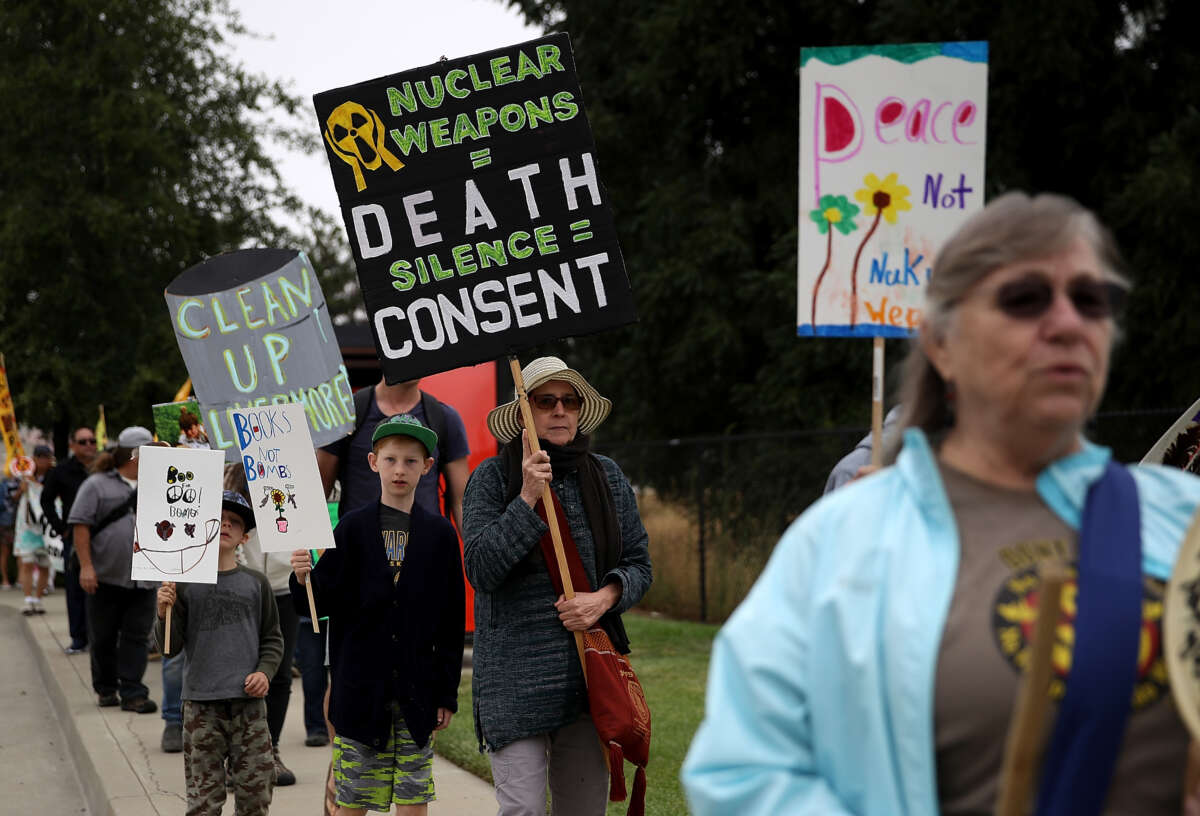
Five of the nuclear experts and one Nobel laureate who were central to writing the declaration (now signed by 129 Nobel prize winners) spoke to Truthout to discuss what the exercise achieved and what they want to see happen next. Everyone interviewed for this story agreed that nuclear threats have increased in recent months, underscoring the urgent need to reduce risks and begin new conversations.
Conversations That Can Reach Policy Makers
“That conversation has been picked up by a lot of people around the world but it has not yet, in my opinion, changed the dial, but it is the beginning,” said Brian Schmidt, a professor of astrophysics at Australian National University and a Nobel laureate (2011 physics). “I see it as that first step, and we are now looking at how we do the next steps and keep bringing it up in conversations.”
Schmidt told Truthout that he has spoken to people across the political spectrum from the far left to the far right and “no one has said ‘I think nuclear war would be a good thing.’” Finding ways to reduce nuclear risks, Schmidt said, is “actually something that can be used to bind us together.”
The deteriorating nuclear threat landscape is reflected in the symbolic Doomsday Clock, now set at 89 seconds to midnight, its closest-ever setting to global catastrophe.
As nuclear nations increase spending and reliance on their arsenals with some people even calling for more countries to acquire nuclear weapons, Laura Grego, senior research director with the Union of Concerned Scientists, was under no illusion that a two-page document alone would change the world, but calls it a necessary step.
“I didn’t expect that everybody would put their pens down and say, ‘the laureates have spoken.’” Rather, she compared the declaration to a protest or demonstration which, by itself, does not bring immediate change, but must be part of a longer, sustained effort.
Even as Trump has made ambiguous and alarming statements about testing nuclear weapons, he has called for a comprehensive missile defense system called “Golden Dome” intended to “defend against all types of missiles from any adversary,” something Grego describes as “fantastical.” Others find the idea ill-defined and flawed. Anticipated costs for the system quickly surpassed $500 billion with some estimates in the trillions of dollars.
“This massive investment in strategic missile defense is really unhelpful,” Grego told Truthout. “It’s not just wasted money,” she said. In the long run it “probably makes the world less safe.” The Nobel Declaration calls on China, Russia, and the United States to “acknowledge the interrelationship between strategic offensive and defensive arms and forgo massive investments in strategic missile defense.”
Breaking through to policy decision-making circles, Grego said, can be difficult as they are often sequestered in the Pentagon and may not be elected officials responsive to voters. Grego says members of Congress are rarely questioned by their own constituents on nuclear issues and that lack of public input is just fine with the powerful, highly organized corporate interests who stand to make a lot of money building expensive weapon systems.
Grego urges people to call their representative’s office and to let them know if their votes don’t correspond to your views. In particular, on rarely challenged issues like nuclear weapons, small, incremental steps can have a positive impact.
“While there’s a lot of decision making that’s held in the Pentagon,” Grego said, “the purse strings are held by Congress and that’s still a powerful lever that we need to use better.”
Reviving Public Concern Over Nuclear Weapons Is Key
According to a recent YouGov survey, 69 percent of Americans think nuclear weapons make the world a more dangerous place. Nearly half (49 percent) of respondents approve of reducing the number of nuclear weapons in the U.S. arsenal.
Alexandra Bell, president and CEO of the Bulletin of the Atomic Scientists, and one of the chief organizers of the Nobel nuclear assembly, told Truthout that whenever there’s been a major reduction in nuclear threats, it followed years or decades of grassroots organizing and ongoing commitment, accompanied by public pressure with people saying, “we refuse to live in this world of increasing nuclear threats forever.” Major arms control achievements like the Limited Test Ban Treaty of 1963 or the agreement by the U.S. and Soviet Union to reduce nuclear stockpiles in the 1980s didn’t just happen. They were the result of sustained movements and public pressure.
“We’ve done this before. We figured out a way to reduce threats in the past and we kind of forgot,” said Bell. “We became complacent that we had dealt with this problem and we didn’t have to spend as much time and effort on it.”
She recognized that people today have a long list of concerns — the economy, health care, crime, the precarious state of democracy — but she said, “[We]’ve got to make room for the nuclear threat as well because it’s here whether or not you want to focus on it…and lack of attention is not going to make the problem better. In fact, it probably will make it worse and if we get the nuclear problem wrong, none of those other problems matter.”
She urged people to start talking about nuclear issues and ask their elected leaders how they are addressing the threat.
This Is Everybody’s Problem
Jeffrey Lewis, director of the East Asia Nonproliferation Project at the Middlebury Institute of International Studies, told Truthout “the risk [of nuclear war] is very, very low but obviously the consequence is impossible to imagine.” To that end, after the Nobel nuclear assembly, Lewis produced a short video that offers a vivid, terrifying snapshot of what a nuclear detonation would do to a city, in this case Chicago, the same city targeted in the movie A House of Dynamite.
He said the nuclear threat seems distant and gigantic, but, he added, “We know eventually our luck will run out.” He said, “We need to be gripped by some sense of urgency that we have made this deal with nuclear weapons to base our security on them and we know that deal is not going to work forever.” Given the enormity of a global nuclear catastrophe, Lewis said, “The fate of the world is everybody’s problem, and everybody has a role to play.”
When considering the possibility of reducing the nuclear risk, Lewis said that Trump has demonstrated a visceral reaction to the destructiveness of nuclear weapons which he believes is quite sincere. “It’s a shame because [Trump] has real political power,” said Lewis. “He has the political power to negotiate a verification protocol to the Comprehensive Test Ban Treaty (CTBT)” which, Lewis asserted, could make the Republican controlled Senate consent to ratifying the treaty which Lewis believes could earn Trump a Nobel Peace Prize. The United States is one of nine countries which have not ratified the CTBT, preventing it from entering into force.
Will Leaders Exercise Courage and Imagination?
Thomas Countryman, chairman of the board of the Arms Control Association and a 35-year veteran State Department diplomat, said the Nobel declaration would be significant if the public responded by demanding their elected leaders take steps to reduce nuclear danger. Those recommended steps could begin, he said, if there was a single leader among the nine nuclear weapons states who had the courage and moral conviction to prioritize nuclear risk reduction.
“I am somewhat encouraged that President Trump has said more than once that he is fearful of the effects of nuclear war. I think he appreciates how dangerous nuclear weapons are on a strong personal level,” Countryman said. “The problem is that neither he nor any of his counterparts in other nuclear weapon states have yet taken a meaningful step forward.” Although he has little confidence that Washington or Moscow will make significant progress on nuclear arms control in the next few years, Countryman says he has hope — “not confidence, but hope”— that China is in a unique position to do so.
Countryman will be watching the anticipated Trump-Xi summit in China next April closely. While he expects the meeting will focus on economic issues, it may be possible to address some nuclear matters too. He sees the opportunity for Trump and Xi to even take a very dramatic step of an announcement of a simultaneous ratification of the CTBT. “That may be too ambitious for both bureaucracies, but if both presidents have a little bit of courage and imagination, it could be done.” And while it could be possible, he fears there are “too many political and bureaucratic obstacles from any of the other nuclear armed states from moving forward on something dramatic.”
He conceded that conveying practical nuclear risk steps like those in the Nobel declaration is an uphill battle because, as he put it, in Washington, Moscow, and Beijing, “those who favor more nuclear weapons are in the ascendancy… all of them are feeling more confident and have the ear of their respective leaders much more frequently than those who are advocating for reduction of nuclear risk.”
Nations Must Play a Role in Building Awareness
Daniel Holz is a physics professor at the University of Chicago and chair of the science and security board of the Bulletin of the Atomic Scientists. As one of the chief organizers of the Nobel Assembly, he’s been closely following progress of the declaration which has included calls by the Vatican to reduce and eliminate all nuclear weapons, ongoing and future follow up meetings around the world, and in October, a presentation and discussion at the Permanent Mission of Norway to the United Nations. Included in the discussion before the largely diplomatic audience was the call for all countries to increase investments and research on the environmental, economic, and other impacts of nuclear conflict by a newly formed UN Independent Scientific Panel on the Effects of Nuclear War, the first of its kind since the 1980s. Of the nine nuclear armed nations, only China voted to support the study.
That UN study, like the Nobel declaration and depictions of nuclear weapons in books, music, movies, and popular media, as well as concerns about nuclear testing, nuclear proliferation, and the collapse of arms control, underscores the urgent need for more public engagement.
An increasing public perception of nuclear risk, Holz said, “leads to discussion, it leads to awareness, and it does lead to pressure on leaders” which is necessary to effect change. “Once the public is aware and engaged, as it should be, because they will be impacted if this goes wrong … then policy makers start to pay attention.”
“Unfortunately, it’s getting easier and easier to make the case that people should be aware.”
A terrifying moment. We appeal for your support.
In the last weeks, we have witnessed an authoritarian assault on communities in Minnesota and across the nation.
The need for truthful, grassroots reporting is urgent at this cataclysmic historical moment. Yet, Trump-aligned billionaires and other allies have taken over many legacy media outlets — the culmination of a decades-long campaign to place control of the narrative into the hands of the political right.
We refuse to let Trump’s blatant propaganda machine go unchecked. Untethered to corporate ownership or advertisers, Truthout remains fearless in our reporting and our determination to use journalism as a tool for justice.
But we need your help just to fund our basic expenses. Over 80 percent of Truthout’s funding comes from small individual donations from our community of readers, and over a third of our total budget is supported by recurring monthly donors.
Truthout has launched a fundraiser, and we have a goal to add 182 new monthly donors in the next 24 hours. Whether you can make a small monthly donation or a larger one-time gift, Truthout only works with your support.