Part of the Series
Russia's War on Ukraine in an Age of Escalating Imperial Tensions
Support justice-driven, accurate and transparent news — make a quick donation to Truthout today!
Three years into Russia’s full-scale invasion, Ukraine is now the most heavily mined country in the world. As United States-led ceasefire negotiations continue to stall, the amount of ordnance buried in Ukrainian soil is only increasing as the war drags on.
In April 2025, I embedded with the Ukrainian Association of Humanitarian Demining (UAHD) at an undisclosed location on the outskirts of Kyiv’s suburb of Irpin, where a volunteer task force of “sappers” — a term that refers to combat engineers such as deminers — works with the local municipality and outside funders to clear what Russian soldiers left behind during their withdrawal in March 2022.
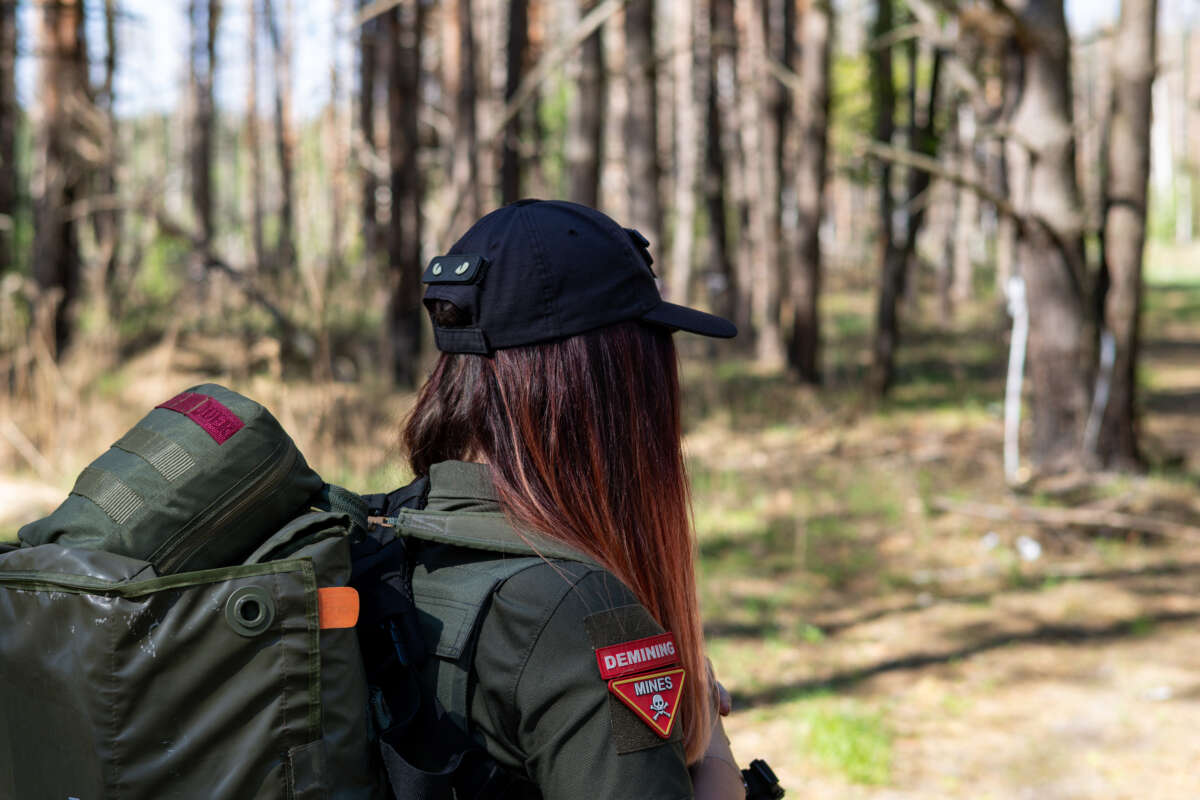
Yaakov, a head sapper, and Marina, a staff paramedic, joined my translator, Evelina Riabenko, and me as we took in the vast expanse of what used to be a Russian military installation. Walking carefully on an already cleared trail, we made our way through a forest littered with unexploded shells that could detonate at any moment.
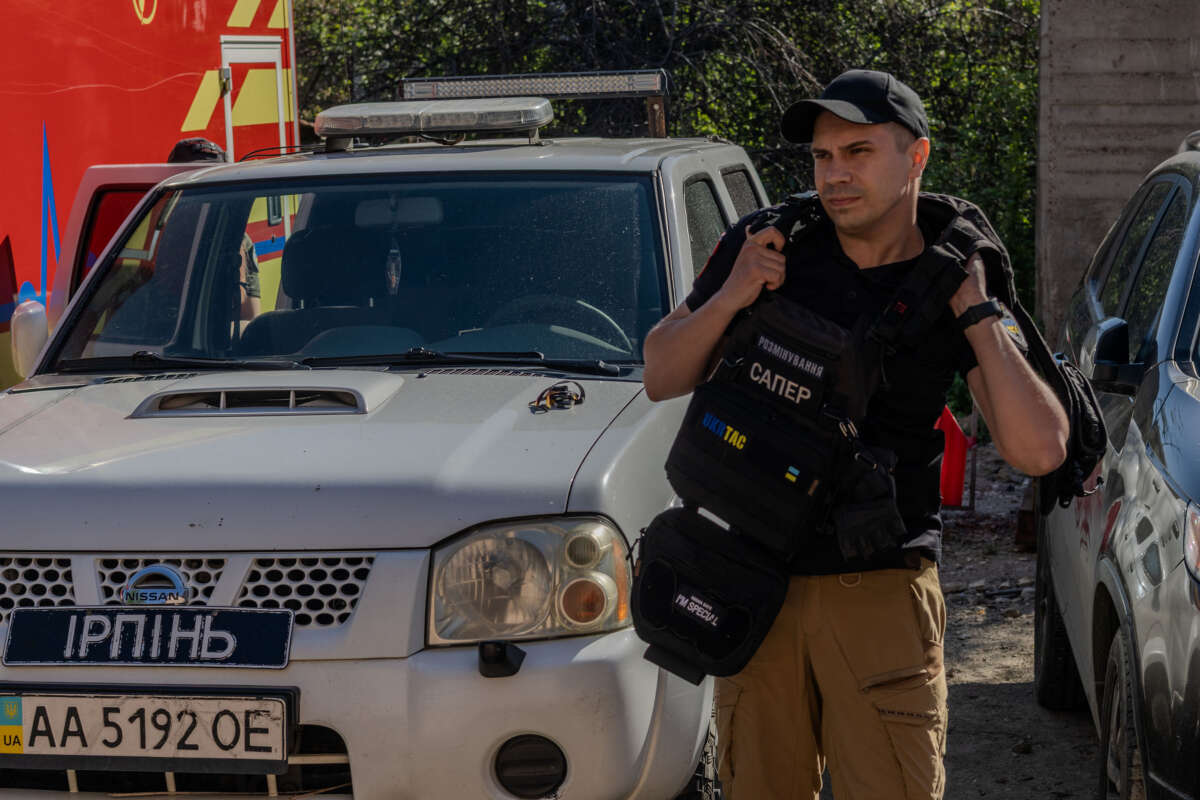
Yaakov has been working with UAHD since 2022, when he joined after serving a stint in Ukraine’s infamous Azov Battalion, a self-funded volunteer militia formed in 2014 to fight Russian-backed forces in the Donbas war. In his past life, Yaakov was an entrepreneur and owned a tattoo studio and independent clothing boutique in Mariupol. But when war broke out in 2014, he left everything behind to join the battalion.
The international community has focused significant attention on the practices of the Azov Battalion, which was formally incorporated into the country’s armed forces in 2023 as the Azov Brigade. But in Ukraine, the issue is complicated. After the battalion’s defense of Mariupol during Russia’s invasion in 2014 and its refusal to surrender to Russian forces for weeks at the Azovstal Iron and Steel Works facility, Azov fighters are viewed as national heroes.
Walking down the streets of Kyiv, it’s hard to miss the large banners that proclaim, “AZOVSTAL: FREE MARIUPOL DEFENDERS,” referring to the more than 1,000 Azov fighters who are still held in Russian prisons. Yet, until last year, the U.S. wouldn’t allow weapons transfer to the battalion due to their links to the far right.
I asked Yaakov about the allegations of Nazi sentiment and fascist sympathies in the battalion, and he responded that while each subdivision is different, he never witnessed anyone professing pro-Nazi or fascist politics in his own. “They were of course focused on fighting the Russians,” he said. He added that while he was raised Christian, he has a Jewish name and carries a deep love for the Jewish people. As many Ukrainians do when the topic of Judaism comes up, Yaakov also noted that the country has a Jewish president.
After years of fighting in the battalion and witnessing horrific violence on the battlefield, Yaakov decided to leave for what he called “a much more normal life.” He said that he watched a sapper working in the field in Mariupol and was immediately convinced of the importance of the work.
Eventually Yaakov left fighting behind to engage in direct humanitarian relief, stating, “I served in the Main Directorate of Intelligence and decided to resign from the army to return to civilian life, but I could not live in Mariupol. There were a lot of people there with pro-Russian sentiments, and I was very uncomfortable.”
It was clear from how he carried himself in the field that he was trained as a fighter. His arms, heavily tattooed with Azov call signs, were testament to his time in the battalion. Yaakov constantly checked on Evelina and me to ensure we were following in his footsteps so as not to set off an undiscovered land mine. His eyes were trained on the ground as he picked up shell fragments to confirm they had been sufficiently cleared of explosive material.
Civilians dying by land mine are a hidden cost of war the world often forgets. Even in Laos, only 1 percent of munitions have been cleared: Twenty thousand people have been killed by land mines since the end of the U.S.’s war in 1973. With 1 out of 10 to 20 bombs that Israel drops on Gaza failing to detonate, the Gaza Strip faces a similar fate. Meanwhile, the news coming out of Ukraine is far from promising. The sappers whom I spoke with in Kyiv said that they have no expectation that they will ever be able to declare Ukraine “mine free” — a full team of sappers takes a month to clear one hectare of land at a cost of $20,000.
“Because of all the stubborn authorities and governments, it took us two years to register. Two years because they demanded millions of papers,” Yaakov said, frustrated. Despite the international community’s commitment of millions toward sapping efforts in Ukraine, Yaakov believes Ukrainian entrepreneurs will have to find ways to make the process more efficient. Without new innovations, he said, volunteers like him will be stuck using decades-old sapping strategies on increasingly advanced killing technologies.
Yaakov’s team is called to assist with ordnance removal on a daily basis. “Spring has now begun. People are going out to their gardens, starting to cultivate the land, and finding dangerous objects,” he said. “We have a ban on visiting forests and reservoirs throughout the country. Especially in the deoccupied territories where people still, well, want to walk, want to go outside.”
There is also a difference between humanitarian demining and operational demining — Yaakov’s team does both. The former involves clearing an area of land of any metal object or anything that could contain explosive material down to a depth of 15 centimeters in a very thorough and time-consuming process. The latter, meanwhile, involves emergency calls routed to Yaakov’s team, oftentimes suspicious objects found by children. While such calls are typically less time-intensive, they can still take up to an hour.

Moreover, so-called “butterfly mines,” a variant of anti-personnel mines, have been deployed by Russian forces in the east. “We haven’t faced butterfly mines in the areas where we work. They are mostly in Kherson, Mykolayiv, and Kharkiv regions at the moment,” UAHD head Oleksandr Bortnikov told Truthout. “They don’t cause deaths, but they wound.”
Currently, 164 countries are party to the 1997 Anti-Personnel Mine Ban Convention, and up until June 29, Ukraine was party to it too. In his declaration signaling Ukraine’s withdrawal from the convention, President Volodymyr Zelenskyy put the blame on Russia for its tactics. What is clear from the last months of fighting is that both countries are digging in for the long haul, and as the rest of Europe ups its defense spending, civilians will continue to pay the price.
The humanitarian toll of its mass mining is immense: cutting Ukrainians off from both their agricultural livelihoods and general access to the outdoors, part of their cultural heritage. In Ukraine, little remains free from contamination, leading the Helsinki Commission to investigate Russia’s practices as tantamount to “ecocide.”
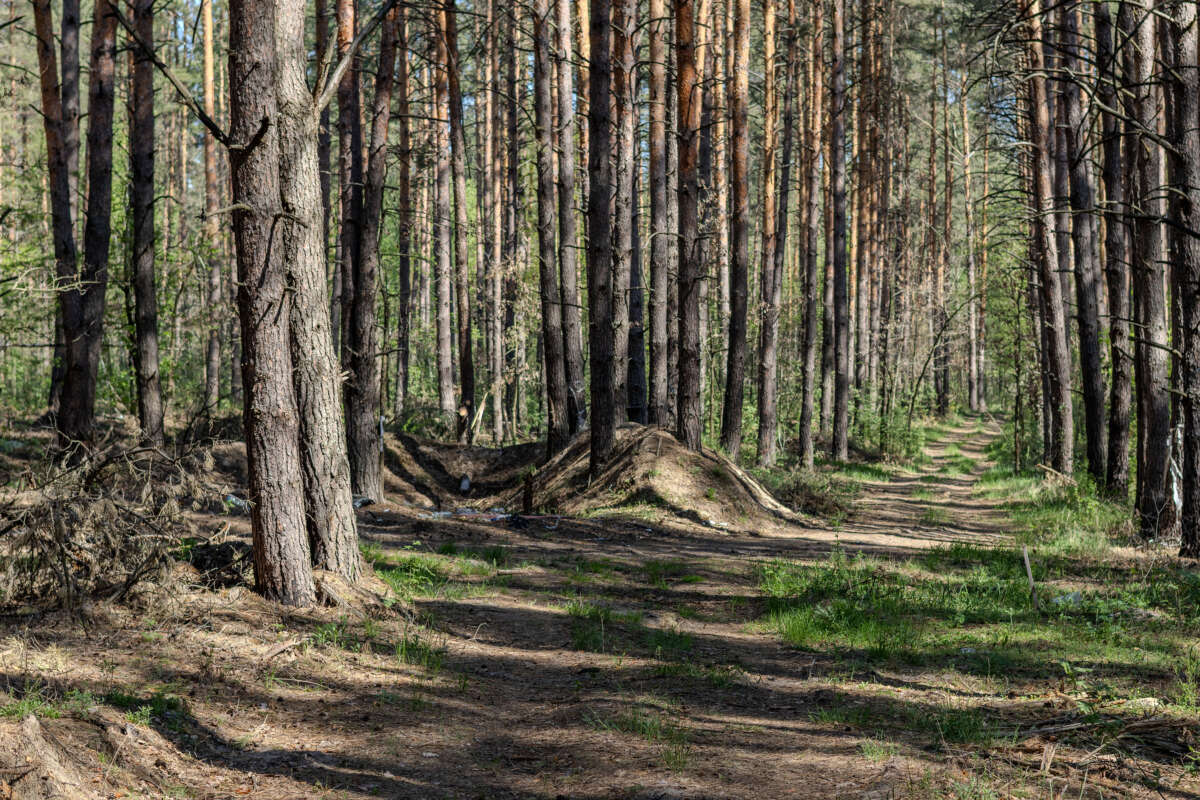

As Yaakov describes, one of the Russian shells used in Irpin in 2022 “first hits the wall and detonates on the second impact. That is, any shell, getting through this ceiling from the outside, will explode on the facade.” But there’s a major problem for shells that don’t get through: “If these shells hit the … sand, a swamp, they get the first hit. They are cocked but there is no second hit, and it lies cocked to the maximum, waiting to explode,” he said.
That’s why Yaakov’s work is so incredibly important and, for him, fulfilling. Yet, there remains a shortage of sappers qualified to work with unexploded ordnance. Yaakov and Bortnikov attribute this to Ukrainian bureaucracy, but significant financial shortfalls also pose a challenge to the organization’s work: If a civilian calls with a suspicious object in their backyard, they coordinate with the municipality to remove it free of charge.
As a former fighter and humanitarian minister, Yaakov has seen both sides of the conflict and doesn’t plan to return to fighting. “When you remove the first mine or grenade, you are like, ‘Oh, cool. Well, [I] did something good.’ On the 100th grenade or mine, you’re like, ‘Oh, cool. Maybe, I saved someone’s life there.’ On the 1,000th mine, you’re like, ‘Oh, well, I definitely saved someone’s life.’ That’s cool. There’s no such feeling in the army,” he said.
As with any war zone with a significant amount of aerial bombardment, Ukraine can lend insight into what postwar construction might look like in Gaza — though it’s difficult to draw parallels to the level of destruction. Still, the international community will have to similarly dedicate an immense amount of money and time to not only clearing the rubble but also ensuring the children can play in the streets and farmers can return to work without fearing for their lives.
With foreign journalists banned from entering the territory, I haven’t witnessed firsthand the level of destruction Israel’s air assault has wrought. But as the world watched the Civil Defense in Gaza work to pull children from under the rubble and respond to calls to remove unexploded ordnance, it’s clear they also work in extremely difficult conditions and, in many cases, without pay.
As we walked from the minefield back toward the emergency response ambulance, Yaakov said, “We also have a joke: If you make a mistake, if you step somewhere, if you defuse a mine, then one foot is here, and one is in Romania.” It reminds me of the dark humor I’ve encountered while working in the West Bank with those who frequently confront Israeli soldiers or are subject to live fire.
Note: Evelina Riabenko contributed reporting for this article.
An urgent appeal for your support: 6 Days to raise $38,000
Truthout relies on individual donations to publish independent journalism, free from political and corporate influence. In fact, we’re almost entirely funded by readers like you.
Unfortunately, donations are down. At a moment when independent journalism is urgently needed, we are struggling to meet our operational costs due to increasing political censorship.
Truthout may end this month in the red without additional help, so we’ve launched a fundraiser. We have 6 days to hit our $38,000 goal. Please make a tax-deductible one-time or monthly donation if you can.