Honest, paywall-free news is rare. Please support our boldly independent journalism with a donation of any size.
A record-breaking heat wave has enveloped much of Europe over the past week, with temperatures reaching as high as 113 degrees Fahrenheit in southern Spain. Scientists say this is the new reality of climate change.
France, Italy, Spain, and the U.K. have all issued high-level “red” heat alerts, with more than half of France under red alerts.
Tuesday’s temperature topped 112 degrees Fahrenheit in parts of France, and 111 degrees Fahrenheit in southern Spain. The heat wave is continuing, with Germany expecting the temperature to reach 106 F on Saturday. France is expecting 104 F temperatures on Wednesday and Thursday.
At least 48 people have died in France, including 40 who drowned trying to find relief from the heat. Two children were found dead in a hot car on Monday afternoon.
Europe is the globe’s fastest-warming continent, but its infrastructure is not prepared for the now-recurrent heat waves.
Air conditioning is rare in both schools and homes across Europe, as the continent historically had mild summers. But now, heat waves are beginning earlier each year.
Many schools have closed across Europe, and railways have advised against travel. In France, the country’s energy sector has been unable to keep up with the heat, and at least 68,000 households lost electricity on Tuesday evening. The outages are expected to continue through Wednesday.
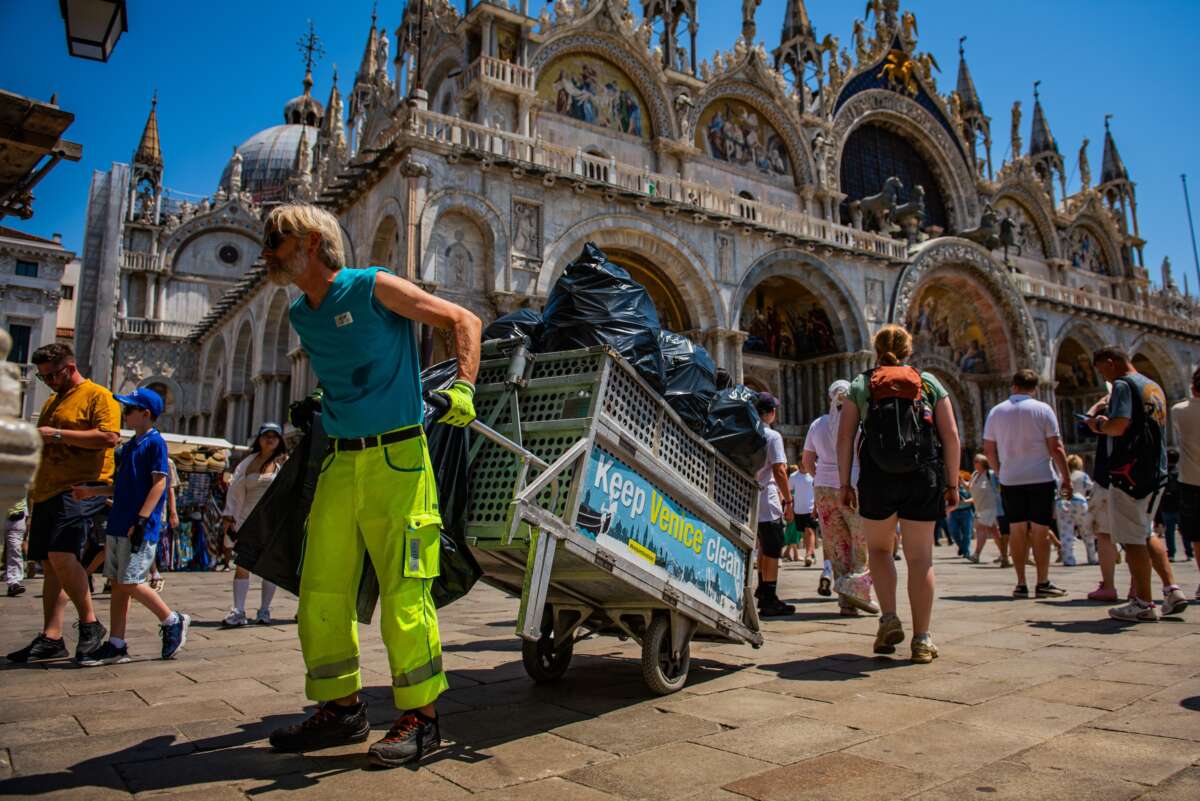
Many are forced to continue working through the heat wave, particularly those in precarious jobs, like delivery drivers in Rome and street cleaners and construction workers in Paris.
On Wednesday, U.K. unions launched a “heat strike” as temperatures are expected to pass 102 degrees Fahrenheit. The Trade Union Congress (TUC), the Bakers, Food and Allied Workers Union, and the Fire Brigades Union, along with the climate activist group Extinction Rebellion, said that over 1,000 people signed up to take part in the Wednesday walkout. Their demand is a maximum workplace temperature across the country, which the U.K.’s climate change adviser called for last month. This could push companies to use air conditioning or other mechanisms to protect workers. The Trade Union Congress called for a maximum workplace temperature of 86 degrees Fahrenheit.
Company executives and business leaders have spoken out against the measure — and on Tuesday, the U.K. government said it was not planning to introduce a maximum workplace temperature.
More record-breaking heat waves are expected across Europe in July. Scientists have stated that climate change is making record-breaking heat waves more frequent and intense.
Last month, during the continent’s previous intense and early heat wave, the UN climate chief Simon Stiell said that these heat waves are “a brutal reminder of the spiraling impacts of the climate crisis.”
“The science is clear that human-induced climate change is making these heat waves more frequent and extreme,” Stiell said.
Working to protect countries from the extreme heat “starts with kicking the fossil fuel addiction much faster,” he added.
On Wednesday, Tedros Adhanom Ghebreyesus, the head of the World Health Organization, posted on X, “The data are clear: temperatures across Europe are rising at roughly twice the global average rate, increasing the likelihood and severity of extreme heat in the future. We cannot afford further delay. Leaders must prioritise investment in climate-resilient health systems, while also accelerating #ClimateAction and mitigating the drivers of the climate crisis.”
The World Health Organization’s European office has said that over 200,000 people have died across Europe from heat-related causes over the past four years.
25 Years of Truthout: An important fundraising appeal
This September, Truthout is celebrating 25 years of publication. For over two decades, we have been a trusted source for fiercely independent journalism thanks to readers like you.
As we look to the next 25 years, we have launched a special fundraising campaign. Looking to a sustainable future for our publication, we have a fundraising goal of $71,000 in the next 5 days.
We are asking for your support at this juncture because we face greater threats than ever before in our organizational history. Trump and his MAGA allies are determined to control the information ecosystem, and movement-based organizations are subject to dangerous censorship and scrutiny.
If you can support Truthout with a one-time or monthly donation, you will make a significant impact on our work and our legacy. Anything you can do makes a difference!