Support justice-driven, accurate and transparent news — make a quick donation to Truthout today!
When the Supreme Court overturned a temporary restraining order in September that kept U.S. Immigration and Customs Enforcement (ICE) officials from questioning and detaining people based on their language, skin color, or occupation — effectively clearing the way for racial profiling — Guadalupe Cardona was not surprised.
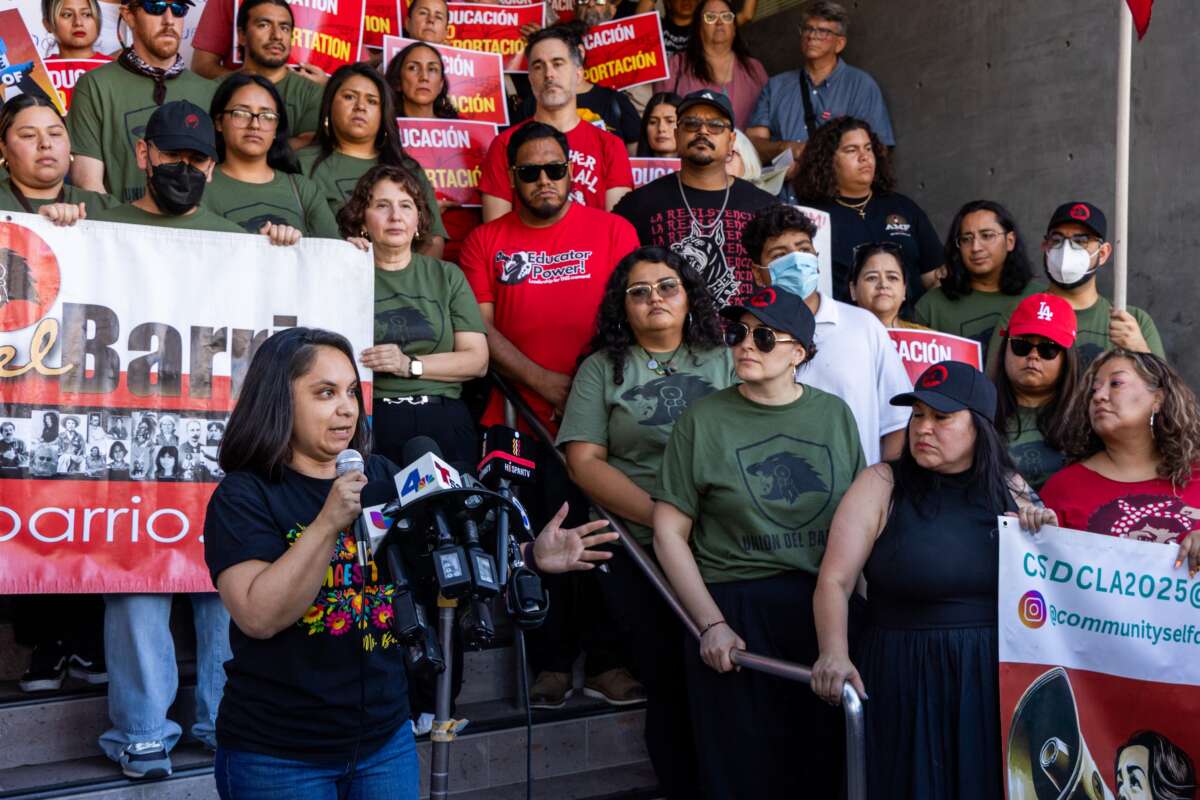
Cardona is a member of Unión del Barrio, a national organization that has led resistance efforts against ICE and police violence since its inception in 1981.
Since the Trump administration took office — but especially in recent months — she has witnessed daily scenes of ICE snatching primarily Latino people off the streets and detaining them without identifying themselves or giving due process. When the Supreme Court granted the Trump administration’s emergency request to expand ICE’s use of racial profiling, Cardona knew it would empower ICE agents to ramp up their raids and kidnappings of community members even further.
“The communities that are being attacked are people who are keeping the world going, producing goods and foods, building things and providing services and doing all the things that are necessary in order for this nation to flourish and continue,” Cardona said.
To Reyna Montoya, founder and CEO of Aliento, an organization that works in Arizona to support immigrant families and Dreamers who came to the U.S. at a young age, the Supreme Court’s order greenlighting ICE’s racial profiling echoed a reality that people in her state had already lived through: the legalization of racial profiling by law enforcement in order to detain individuals they believed to be immigrants under SB 1070. During this time, from its implementation in 2010 to a settlement stripping several provisions in 2016, Black and Brown communities lived in fear, she said.
When it was passed in 2010, SB 1070 was one of the harshest anti-immigrant laws in the country. Among other measures, it deputized law enforcement to carry out immigration enforcement by determining the immigration status of anyone they deemed suspicious — even U.S. citizens. Montoya says the law also emboldened people who already had racist ideas. She recalled getting “dirty looks” while speaking Spanish at a supermarket with her mother.
In another instance, Montoya told Truthout, an intern who worked with Aliento at the time said that her father was pulled over, even though he was an authorized resident, because he was Brown. She also heard that people in Latino communities were not reporting crimes — from domestic violence to shoplifting — because they did not trust law enforcement.
“These were stories that I grew up listening to at that time,” 34-year-old Montoya said.
The impacts of legalized racial profiling rippled out to the mental health of Arizona’s young people. Cesar Escalante, a researcher at the University of Georgia, found that during the period SB 1070 was in place, youth in Arizona faced isolation, depression, anxiety, and eating disorders due to the stress of either being undocumented or being assumed to be undocumented.
“Young [Latino] people who went to school, especially middle school and high school … were subjected to a lot of ostracism, labeling, and bullying,” Escalante said.
However, communities mobilized against the law, holding protests and boycotts across Arizona. Two years after the measure passed, the Supreme Court ruled that it was unconstitutional to make it a crime if people failed to carry documentation to prove their immigration status and to outlaw police from arresting someone for believing them to be deportable. Further provisions to the law were stripped in 2016 when Arizona’s then attorney general banned law enforcement from prolonging a stop based on immigration status, although the rule about allowing law enforcement to inquire about immigration status still lingers.
Montoya is worried that history is repeating itself — only now it will be across the country, not just in Arizona.
“It is heartbreaking,” Montoya said. “Unfortunately, there’s probably going to be increased discrimination among the Latino community, among other communities that may appear to look Latino.”
“A Recipe for Disaster”
The Supreme Court’s decision to greenlight ICE’s racial profiling in September came in response to a lower court decision in California, Vasquez Perdomo v. Noem, that attempted to ban the use of racial profiling and roving patrols of ICE agents to detain people. In response to an “emergency request” from the Trump administration, the Supreme Court issued a quick order that overturned the ban, allowing ICE agents to arrest anyone they might deem to be an immigrant based on their language or skin color, without identifying themselves. In legal circles, these are now dubbed “Kavanaugh stops” after the Supreme Court justice claimed that legal residents are only briefly stopped and not arrested, despite lawsuits proving otherwise.
As the American Immigration Council noted at that time: “Crucially, this order is not a final ruling, but it strongly signals the Supreme Court will not uphold strict constitutional limits on the authority of immigration agents to stop and question people they suspect to be immigrants.”
Jorge Loweree, managing director of programs and strategy at the American Immigration Council, said the Supreme Court’s recent decision is enormously consequential and could result in even more aggressive immigration raids across the country. Although he anticipates more litigation on this issue, the court’s decision could still take years to overturn — during which a lot of damage could be done, he said.
Since Donald Trump began his second term in office, more than 170 U.S. citizens have been detained by ICE, reporting from ProPublica has found; the government does not track the number of citizens held by immigration agents, so the count could well exceed that number. Loweree is concerned that the ruling could worsen this threat.
“If we live in an environment where ICE can target people based on the way that they look, including U.S. citizens, that’s a situation where no one in this country is safe from this sort of action,” Loweree said.
Loweree also noted that ICE is cutting corners during background checks of onboarding officers. These factors are emboldening ICE agents and “things are escalating seemingly every day with many different people impacted,” he said.
“All of this is a recipe for disaster, for some very ugly, negative outcomes impacting many people across the country, and it’s all something that was facilitated by the Supreme Court.”
“You’re Not Gonna Get Rid of Us”
Still, community members have been vigilant. Mario Nodal, creator of Unidos Podemos, a bilingual Instagram page, has spent the last months documenting ICE kidnappings and raids across the country by sharing crowd-sourced videos.
He said the ICE raids and Supreme Court ruling are very concerning. While Unidos Podemos originally started as a page to uplift Mexican American culture, it quickly turned into a platform to raise awareness about ICE activity after the Trump administration took office.
“People are just doing their job,” Nodal said. “They’re just out there doing what they need to do to survive, and ICE just pulls up on them, simply because of how they look and how they sound, and just takes them away. They don’t identify themselves. They don’t show their faces.”
Nodal said it is important to document the raids and their intensity. People have messaged him about families being separated, neighbors being profiled, and people being afraid to go to work or even leave their homes.
“It’s impossible to ignore what is happening,” Nodal said. “There are thousands of videos just showing abuse, discrimination, and just racial profiling.”
“In this moment, there is a beautiful hope that exists in this solidarity and that people are standing up for what is right. There are people out there that care and that are organizing to defend rights, and that’s what they are — their rights.”
Nodal shares fundraiser campaigns of people who are impacted by ICE raids. He also said it is important to continue celebrating Latino culture and honoring the sacrifices that have been made to make a life in the U.S.
“In the midst of all of this, we’re still trying to push that culture, like Día de los Muertos, still trying to push it in front of people that don’t like us, people that hate us, like ‘We don’t care, you’re gonna see our culture, you’re gonna see who we are,’” Nodal said. “We’re still here. This is who we are, you’re not just gonna get rid of us.”
Cardona said her organization has also been proactive in fighting back against ICE activity. She said Unión del Barrio has been doing “know your rights” workshops and training people on how to spot ICE and report to the community when they do see them. Like Nodal, Cardona also said it is important to document ICE raids and kidnappings to help people understand what they have been seeing and the way ICE goes about these operations.
Advocates have also been organizing patrols and responding to reported ICE activity. Cardona said there have been many instances where community members in Los Angeles have been able to chase ICE agents away and prevent people from being detained.
“We know that less happens to people when there’s large numbers of community members, when the agents are outnumbered in large quantities,” Cardona said.
Unión del Barrio also encourages people not to walk on the street by themselves, to stay in large crowds, and to use their right to stay silent, so that it’s impossible to distinguish if there’s anyone in the group who’s undocumented.
“In this moment, there is a beautiful hope that exists in this solidarity and that people are standing up for what is right,” Cardona said. “There are people out there that care and that are organizing to defend rights, and that’s what they are — their rights. These are human rights and civil rights that are being infringed upon. I’m very proud of how community members, community organizers, and of course, my organizations have stood up in defense of our people.”
Press freedom is under attack
As Trump cracks down on political speech, independent media is increasingly necessary.
Truthout produces reporting you won’t see in the mainstream: journalism from the frontlines of global conflict, interviews with grassroots movement leaders, high-quality legal analysis and more.
Our work is possible thanks to reader support. Help Truthout catalyze change and social justice — make a tax-deductible monthly or one-time donation today.